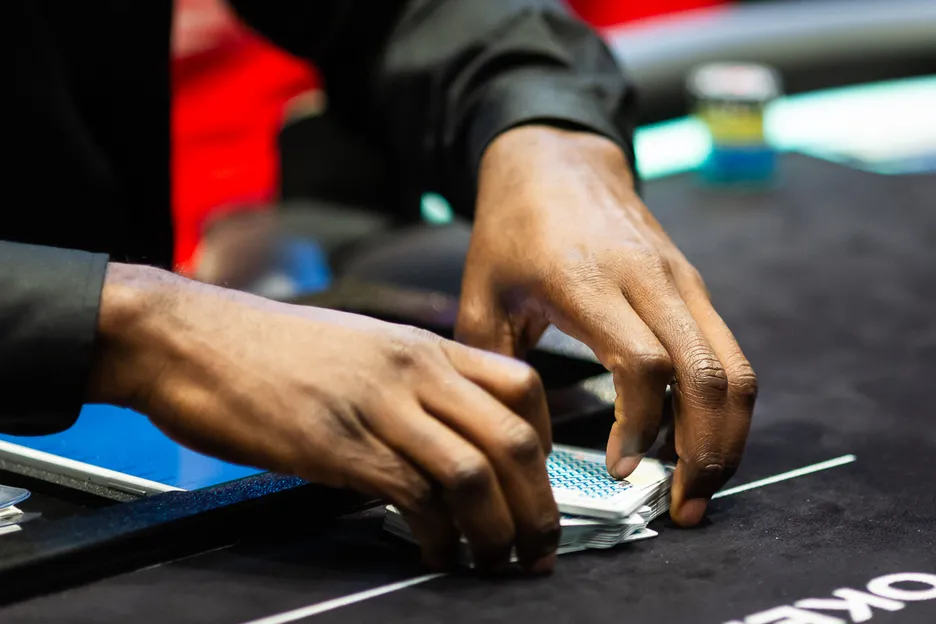


Name: The riffle, the overhand, the wash, the Hindu, the strip, and others.
Age: 1,200, give or take — as old as cards themselves.
Appearance: The manipulation of a deck of cards so it forms one of the 52! sequences possible.
Wow! 52! Why are we shouting?!? ‘52!’ means 52 factorial, or 52 x 51 x 50 and so on, all the way down to 1.
That must be a fairly large number? You can say that again. Rounding down, it’s an 8 with 67 zeroes after it.
Sorry, my calculator’s screen isn’t big enough for that. My brain’s not big enough for that. It’s a figure greater than the number of atoms in the Milky Way.
The candy bar? No, the galaxy. This level of randomness is part of what gives card games their infinite depth and complexity.
If it’s so random, why does someone always have aces whenever I get kings? That, I’m afraid, is an even deeper mystery of the universe.
So every single time I shuffle the cards they’re in a completely different order? Yes, in fact you could go so far as to say they’re in an order that has never existed before in the history of cards. Of course, it’s not quite that simple…
It never is, is it? You’re learning. It’s possible for a deck to be rigged, positioning cards in specific spots in the deck to ensure an expected and desired outcome. Highly skilled card ‘mechanics’ have been swindling folks since the days of the riverboat gamblers, if not long before, by manipulating the shuffle using sleight of hand and advanced ‘cardistry’.
You made that word up. I absolutely did not. It’s related to card magic, but is a field of its own. But doesn’t take a dodgy dealer to remove randomness from the equation — sometimes it can happen by accident.
What do you mean? According to a 1992 study by the mathematician (and former magician) Persi Diaconis, building on the Gilbert-Shannon-Reeds model, a deck should be shuffled seven times before it can be expected to be suffiently randomized.
So if I don’t do that I could deal a whole deck and give one player all the hearts, one player every spade, and so on? It could happen.
I doubt it. It has happened. During a game of bridge in the United Kingdom in 2011, every one of the four players was dealt a full suit. It also reportedly happened in another game in England in 1998, in 1978 in Milwaukee, in 1963 in Wyoming and Illinois, in 1928 in London, and various other documented occasions.
Was it… magic? Of course not; these were simply accidents due to lazy, if precise, shuffling. If you start with a brand new deck and do a perfect riffle shuffle — interleaving every single card in each half of the deck — and then do another perfect riffle shuffle, you end up with a deck in which every fourth card is of the same suit. Deal that to four players and bam: you’ve got one crazy hand of bridge. Shuffle at least seven times, people!
Can’t we just use machines for this? We can, and we do. Shuffling machines were first patented well over 100 years ago, and these days you’ll often see them used at final tables of big tournaments. In well-run casinos and card rooms they can really put your mind at ease if, to pick an entirely random example, you’re worried the dealer hates you after you almost ran them over in the car park that one time at Caesars.
Maybe I’ll get one for my home game? Maybe you shouldn’t. A journalist for WIRED recently revealed how automatic shufflers like the Deckmate 2 can be manipulated in disreputable private games — which I definitely assume yours would be. Better to leave the shuffling machines for the casinos, where they are highly secure and regularly inspected by professionals.
Do say: “Shuffle up and deal!”
Don’t say: “Do you mind if I plug my phone into your Deckmate 2 to charge?”


