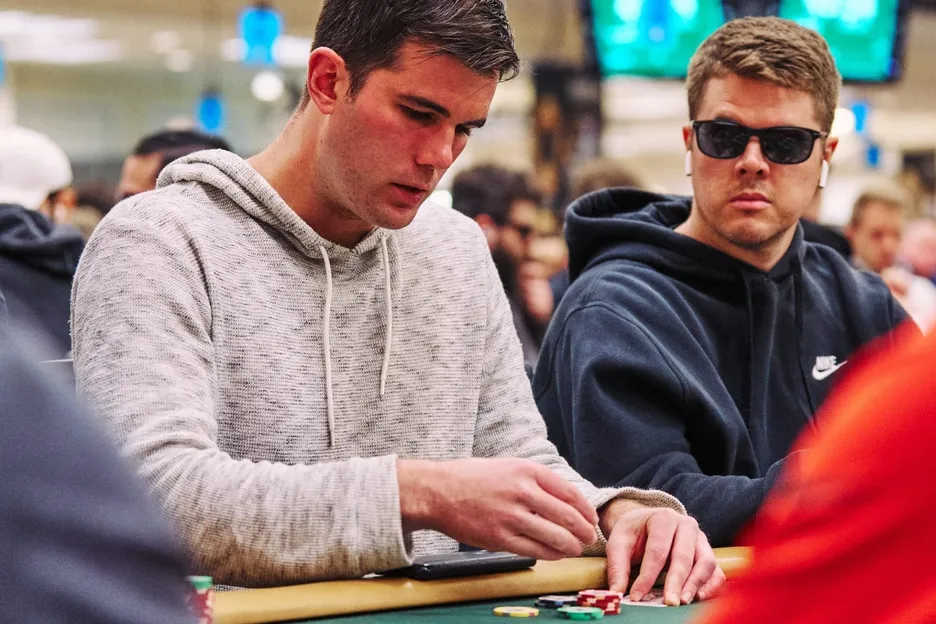


Are you going to the World Series of Poker this year? Do you normally play in a smaller market?
Let’s talk about the plays that might work in your hometown but are not as likely to work at the WSOP in Vegas.
1. Double barreling without a plan
A lot of players make decent money around the country by double barreling as a bluff.
In many smaller markets, people call too much on the flop because they want to see what you do on the turn. Then, when you fire again, they think, 'Okay, I guess this person actually has something,' and they fold.
The problem in Vegas is that many players know this play.
They know you might be testing whether they floated the flop. They know you might be firing the turn just to see if they can continue. Because of that, you are going to get called down by third pair, second pair, and hands that would fold much more often in your hometown game.
If you are going to double barrel in Vegas, you need to have a real plan.
Either commit to the triple barrel when the runout makes sense, or use a larger turn sizing, including overbets in the right spots. Otherwise, you may not want to bother with the standard double barrel at all.





2. 3-betting everyone too quickly
A lot of young pros around the country love to 3-bet aggressively in their smaller markets.
And why wouldn’t they?
In those games, many players do not know what to do. They call too much out of position, miss the flop, and then check-fold. That makes 3-betting print.
Vegas is different.
In Vegas, more players are going to know how to put pressure back on you. They will use small 4-bets with some bluffs mixed in. They will call your 3-bet, call the flop, wait to see if you cap your range by checking turn, and then apply pressure on the river. Some will check-raise you on the flop just to make your life difficult.
As you are getting used to a new table, slowly increase your 3-betting frequency. Do not just sit down and start blasting immediately.
Feel out the table first. Once you know which players are going to have a harder time dealing with pressure, then you can start expanding your 3-bet range.
3. Pot controlling too predictably
A lot of players love to check back the turn with a mediocre hand.
In smaller markets, this can work beautifully. Your opponent sees the turn check and thinks, 'Great, this person does not have anything.' Then they fire some haphazard river bluff for half pot, and you get to call and make money.
But in Vegas, stronger players are going to understand what your turn check represents.
If you check back a turn where there are flush draws and straight draws available, they may correctly assume you probably do not have sets, two pair, or overpairs. After all, those hands usually want to bet for value and protection on a dangerous board.
Then, if they have any kind of relevant blocker on the river, they may overbet and put you in a miserable spot.
Sometimes, the lesser of two evils is simply betting the turn yourself. If you think your opponent will behave more predictably when you value bet thinly for a slightly larger size, that may be better than checking back and inviting a brutal river decision.

4. Automatically making the hero fold
Across most of the country, players under-bluff.
That means when someone plays a huge pot, they usually just have a huge hand. In many smaller markets, if someone triple barrels, overbets, three-bets and double barrels, raises multiway, or fires multiple streets into multiple opponents, they are usually telling the truth.
So you can make big hero folds and feel pretty good about it.
You cannot automatically do that in Las Vegas.
There are many players in Vegas who are willing to apply maximum pressure. You are going to have to watch people closely. Do they seem anxious when they are bluffing? Are they more relaxed when they have a hand? What do they show down? Are they capable of semi-bluffing? Are they capable of putting chips in without the nuts?
You cannot just assume every big bet is value.
Sometimes it still will be. But in Vegas, you need evidence before you start making every big fold.
5. Check-raising every flop from the big blind
You also cannot check-raise every heads-up flop from the big blind and expect your opponents to have no idea what to do.
Many Vegas regulars have spent a lot of time studying training sites and solver outputs. They know what to do when someone check-raises out of the big blind. They know which hands they need to continue with. They know how to call down thinner than the average player in a smaller market.
In many hometown games, you can check-raise much more haphazardly, fire later streets, and get a lot of folds.
That is much less likely to work in Vegas.
Personally, I have found more success in tougher markets by 3-betting large out of the big blind. Fewer players have experience dealing with that strategy, and many will assume your range is stronger than it actually is.
That gives you a different way to apply pressure without running directly into a play they have studied hundreds of times.
I hope these tips serve you well in Vegas.
Wishing you the best of luck.
Alex Fitzgerald is a best-selling author published by D&B Poker. Check out Alex’s most recent book, ‘How to Beat Players Who Never Fold.’
Visit pokerheadrush.com and subscribe to Alex's FREE strategy newsletter to receive three FREE training video packs. Follow Alex on X and Instagram.


