

"DO NOT use the 13th annual world series of poker."
It was one of a few strict notes listed in drafts for the brochure of the 1982 WSOP, a colorful invitation sent to high rollers and poker players from the Binion's rolodex every year.
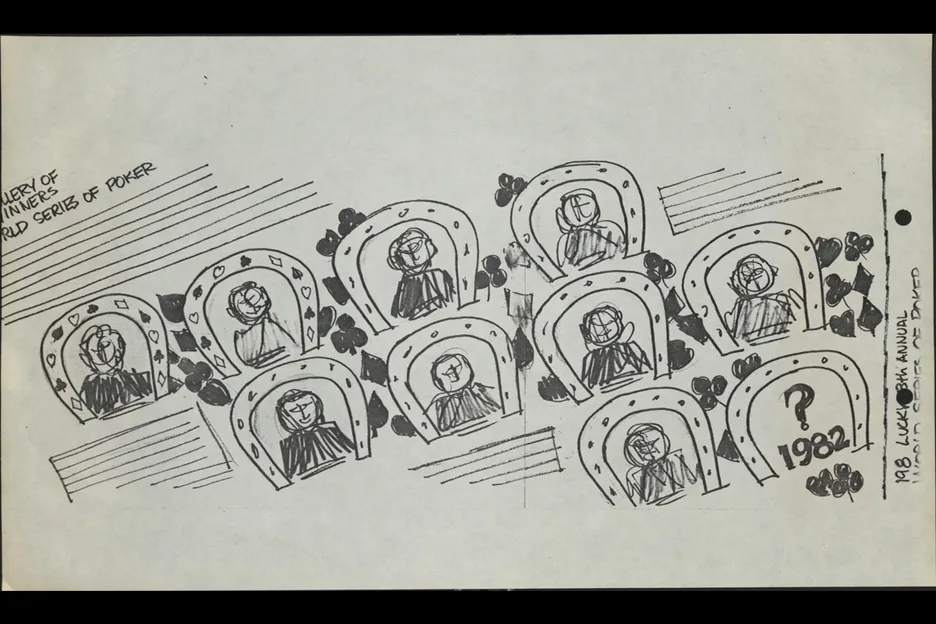
Another note, in all caps: "PREVIOUS CHAMPIONS OF WORLD SERIES OF POKER not WINNERS"
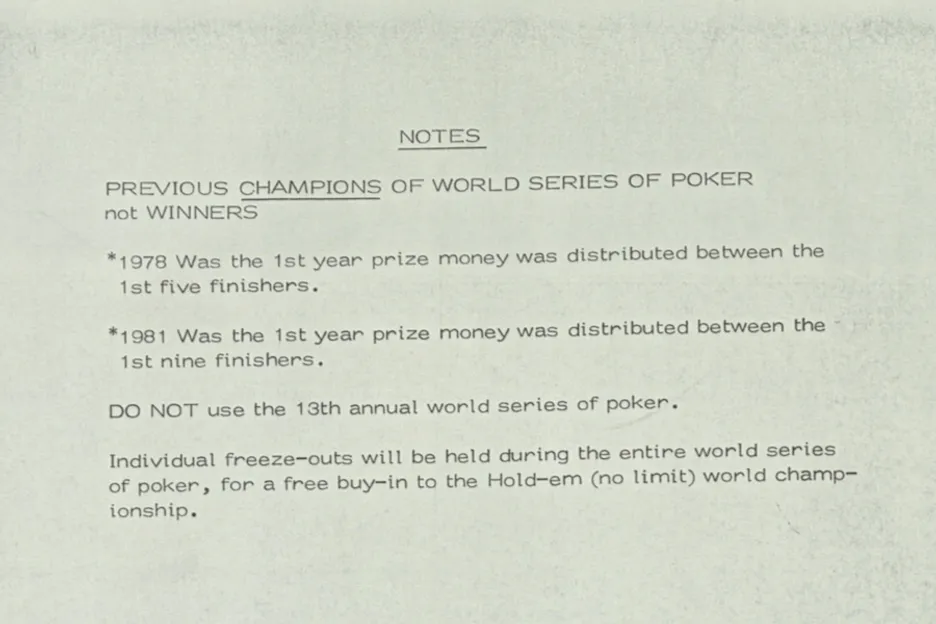
It is an early example of how particular the growing poker festival could be about its presentation, especially as the industry approached the early days of poker on TV. There was no attached reasoning. The previous year was the 12th before the following year was the 14th, so the best bet is probably superstition. However, some mockups called it the 'Lucky 13th WSOP.'
Several folders of records from the 1982 WSOP sit in the Special Collections department at the UNLV Library. They originate from the files of Henri Bollinger, a high-powered L.A. press manager who worked on behalf of Binion's throughout the early years of the WSOP. Within the files are decades of hand-written chip count sheets, interviews, media guides, and other materials used to promote Binion's and its annual poker festival.
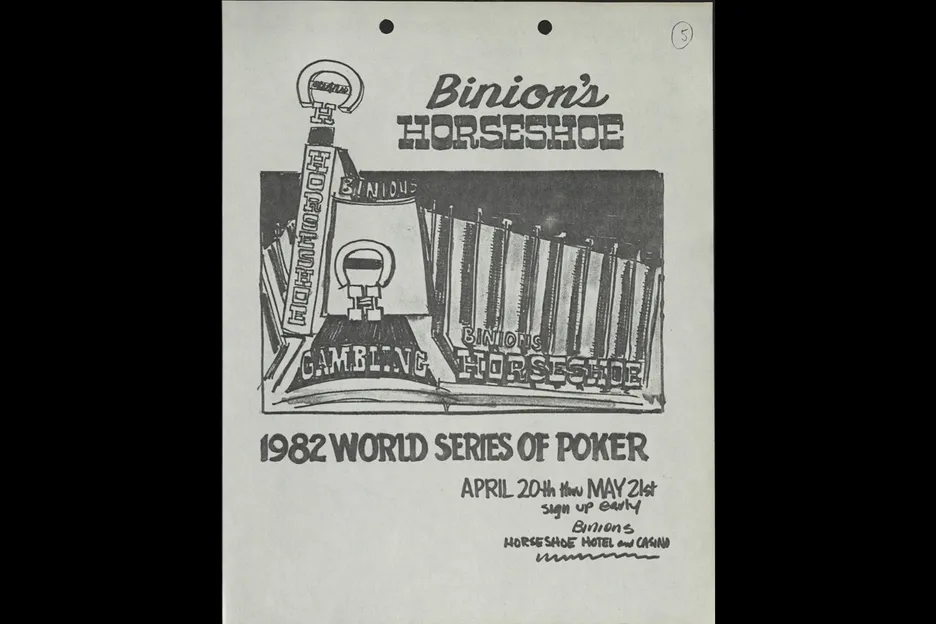
The gold watch year
Despite any superstitions, the 13th annual WSOP held 13 events in May of 1982, drawing 1,253 total entries for a little over $2.6 million in total prize pool. It was a moderate leap up from 1981, where 1,133 total entries turned out across 12 events. Billy Baxter won the first two tournaments of 1982 and author David Sklansky would conquer two of his own. Chip Reese would also score one of his WSOP titles in the $5K Seven Card Stud Event.
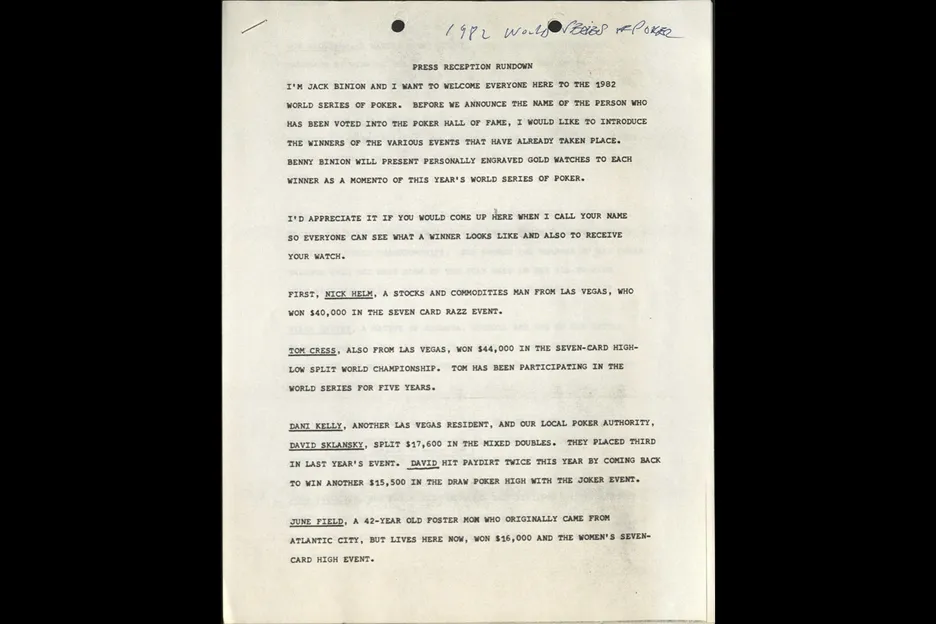
It was the second of three WSOP bracelets for Reese — but it wasn't a bracelet. In what might have been a marketing misstep, 1982 was the year that no bracelets were awarded. Instead, players were honored with special gold watches at the annual press event on the eve of the Main Event.
"I would like to introduce the winners of the various events that have already taken place," Jack Binion said in a speech at the 1982 press reception. "Benny Binion will present personally engraved gold watches to each winner as a memento of this year's World Series of Poker.
I'd appreciate it if you would come up here when I call your name so everyone can see what a winner looks like and also to receive your watch."





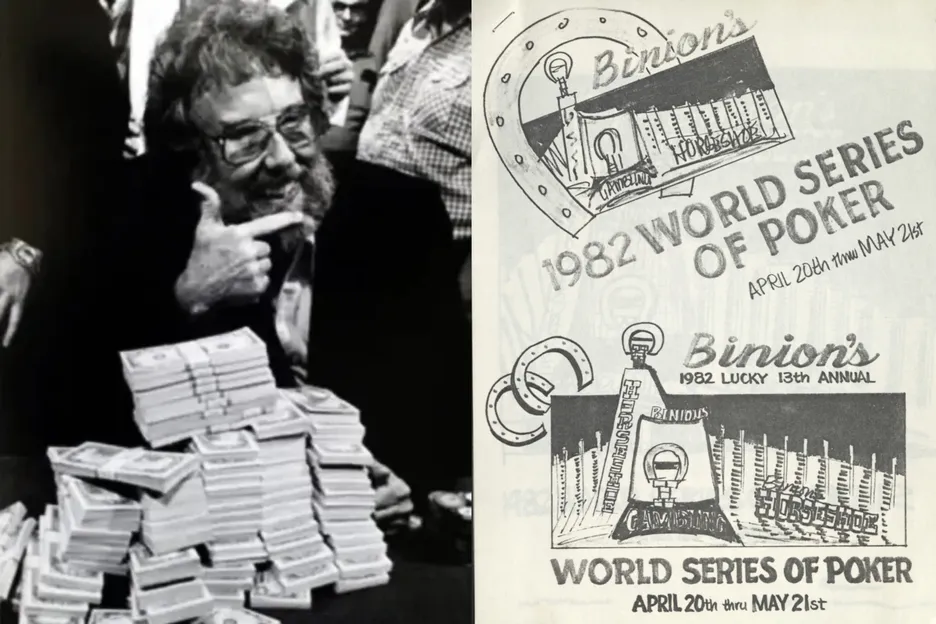
Straus beats Tomko
The following day, the Main Event tally jumped into triple digits for the first time ever with 104 runners, up from 75 the year before when Stu Unger won his second world championship in a row. Ungar would finish Day 1 with a top ten chip stack, trailing the likes of Reese, Doyle Brunson, Sailor Roberts, and leader Sam Petrillo after four two-hour levels of play. (The brochure would advertise this long lost perk — promising no more than eight hours of play starting at 1 pm every day.)
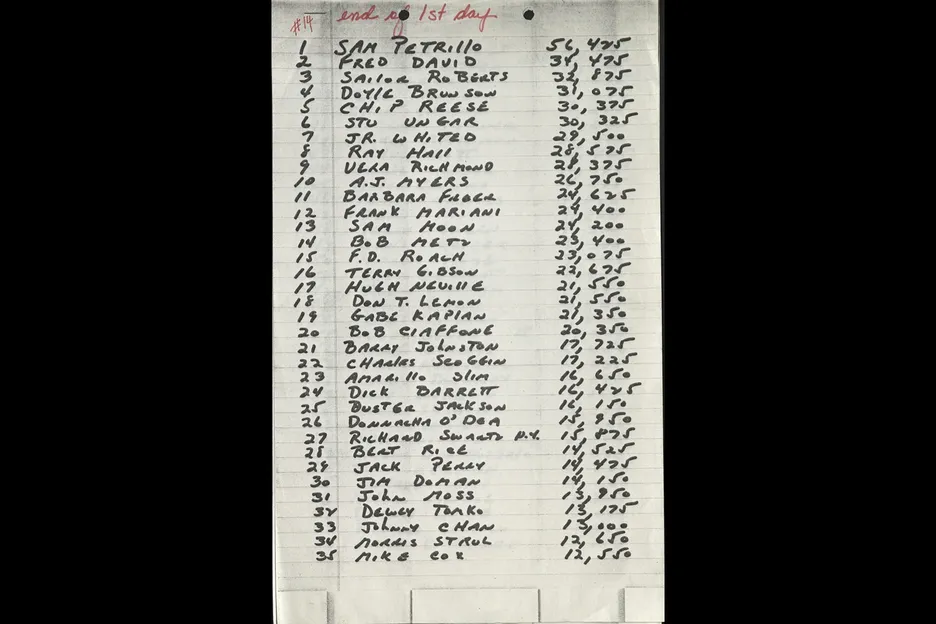
'Chicago Sam' Petrillo, the ninth-place finisher in 1981, wrapped up the opening day of the Main Event with more than five 10,000-chip starting stacks, while his nearest opponent, Fred David, was more then 20,000 chips behind. Barbara Freer also made an appearance on the first page of Day 1 chip counts in 11th place. She was the 1979 Women's champion — the third time that event was held.
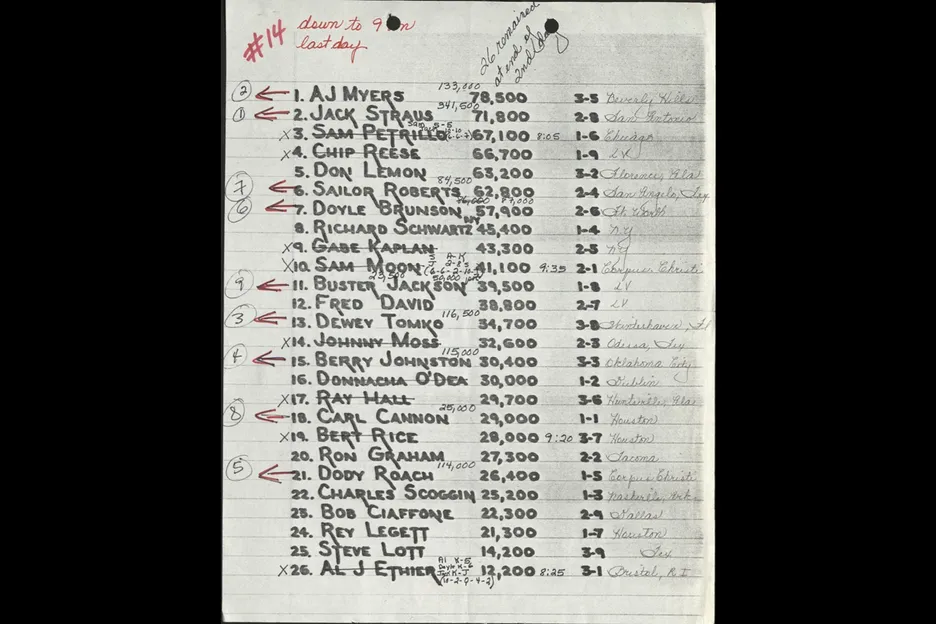
Day 2 worked down to the final 26 players of the tournament, and with much sharper handwriting. AJ Myers was the new leader after four more levels of play and eventual champion Jack Straus, 52 at the time, was right behind him after a slow start on Day 1. Straus would take a massive lead into the final table of nine after Day 3 with a chip stack of 341,500 — well clear of Myers in second with 133,000 and Dewey Tomko in third with 116,500. Brunson also made the final table, sliding in the sixth slot on the leaderboard with 87,000, just ahead of Sailor Roberts with 84,500.
Straus, or 'Treetop', would win the tournament and its $520,000 grand prize. "Your peers consider you the best for this year," Straus said. "It really is a good feeling." He was famously down to his last hidden chip at one point, which is noted on the post-win bio sheet.
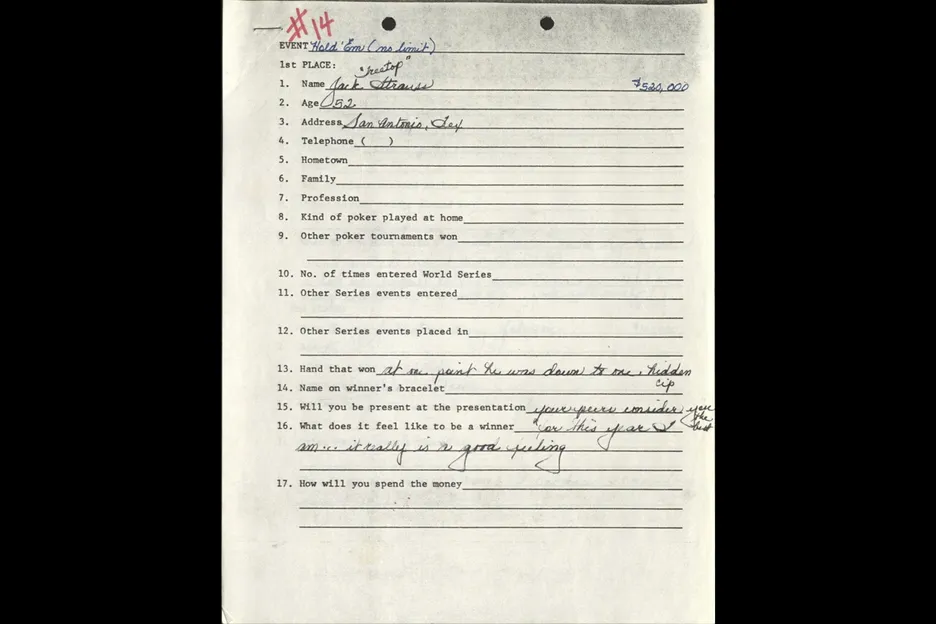
Second-place Tomko's bio sheet lists his address as Winter Haven, Florida and his occupation as poker professional, a few years removed from his bid as a school teacher. "You've gotta try to win it," he told the interviewer. "I tried to win it but I didn't. I've got a lot of years to try again."
1986 champion Berry Johnston would finish third and Brunson in fourth. Brunson's bio details are slim — just a married poker pro — though they already had as much biography information on Doyle Brunson as they'd ever need by this point.
Join the World Series of Poker Club
A random sheet of copy was found in the 1982 archive — possibly the first example of a WSOP player's club promotion.
"Join the World Series of Poker Club" the header says, with a promise that the club has been "launched for the convenience of World Series participants." Membership was open to entrants of any WSOP event, and it included several special privileges like:
- Complimentary food in the Sombrero Room during the tournament.
- Reduced hotel rates
- Year-round Horseshoe casino privileges (unspecified)
- Invitation to the press party
- Future mailers
Not a bad deal, at least compared to today.

The 1982 WSOP wrapped up on May 25 and crowned Straus as its winner shortly after 10pm. Binion's would begin to turn its eyes toward promoting its casino on television as the 1980s went on, with a debut of the WSOP on ESPN to come in 1987. Documentary footage of the 1982 series is missing from the PokerGO archive, but a Betamax video from Bollinger's personal collection exists in the UNLV collection.
More in our 1982 WSOP artifact gallery:
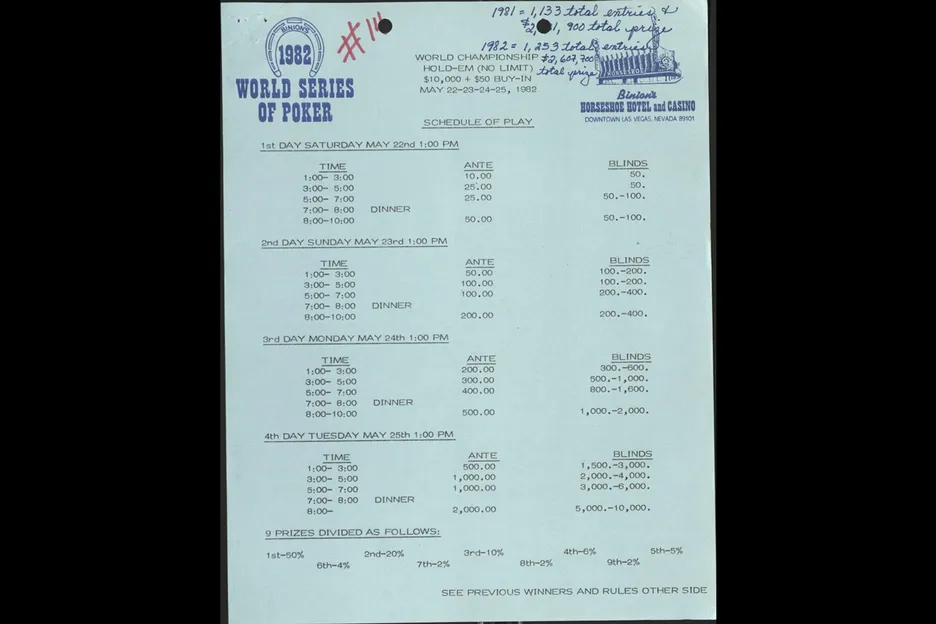
Artifacts obtained from Binion's Horseshoe Casino Records on Poker, 1960-2006. MS-00325. Special Collections and Archives, University Libraries, University of Nevada, Las Vegas. Las Vegas, Nevada.


