


As we age, our bodies cannot help but be affected by the passage of time. But what about our minds?
Sadly, it’s not uncommon for our cognitive abilities to also decline as we age. Diseases such as Alzheimer’s, and other forms of dementia, can brutally rob people of their cognitive functions. Many will know the reality of this situation all too well from personal experience, while recent high-profile documentaries from the likes of Chris Hemsworth and Seth Rogen have helped to drive awareness of the issue to the wider public.
It’s estimated that over 57 million people are living with dementia worldwide, though there isn’t always a specific condition such as Alzheimer’s on which to pin the blame.
Issues around memory, processing speed and a general decline in mental performance are often a byproduct of ageing, so it’s important to do what we can to combat these potential pitfalls. And any age is a good time to start.
A healthy lifestyle is the best way to give your brain, and body, the best possible chance to stay sharp while growing old. For your body, that means things like a healthy diet and regular exercise.
And for the brain, it’s not so different: staying mentally active and stimulated helps to keep your mind from degenerating, just as keeping physically active helps your body stay healthy.
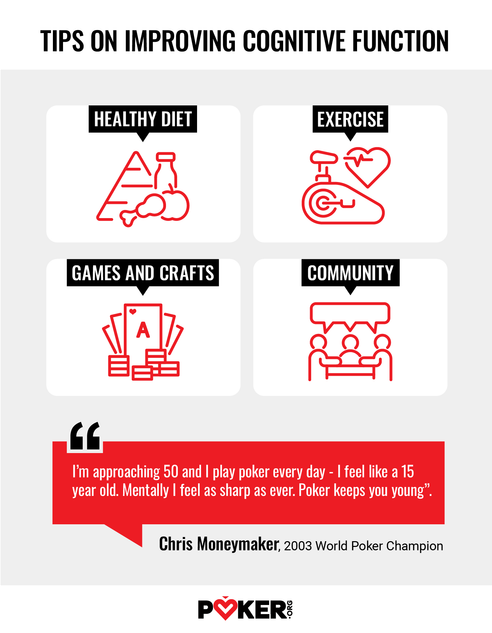
This relationship between mental exercise and cognitive health feels intuitive, but it’s also supported by a 2019 academic study which concluded that ‘Cognitively normal elderly individuals who engage in playing games, craft activities, computer use, social activities and specific mentally stimulating activities even in late life have a decreased risk of incident MCI [mild cognitive impairment]’.
Many find sport and games a great way to have fun whilst exercising, providing an engaging context to help keep you focused, in contrast to simply pounding the treadmill, for example. And the same goes for keeping in good mental shape: Brain teasers such as Sudokus are all well and good, but the introduction of competition can often help you stay engaged for longer, push yourself further, and provide you with a great reason to come back for more — because you enjoy it.
And when it comes to enjoyable, mentally stimulating games, there are few that compare to poker. As we explore below, there are significant medical and social advantages to the game that make it one of the best ways to stay mentally healthy into old age.
The medical case for poker
Playing strategy games such as poker, chess and bridge, to name but a few, has been identified as beneficial to long-term cognitive health.
While detailed research into poker has yet to be published, the aforementioned 2019 academic study, which examined the effects of chess-playing in older people, concluded that ‘chess could be considered a protective factor against dementia and cognitive decline in older people’, and that ‘the practice of chess is a protective strategy in the development of dementia from a preventive perspective’.
Poker, chess and other strategic games share several key cognitive requirements:
- Strategic planning: Long-term thinking and pattern recognition
- Working memory: Holding game states and potential moves in mind
- Executive functions: Planning, inhibition, and cognitive flexibility
- Attention and processing speed: Critical for time-pressured decisions
Research suggests that the benefits of regularly exercising one’s mind in these ways can be significant:
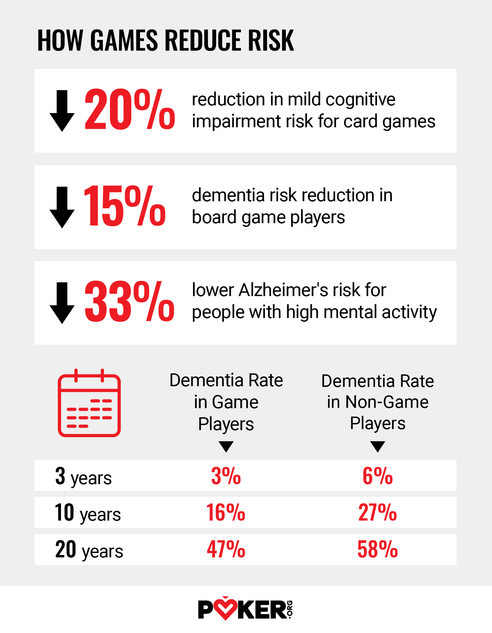
- 15% dementia risk reduction in board game players
- 20% reduction in mild cognitive impairment risk for card games
- 33% lower Alzheimer's risk for people with high mental activity
- 35% less likely to develop dementia for regular vs. occasional board game players
- Longitudinal protection: Benefits maintained over 3, 10, and 20-year follow-ups
While chess is clearly a great game for ageing brains to play, it can be tough to learn, and with its heavy emphasis on skill is not always a fun experience for lesser skilled or beginner players — especially when matched against a more highly skilled opponent.
Poker, on the other hand, is an extremely easy game to learn, and contains an element of short-term luck which makes it more viable as a fun experience for newer players. Moreover, while it ticks the same boxes as chess in terms of cognitive requirements, it also offers the opportunity to test other skills such as mathematical and probabilistic reasoning.
And then there’s the social component; an element that chess may be somewhat lacking, but that poker has… in spades.

The social case for poker
Many leisure activities have been found to have beneficial effects on cognitive and memory functions in older adults, with a recent article in the Journal of Clinical Neuroscience stating that leisure activities such as mahjong, chess and poker ‘not only improve cognitive function and memory levels, but also enhance executive ability and improve quality of life’.
Where poker has an edge over its fellow games of strategy, however, is in its emphasis on social interaction.
The poker phrase, ‘don’t play the cards, play the person’ is something of an over-simplification, but contains a nugget of truth: empathy and social awareness can be powerful tools in the game of poker, as a large part of the game involves understanding and predicting your rivals’ strategies through perception, observation and intuition.
Rather than facing a single opponent or a computer, playing poker often entails interaction with up to eight other players at once. What’s more, this cast of opponents can change as the game goes on, introducing new people to evaluate, to understand, with whom to socialize and engage.
The stimulation of facing off against real players not only provides new challenges for which our brains must adapt, but a different type of exercise; a new set of mental muscles are being stretched and primed.
Among the poker-specific benefits are:
- Enhanced social processing: Poker players show specialized abilities in processing social cues
- Community engagement: Regular social interaction through gaming
- Isolation prevention: Structured social activities combat loneliness
This last point is perhaps the most useful to note; many elderly people are more at risk of dementia due to isolation, a lack of social stimulation hastening the decline in their cognitive abilities through fewer opportunities to engage with others.
Poker is an inherently social game, and can provide players with more than a mental challenge: It can provide a community.

Chris Moneymaker, winner of the World Series of Poker in 2003, agrees.
“I’m very competitive. When you reach a certain age, the ability to compete in a physical activity is not an option, for the most part. I can't go out and play soccer, or I can pick up basketball but I’ll be playing against kids half my age, and it’s not really an option.
“Poker is an option where I can get my competitive juices flowing and compete with basically anybody, on any level, and not be handicapped by my age.
“As you age your mental aptitude drops. I’m approaching 50 years old and I play a mental game every day, and I feel like a 15 year-old kid. Mentally I feel as sharp as ever. I think the game keeps you sharp, keeps you young.
“Loneliness is a very big thing when it comes to seniors. Having a home game or a community to come to and play and be a part of something, is something that as a senior, when I get to 75 or 80, I hope I can continue to do.”
Poker is a stimulating game with a low barrier to entry, easy to learn yet with the potential for limitless depth. It can be played online or live, for money or for fun.
If you’re new to poker check out our useful resources for new players, including guides on how to get playing quickly and handy tips on how to improve, fast.
Sunday, September 21 is World Alzheimer's Day. For more information on Alzheimer’s and dementia, visit Alzheimer’s Disease International — an international non-profit organization supporting people with dementia in over 100 countries across the world.


