


The $10,300 Phil's Thrill tournament runs each Sunday at ACR Poker, live-streamed with commentary from the likes of Rob Kuhn and Chris Moneymaker.
With a 30-minute delay on the stream, you'd think it would be tough for Moneymaker to juggle playing live while commentating on hands he’d played half an hour earlier — and you’d be right. But that didn’t stop him winning the $165K up top, last Sunday.
Hiding the fact I was still playing was the hardest part
They call it the softest $10K on the internet, but I don't see how you can do that when the whole field is nothing but stone cold killers, with the exception of [ACR Poker CEO] Phil Nagy. One player does not make it the easiest tournament on the planet.
Doing the commentary while I was playing was difficult. It's on a 30-minute delay, so it's not so much that I'm going to give away any of my strategy — I mean, I think everybody knows what my strategy is going to be at the final table: As the massive chip leader I'm going to apply pressure and try to use the money jumps to build my stack, and that's why I did that successfully without getting into any danger. I was able to navigate through the tournament without having to really run too many big flips.
But commentating on it was difficult, because I didn't want to give away the fact that I was still in the tournament 30 minutes later, as that would have been a spoiler.
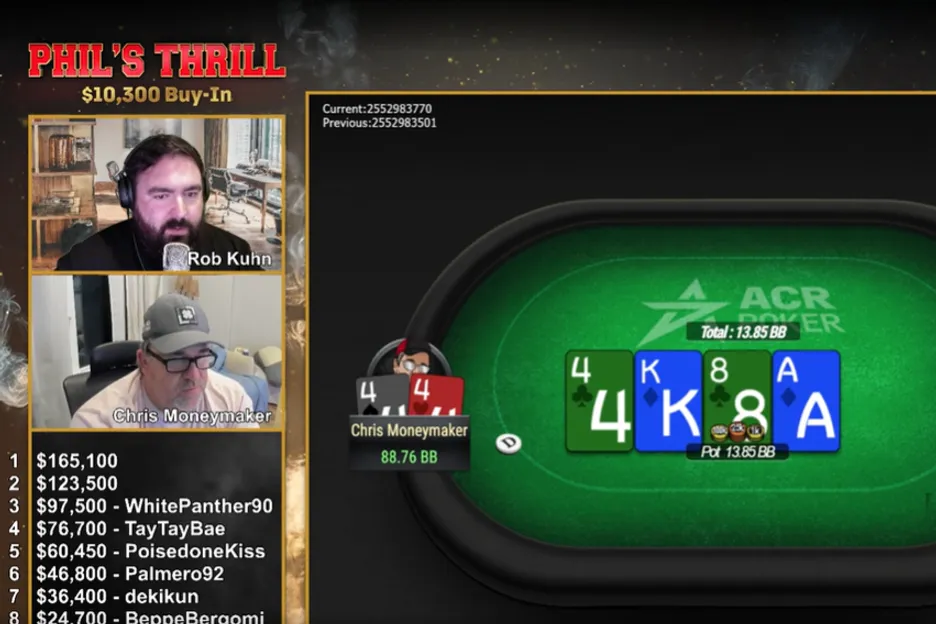
So I had a very calm demeanor and was just trying to focus on the commentating side, and when I hit big hands, in real-time, I didn't have any reaction. I generally don't when I'm playing at home — there's really not a whole lot of reaction to have when you're sitting by yourself — but I wanted to make sure that I didn’t give away any indication that I was still in the tournament or doing well.
I thought it was very important for the enjoyment of the stream and the people watching. I was trying to really be cautious about doing anything that would give away the fact that I was still in the tournament — even as far as saying I was playing a different tournament when, for example, I was actually focused on a 3-bet hand when we were three-handed.





Flopping sets made it easy to close it out
In terms of the tournament itself, I had a really massive hand that propelled me to build my stack. I had 
 on the button and I opened. The big blind 3-bets to 8BBs — he's been pretty actively 3-betting me. Both of us had about 40 big blinds. There's a lot of tournaments where I don't 4-bet A-5, A-4 and those kinds of hands. If I feel like I have a significant edge on the field I generally don't take the line of 4-betting those types of hands, even though the solvers love doing that.
In this tough field, I took the solver route and shoved, and he called with pocket tens, and I ended up hitting a flush, so that gave me 80 big blinds. That was a super significant hand.
As we got close to the final table, I had another very significant hand where the small blind limped and I was the big blind. I had 6-3 offsuit, and the flop comes 9-6-3 with two hearts, so I flop bottom two-pair. The guy was basically second or third in chips, and I was chip leader, and we ended up getting it all in. I guess he put me on, like, 
 , or some kind of combo draw, because he had K-9 and just put a massive amount of pressure on me. We got it all in and I held.

So I came into the final table with heaps, like 100BBs and second place had around 30BBs, so it made it really easy for me to play the final table. I could apply max pressure without really endangering my stack; I really didn't have a single tough decision on the final table.
Flopping two sets against the last two guys makes it really simple to win the thing — I just ran ungodly good and it was really wild that on the final table I had no difficult decisions. The two most difficult decisions I had was whether to 3-bet A-8 offsuit and to 4-bet A-9 offsuit. Both times I just chose the lower variance option.
It was a great experience, going through and talking through the spot 30 minutes later and seeing what the people had. It really kept my mind at peace, so I didn't do anything stupid.
But then, my cards were either really good or really bad; I really couldn't do too many things that stupid.
You can watch Chris Moneymaker’s final table performance — as both a player and a commentator — below, courtesy of ACR Poker’s Twitch channel.


