


There are some phenomenal modern poker writers who articulately put forward the concepts and heuristics necessary to level up your game. Dara O’Kearney and Barry Carter created the Poker Solved series of books which are a must-have on any poker bookshelf. Michael Acevedo blew me away with the game-changing Modern Poker Theory. Andrew Brokos’ Play Optimal Poker is an insightful read from a renowned communicator.
Tempting as it is to write about a book penned one of these great authors, I want to instead review the first serious poker strategy book that I ever consumed.
From 'reading souls' to logic and precision
Harrington on Hold’em - Volume 1 came out in 2004, just a couple of years before I turned pro. If Doyle Brunson’s Supersystem was the Old Testament, then Harrington on Hold’em was the new poker covenant, the new agreement on the best ideas from which to build a poker game.
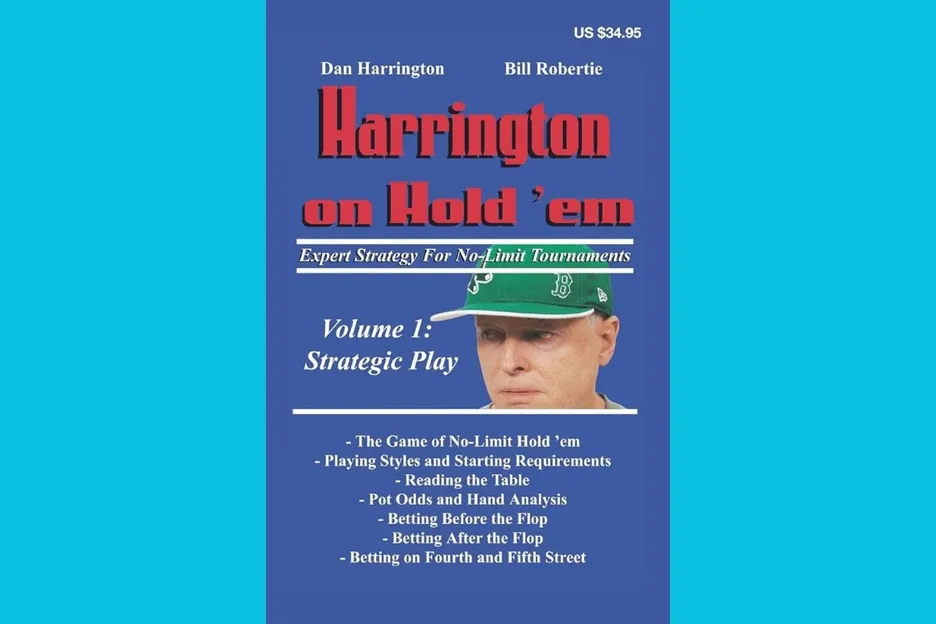
Dan Harrington and his co-author Bill Robertie taught me ‘the gap theory’, the importance of position, pot odds, implied odds, and the 'M' concept — a way of measuring stack size relative to blinds and antes that became gospel among mid-stakes grinders for the next decade.
As an amateur, playing home games with my pals, I had some decent poker instincts but prior to reading Harrington, I was undisciplined and leant into vague talk of ‘feel’ and ‘reading souls’.

The book provided oxygen in the form of logic, precision and a strategy that I could actually implement. The hand quizzes at the end of each section were particularly valuable and played perfectly into how I best consumed knowledge. Harrington’s ‘correct answers’ (even if it turned out that they weren’t GTO) were usually accompanied by a clear, didactic explanation that you read in his voice. Presenting the material in that way was a fantastic way to make the reader really engage.








Its strength was also its weakness
Harrington, a former WSOP Main Event champion and back-to-back final tablist in 2003 and 2004 (when the fields were ballooning with Internet kids), brought a disciplined, mathematical approach to a game that, at the time, still featured its fair share of cowboys and punters. His advice became the Holy Grail for plucky up and comers who were starting out from scratch and needed to reduce their risk of ruin.
Here’s the rub though. Harrington on Holdem’s strength was also its weakness. Its success became its limitation. By educating a generation of players, many of us became disciples, moulded into a particular archetype. I was transformed into a tight-aggressive, risk averse grinder who played premium hands, avoided marginal spots and always folded ace-queen to a 4-bet.

That was a good thing and it helped me to beat the game consistently for about five years. It gave me some solid building blocks and a cheat code of sorts to beat the fish and maniacs. It did, however, open me up to a gaping exploit. I became the meat in the sandwich for loose aggressive players who were more balanced, more willing to take it to the streets and adept at leveraging my caution against me.
As poker evolved, the lines between optimal and exploitative blurred, and game theory optimal exposed some of Harrington’s more conservative tendencies. His aversion to bluffing in uncertain spots and his lack of sufficient adjustment for ICM left significant strategic gaps to be filled.
Nonetheless, it was a seminal book to which I owe an awful lot. Just like in many other disciplines, poker players are standing on the shoulders of giants. Harrington was undoubtedly one of those giants and Harrington on Hold’em remains a brilliant introduction to 'the why' of tournament poker.
David is a professional poker player, writer and commentator. He has written over 750 blogs and articles on poker; including news, opinion and strategy. He is the producer and host of the 3-time GPI Global Poker Award winning podcast ‘The Chip Race.’ In 2025, he was nominated for the GPI Global Poker Award for journalism. David is a brand ambassador for WPT Global.


