

When he's not making final tables and cashing for six figures at WSOP Paradise, Jonathan Little shares his vast poker knowledge through his training site PokerCoaching.com and his ever-growing library of poker strategy books.
Little's latest title from D&B Publishing – The Complete Poker Workout: Test Your Knowledge with 100 Key Tournament Hand Quizzes – gives you the chance test your own knowledge across a variety of important tournament concepts. Through the 100 hands, Little presents complex poker concepts in an easily digestible manner, breaking down each of the situations into a number of decision points with a Q&A format to further explain his thought process.
In the introduction, Little writes: "When learning poker, I always suggest my students spend substantial time away from the poker table learning Game Theory Optimal strategies as well as when and how to adjust away from those strategies to take advantage of their opponents’ mistakes. That said, there is no substitute for actually playing lots of poker hands to get experience implementing those strategies in real time. This book is designed to give you the experience of 'playing' poker, with me there to give feedback at every decision point."
Check out an exclusive extract from his new book below.

Good spot to bluff? (90BB)
You are playing in a $5,000 buy-in tournament with 45,000 at 300/500 with a strong professional poker player on your left. The splashy player UTG limps and it folds to you on the button holding 
 .
.
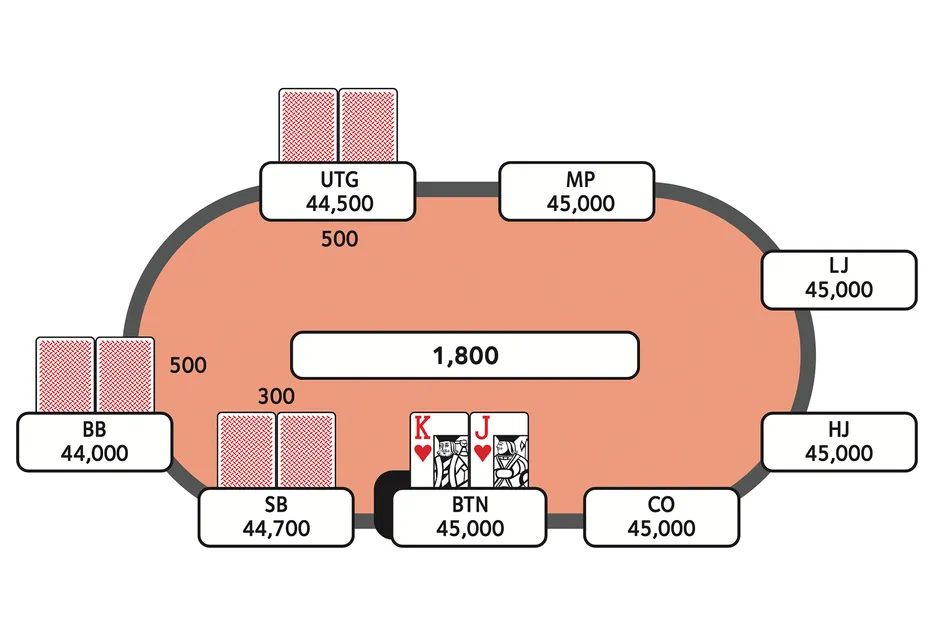
Question 1: Should you:
- Fold
- Call
- Raise to 2,500
- Raise to 4,000
Answer: You should raise to 2,500 purely to extract value from the UTG limper’s loose, splashy range. The only time you should avoid raising is if you know for certain that UTG is a tricky limper or either of the players in the blinds is likely to 3-bet. Raise the vast majority of the time, but if you get bad vibes, calling is fine too.
You call, the professional small blind raises to 2,500, and the UTG player calls.
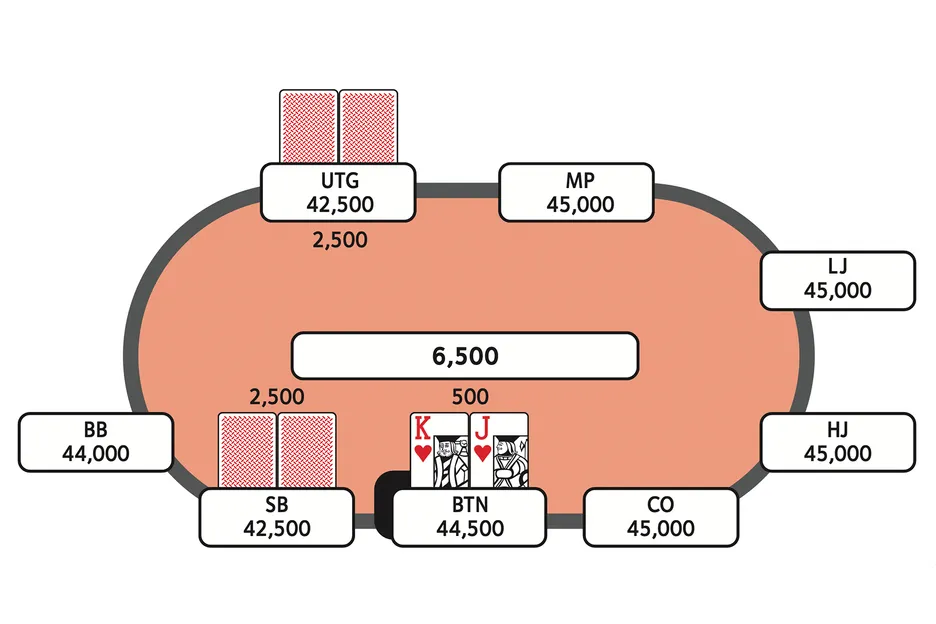
Question 2: Should you:
- Fold
- Call
- Re-raise to 7,000
- Re-raise to 10,000
Answer: You do not want to re-raise because there are no premium hands in your button limping range that would induce folds from your opponents. You have a hand that flops well, but it is not good enough to 3-bet. Calling is the only option because you are getting good odds in position with a hand that flops well.
You call, the flop comes 

 and both opponents check.
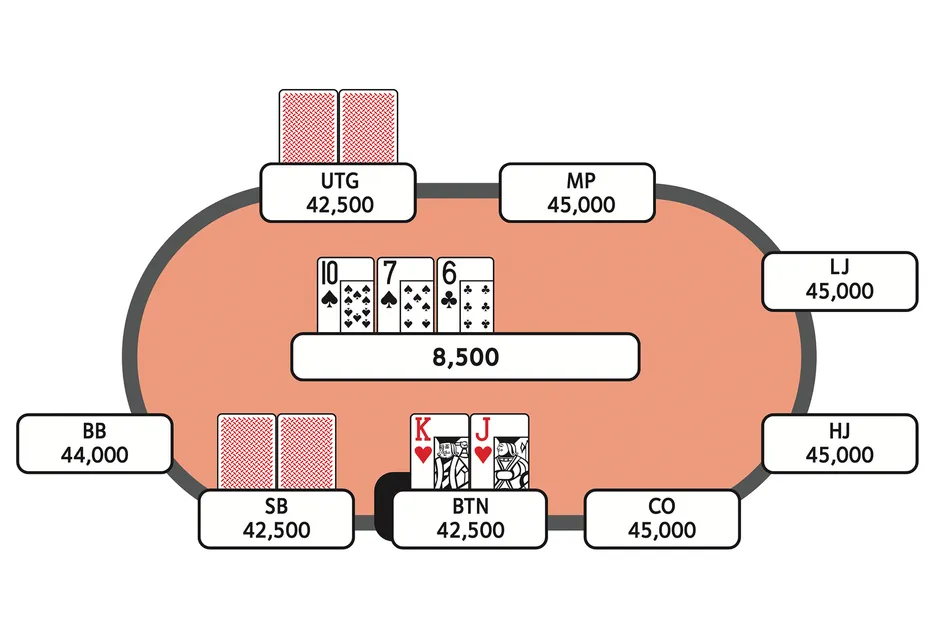
Question 3: Should you:
- Check
- Bet 2,500
- Bet 5,000
- Bet 7,500
Answer: If you notice physical tells suggesting both of your opponents are weak, you can rationalize making a bet to try to win the pot immediately. If you bet, you should use a large size to discourage your opponents from calling with marginal pairs. If you think your opponents will protect their checking ranges well by including some hands they are never folding, check behind and hope to improve on the turn.
You think your opponents are both weak and elect to bet 5,000. Only the small blind calls. The turn is the  and she checks.
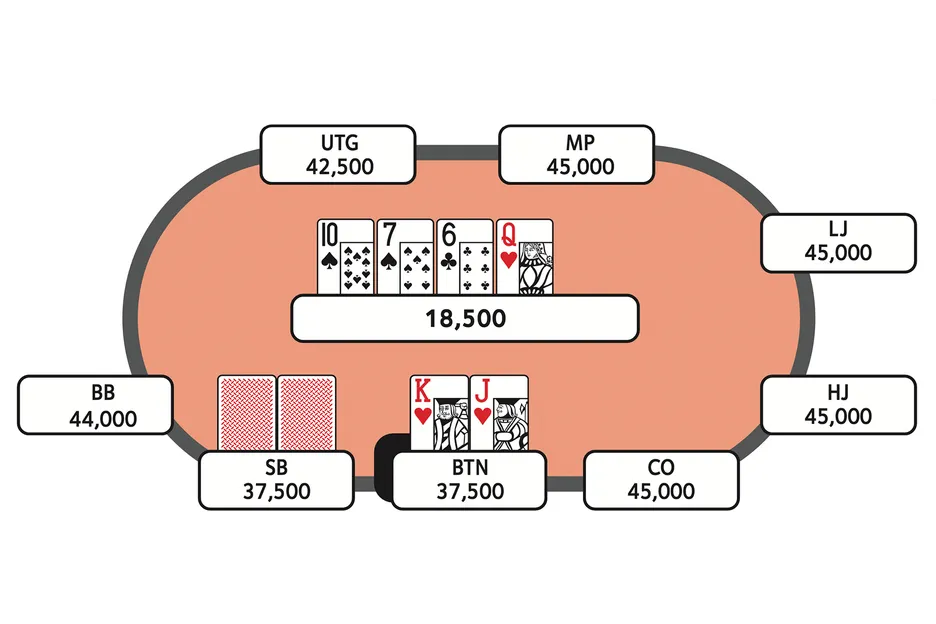
Question 4: Should you:
- Check
- Bet 5,000
- Bet 10,000
- Bet 15,000
Answer: It is important to note that when a strong player check/calls from out of position, they usually have some sort of decently strong made hand. While caution is encouraged, you still want to bet with some bluffs, making a point to use a size that gives you fold equity on the turn and river (when you feel inclined to continue bluffing). You can bet small now and then bet large on the river, bet medium now and then medium on the river, or bet big now and then small on the river. Betting small is the best option because it provides some fold equity for you now and again on the river while also limiting the damage when you get check/shoved on.
You bet 5,000 and she calls. The river is the  and she checks.
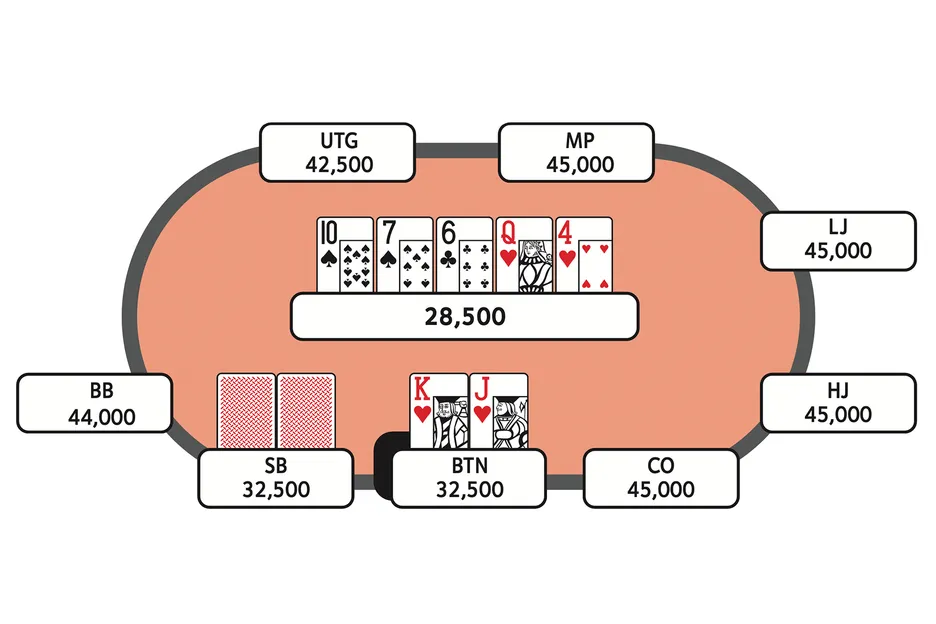
Question 5: Should you:
- Check
- Bet 10,000
- Go all-in
Answer: The only possible way you win this pot is if you go for the bluff all-in. While she may very well call, there are plenty of hands in her range that could easily fold. If you are trying to get her to fold specifically A-K or A-J, then you do not need to bet too big, but considering the pairs in her range, only an all-in bluff has a chance of getting her to fold.
You move all-in and she thinks for a while before calling with 
 . While you lost most of your chips, you have to be willing to make big bluffs with logical hands when the opportunity presents itself. Sometimes it is not going to work out.
The Complete Poker Workout: Test Your Knowledge with 100 Key Tournament Hand Quizzes is available now from Amazon and D&B Publishing.


