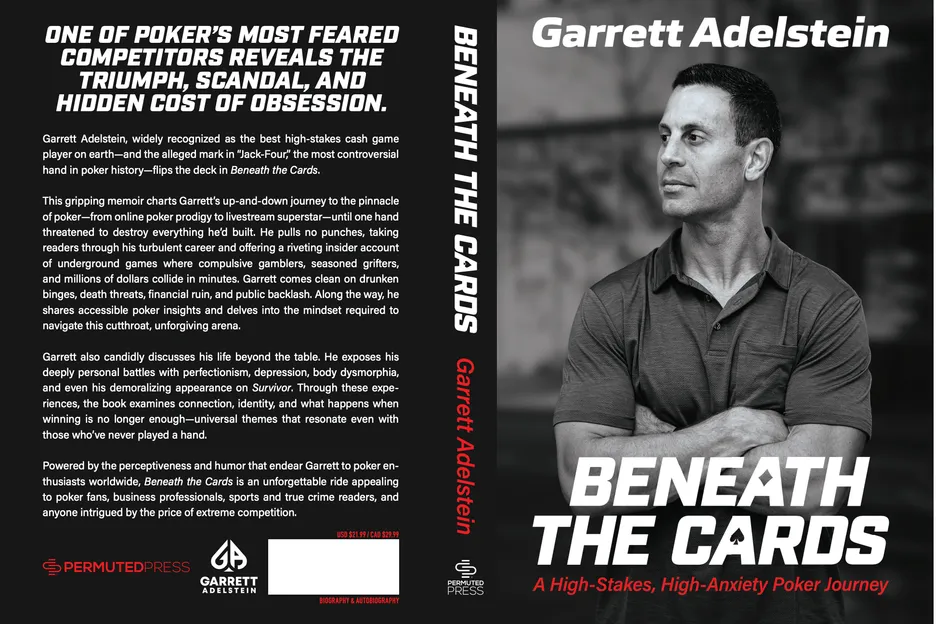


This is an extract from Garrett Adelstein's new book, 'Beneath the Cards: A High-Stakes, High-Anxiety Poker Journey', which is released September 1 on Amazon. Get more details via publisher Simon & Schuster and follow Adelstein on X.
Chapter 61: I've Got It
My stellar run continued. On April 8, 2022, I played a sizable pot in another $100/$200/$400 game that generated attention. The hand began when Ethan, a twentysomething, mild-mannered businessman visiting from the Midwest, raised to $1,200 with ace-queen of diamonds. I looked down at a couple of jacks on the button and 3-bet to $5,500, which Ethan called. The flop came ace, seven, five:
- Ethan:


- Garrett:









Flop: 


I made a standard $4,000 bet into the approximately $13,000 pot, and my opponent made the easy call with his top pair, second kicker. The turn was the sexy jack of clubs for a board now reading ace, seven, five, jack, giving me a hidden set of jacks:
- Ethan:
- Garrett:
Turn: 
As it was reasonably likely Ethan held an ace, I elected to bet $17,000 into the roughly $21,000 pot, trying to get as much money in the middle as possible. Watching his body language, I noticed some discomfort. Eventually, he called anyway.
How can I tell the difference between someone who’s truly uneasy as opposed to feigning weakness and giving off a false tell? You can rarely be 100 percent certain of much in poker, but I’ve played thousands of hours with guys like Ethan — wealthy, yes, but also a fish out of water, understandably spooked by the prospect of losing six figures in a hand. After calling my turn bet, it was likely he had an ace with a good kicker like ace-king (AK), ace-queen (AQ), or ace-ten (AT). These hands were too strong to fold but far from a slam dunk.
The river was a decent card for my hand, the ten of spades, for a final board of ace, seven, five, jack, ten:
- Ethan:
- Garrett:
River: 
The ten would give Ethan two pair if he held ace-ten (AT), a hand still behind my set of jacks, yet too good to fold. If he held ace-king (AK), it would also be difficult to let top pair, top kicker go. But if he had exactly ace-queen (AQ) or a worse ace (Ax), I suspected he wouldn’t call a big bet.
Based on this oversimplified analysis, I thought going all-in for the $66,000 Ethan had left into the $55,000 pot was best. I also considered betting around $25,000. This sizing might get him to call with any ace, but it would leave money on the table with the hands he was likely to call all-in with. It was a tough decision.
After I put a stack of $5,000 chips out, I saw Ethan squirm in his chair out of my peripheral vision and immediately began to regret my greedy bet sizing. Everything about his body language indicated that he only had one pair — and he was going to fold it. I decided on a whim to call an audible, reaching for a tool I rarely utilized when the action wasn’t on me: I spoke. Usually, this psychological tactic is a negative freeroll that can only have adverse consequences. Talking gives my opponent more information to consider before making his decision. Information is power, on and off the green felt.
On the other hand, I was extremely confident he was about to fold anyway. I decided to throw up a Hail Mary by declaring, “I’ve got it.”
I did this in hopes he’d decode my words through the lens of “strong means weak” and wrongly conclude I was bluffing. Instead, the opposite happened. Ethan, clearly surprised I said anything at all, was convinced my words were genuine — certain I was such a mensch that I wanted to cut the successful businessman a break to the tune of $66,000! He didn’t take long to slide his cards into the muck.
This hand was a critical lesson in remaining hyperaware of how others perceive you at the table. The image I sought to project — a skilled yet benevolent competitor — had bitten me in the ass. Although Ethan knew I was unafraid to run a big bluff, he also, as he later told me, thought I was as much of a class act as anyone in poker. From where he was sitting, I was just too good of a guy to ever lie about the strength of my hand.
Vertucci was again in the booth, providing commentary as the hand played out. And upon hearing me say “I’ve got it,” he too presumed I was trying to give a good-looking, affluent young man I’d just met a gift that exceeded the median US annual income: “You want to talk about giving someone some mercy.… Did Garrett just tell Ethan ‘I’ve got it’ and save him sixty-six thousand dollars…? That changes so many things for me, and I already love the guy.”
Nick didn’t love me; he loved the money I put in his pocket by showing up twice a week. He loved perpetuating the narrative that I could do no wrong because it was good for business.
The hand immediately went viral, with most viewers misinterpreting my words just as the HCL owner did. I stayed mum on my motivations for talking; I didn’t want to let my fans down. The reality, however, was clear to numerous seasoned pros who weighed in, who assumed “I’ve got it” was a last-ditch attempt to earn a call — and not a particularly clever one. They were right, of course.
Processing the online feedback, I realized something unsettling that I should’ve already known: I had little control over how the public saw me. By then, some fans and announcers had stopped calling me by my name or longtime alias, “Gman.” Instead, they referred to me only as “the GOAT” (greatest of all time) or, thanks to Vertucci’s commentary, “the Eighth Wonder (of the World).”
Although this had its perks, it also set the bar impossibly high for a guy just trying to play poker well. I was not — and never will be — an infallible hero. I wasn’t immune to all the praise, which ironically is proof of my fallibility right there. I read far too many of the tweets, Reddit threads, and YouTube comments singing my praises. I can’t lie, the dopamine hit felt good; it kept me coming back for more.
As long as the chatter is overwhelmingly positive, I thought, how bad can a little indulgence be?
Check out Garrett Adelstein's website, where you can buy a signed copy of his book, 'Beneath the Cards: A High-Stakes, High-Anxiety Poker Journey'.