The current debate over rising rake and higher buy-ins, sparked by WSOP Main Event champion Joe McKeehen recently on X, isn’t just about numbers.
It’s about balancing lower rake with buy-ins that the mid-stakes player pool can actually afford and lend their full support. The bottom line: what's it going to take to make that a satisfying reality for the players and operators?
A mid-stakes voice
PokerOrg reached out to Greg Himmelbrand to continue the conversation he began in response to McKeehen’s thread and interview on PokerOrg.
Himmelbrand plays series openers, mid-stakes, and value-driven mains, and with nearly two decades as a pro and more than $3,000,000 in career cashes, he proudly calls himself a 'mid-stakes guy.'

That range gives him a clear read on the entire player pool, which includes pros, recreational players, and weekend warriors.
“I think the perspective and the value that I bring to this conversation is because I play all these different mid-stakes events,” says Himmelbrand. “I know the player pools in each of them. I also have a very diverse group of poker friends, especially the casual guys. Many of those players know that I play a lot of these tournaments and reach out to me for feedback and their ongoing concerns.”
Himmelbrand feels that McKeehen’s main point on X was overlooked by many recreational players.
“The casual players didn't give Joe a chance to get his point across, that lower buy-ins mean higher percentage rakes for all players. All they heard was a WSOP Main winner wants to raise buy-ins. They didn’t get past that part to hear him out in the full interview on PokerOrg."









ROI isn’t the driving force
The average lower buy-in tournament player isn’t thinking about ROI. They’re thinking about taking a shot.
That’s what drives these lower buy-in fields. It’s not long-term expectation, but the chance to turn a $500 or $600 entry into a six-figure score.
“Many of these casual guys who fire the opening events, the ROI is not their priority. I don't want to say they don't care because that's probably going a little bit too far. But their priority is the allure of putting up $500 for a chance at a $1 million prize pool and a six figure first prize if they run good.”
That mindset runs headfirst into the dollars spent reality at one key number.
“When you start asking the casual recs to put up $800, it just becomes a little bit less appealing.”
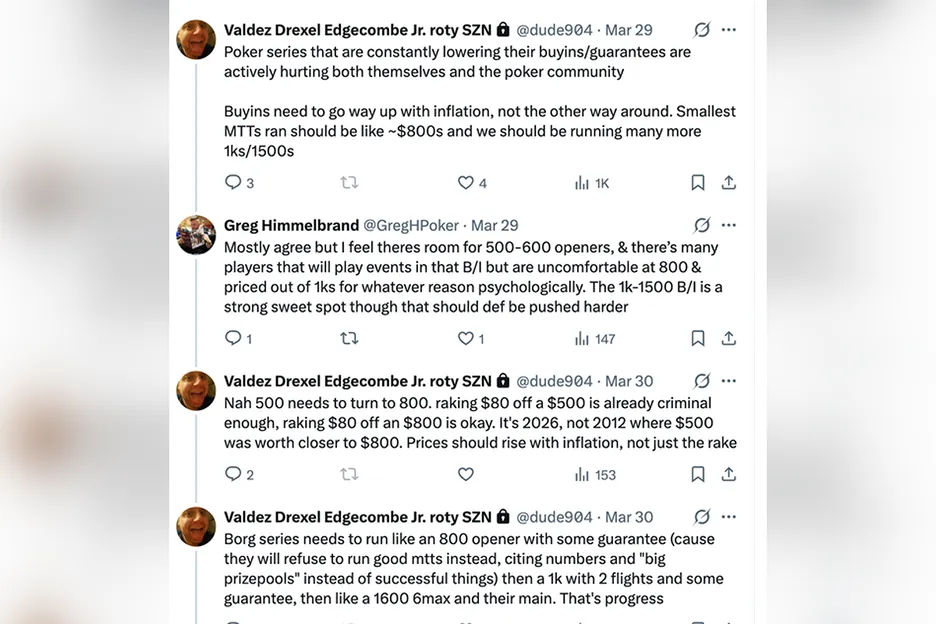
Himmelbrand has seen it time and again over the last ten years. There's a buy-in number that tends to stop their participation in their tracks.
“When the buy-ins are around the $500 to $600 level it doesn't really make a difference. But once you get to that $800, people kind of notice it a little bit.”
That’s the line where affordability starts to override logic, even if the structure improves for the recreational players.
'That wasn't Joe's point'
McKeehen’s argument is rooted in sustainability: higher buy-ins keep rake percentages reasonable and tournaments beatable. That point may have been lost on the weekend warrior looking for a fun time and a run at a final table's payouts.
Himmelbrand doesn’t disagree with the math, but he sees the initial gut reactions from fellow players both on and off the felt.
“Joe spoke about inflection points. Some of the casual guys couldn't get past the fact that we had a former main event champion who plays some high rollers with $20M+ in earnings saying, ‘Hey, raise the buy-ins.That may be cool for Joe, but I'm a regular guy. I can't afford that.’ But to be clear, that wasn't Joe’s point.”
Greg’s overall conclusion is practical and cuts to the chase.
“I think when an operator is creating a series, it's one part math and one part psychology. You have to gear a series towards your player base. That’s where I diverge from Joe’s thinking. I still think the lower buy-ins do make sense, even if the percentage rake is a little bit higher.”
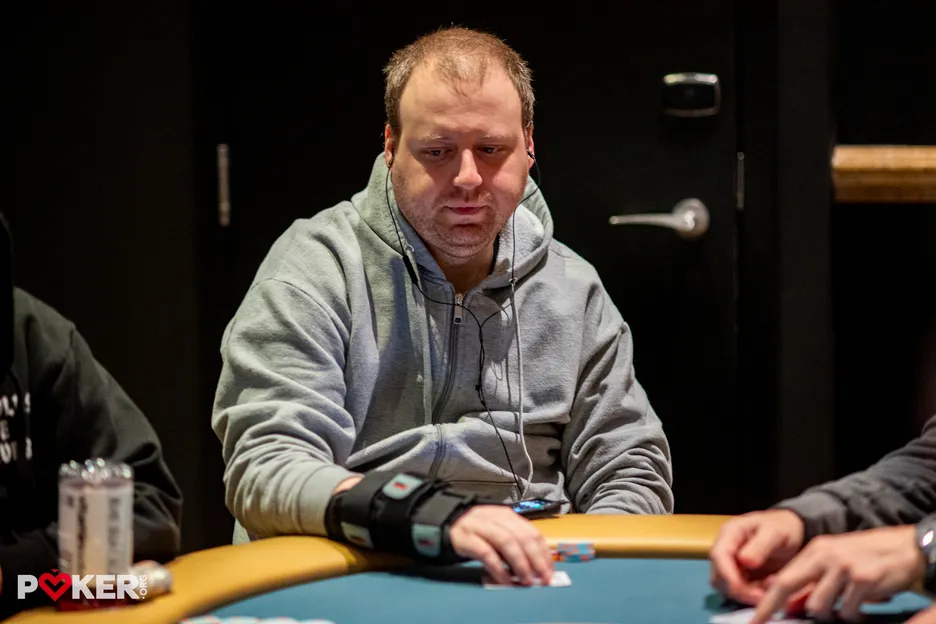
Lower buy-ins can still work
There is a subtle but essential balance where the smaller buy-in events can remain alive and thriving.
"I feel like there is a lot of room for these smaller openers to still exist. I want to say a better way to deal with the rake is basically look at what the industry standards are and then see if someone is out raking their neighbors.”
Players may not optimize nor prioritize for the math of ROI, but they do respond vehemently when something feels off.
So where is the clear path forward for the players and operators to find a balance between rake and buy-ins? Himmelbrand points to an example of how that all can play out to benefit all parties.
"There was a scenario a year and a half ago where a casino ran a series on the Northeast and their rake was higher than everybody else's. It was to the point where people noticed it and they missed the guarantee or two.
"The next series, they announced a reduced rake structure. That was one of the times where what we did worked. We didn't show up for their events as much. They were raking too much, and they were forced to bring it down to the industry standard.”
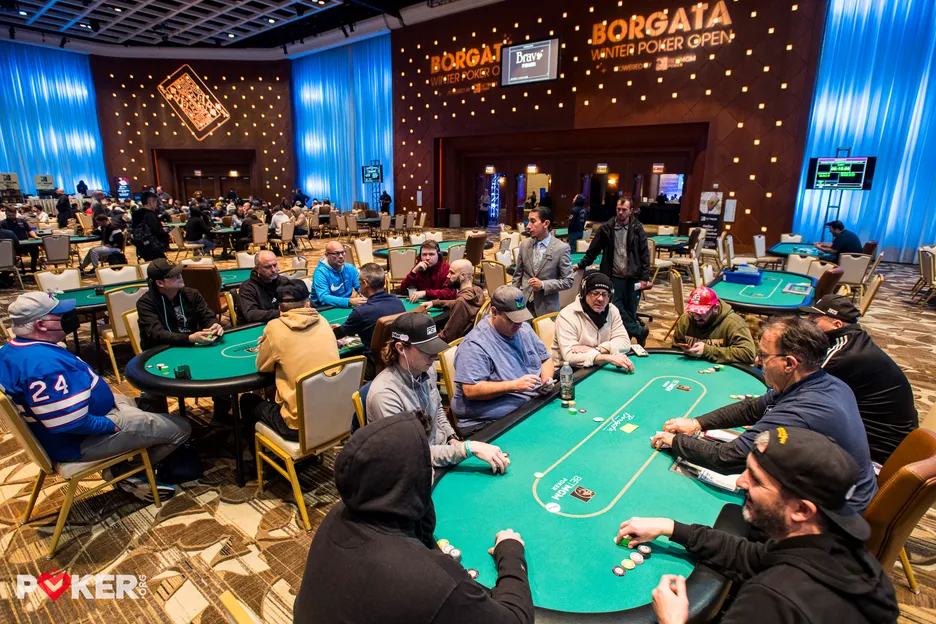
Bottom line: Vote with your wallet
At the end of the day, the balance between rake and buy-ins isn’t theoretical nor a mathematical equation, it’s dictated by a player's behavior.
"We know the venues aren’t putting on charity cases. They need to make a profit. The players totally get it. But it’s very important to just look at the rake numbers and see what’s a fair amount across the board."
Himmelbrand brings it back to the reality he’s seeing play out across the poker circuit, especially on the East Coast. He points to Justin Hammer’s core takeaway in a recent PokerOrg feature to drive the point home.
"Justin said, by definition, it becomes a fair market value if you're willing to pay a higher rake. So, on these lower buy-ins, there is going to be a little bit of a higher percentage rake and that's understandable. But for the mid-stakes and higher stuff, it could be a higher ROI percentage and a lower rake percentage, which is great."
Follow Greg on X.