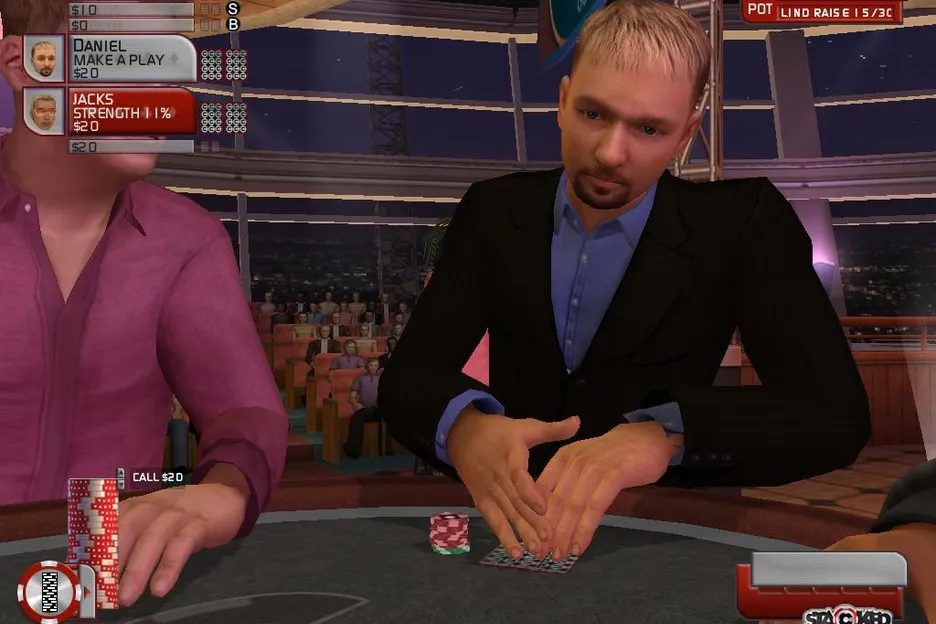


If you didn’t live through it, it’s hard to explain just how deeply poker infiltrated pop culture in the 2000s. Kids today have no idea that Daniel Negreanu was primed to be the John Madden of poker video games.
No, it's true. Nigel Goodman of ESPN The Magazine said so himself when he predicted that Stacked "could be the Madden of poker games." Maxim magazine took it one step further, calling the game "Halo with chips."
The golden age of poker gaming
Poker was everywhere in the decade after Moneymaker won the 2003 Main Event, and video games were no exception. Both the World Series of Poker and World Poker Tour licensed games for consoles in 2005, followed by a WSOP sequel starring Chris Ferguson in WSOP: Battle for the Bracelets in 2008. Howard Lederer even had a game called World Championship Poker 2.
The games were released across all platforms at the time, which included PS2, Xbox, PC, PSP, and GameCube. Add this to the piles of niche freeware games that popped up for PC, and the 2000s were a golden age for poker video gaming.
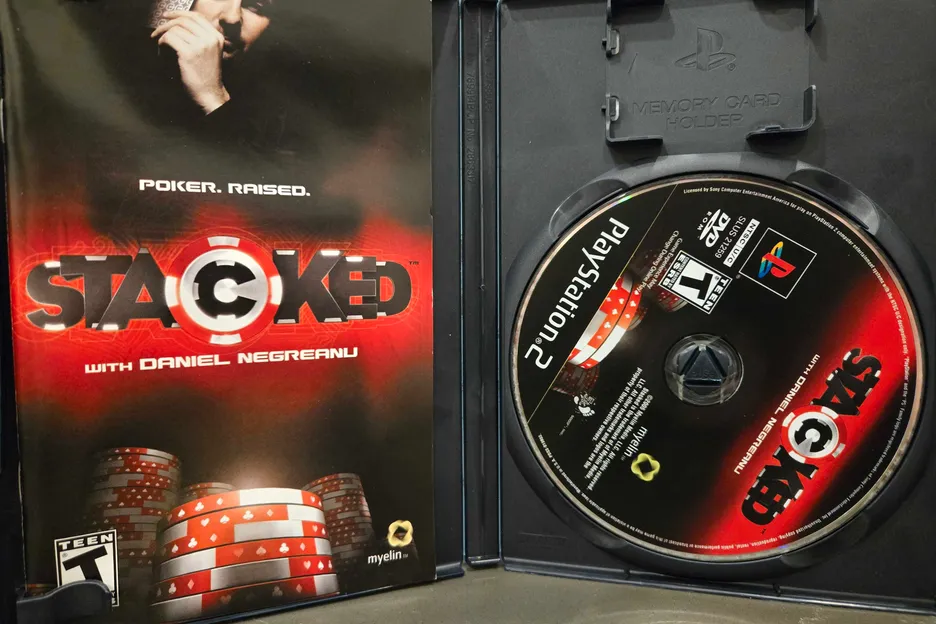
Negreanu's 2006 entry, Stacked, was developed by Eidos Interactive, a major publishing company known for franchises like Tomb Raider, and released in May of 2006. It was a year that may be considered the peak of poker's promotional excess, with a WSOP that included a $10M bonus from Full Tilt, Bodog-branded pillow fights, Jamie Gold's bodyguard, and an appearance by Pamela Anderson to promote her Doyle's Room-affiliated PamelaPoker.com.
In hindsight, a licensed video game was one of the less outrageous ways poker entered the mainstream in 2006.








Stacked: Was it any good?
We happened upon a copy of Stacked for PlayStation 2 at the local retro video game store in the Chinatown area of Las Vegas. It was only $4, so we snapped it up and took her out for a spin.
It’s not the worst poker videogame, but like many of these types of games from this era it suffers from one, crucial flaw: it’s really boring.
There are three venues, seven unlockable pro players and ring games, single-table and multi-table tournaments, all exclusively hold’em but with no-limit and limit versions at every stake level. The character models are also standard for the time, with the type of low-polygon faces that gave kids nightmares in the days before botched AI fingers and spaghetti legs, though they have managed to recreate the look of hideous casino carpets to a nauseating degree of accuracy.
The main problem with these games is that watching a poker hand play out that you’re not involved with is especially dull when the players aren’t human. If you’ve ever watched a game and bemoaned the lack of personality in some real-life players who express no emotion at the tables, yet find their way to the feature table or a seat in a livestream, just imagine the experience when the players are literally mindless automatons. There is the option for network play, but unsurprisingly it’s not available 20 years after the game’s release (and over a decade since the PS2 went out of production).
But this isn't a video game review. There's no way a console poker game from 2006 would still stack up today. However, contemporary reviews paint a clear picture: it was okay.
There are a few positive reviews, mostly in the context of what would be expected from a poker game in 2006. Gameshark gave it a 91, calling it the best Texas Hold'em video game on the market. Gaming Trend scored it 84, citing the quality of its training tools.
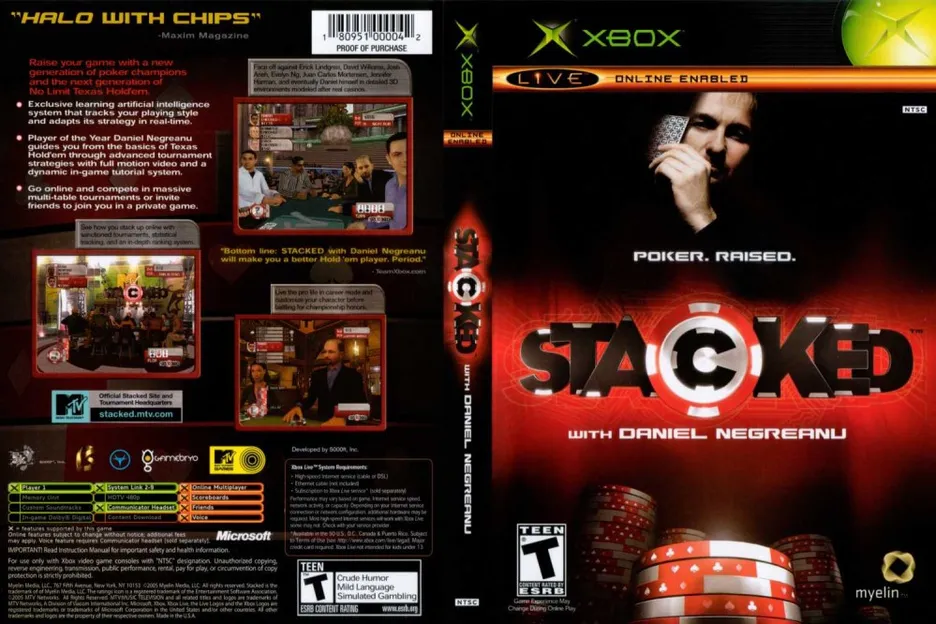
Alex Navarro of Gamespot took a deep dive: "For serious poker enthusiasts, it's even easier to dismiss most of these games, since they all tend to suffer from the same silly issues. The presentation always sucks, the opponent artificial intelligence is frequently exploitable, the list of features is never deep enough, and so on and so forth."
Navarro set the game apart from thrown-together poker games of the era. "Stacked takes a laserlike focus to the game of Texas hold 'em, exclusively building its multifaceted artificial-intelligence routines around the workings of that specific variation of the game and then building a video game around it that functions pretty well as a learning tool for would-be hold 'em players. By no means is the system perfect, but compared with the dregs of what else is out there, Stacked stands out as the most engaging and smartest game of poker currently available."
IGN's Chris Roper was less enthusiastic, scoring it a 4.7/10 while saying the "most-hyped" poker game was a letdown. A lot of the game's long-delayed anticipation was built around its advanced use of the Poki engine, a poker AI developed at the University of Alberta. The game's AI, says Roper, was a disappointment.
"On one of the most extreme occasions, we managed to get the game stuck going all in every hand by first doing so ourselves about five or six hands in a row, and then subsequently folding every hand thereafter. At least one player at the table would then push in all of their chips every round following this until we finally checked the big blind about 10 minutes later."
Poker training on your PS2
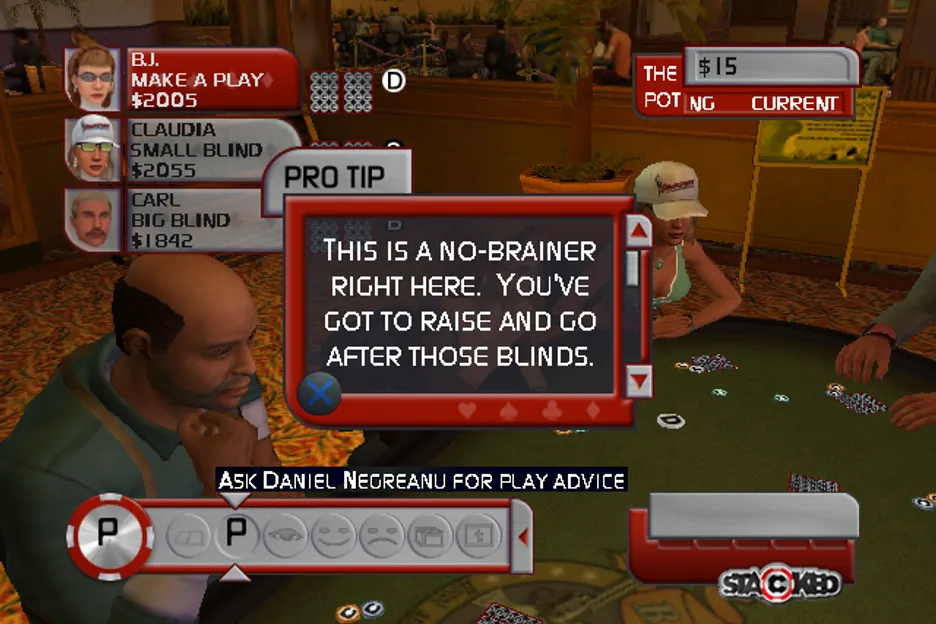
Everything is rich and in full color, including the patented frosted tips of Negreanu. The game also features players like Carlos Mortensen, Erick Lindgren, and Evelyn Ng, along with an online multiplayer mode and a tie-in with MTV's Stacked. The big draw, however, is the Stacked Poker School, hosted by Negreanu himself. The seven-time champion teaches the basics in a series of tips and videos that accompany Career Mode, which allowed players to use a feature called Ask Daniel. The instruction booklet is dense with information, including the rules of poker and an extensive chart of probabilities.
Reviewers tout the game as a solid training tool for beginners, since there wasn't a ready AI equivalent for learning at the time. It would have had trouble catching on with seasoned poker players, who could find play money games on a number of internet poker sites at the time. It's a unique but unplayable time capsule for both the 2000s poker craze and the expansion of console video gaming.
Poker game development would continue into the next decade with Full House Poker, which would eventually spawn a free-to-play sequel with WSOP branding. Poker Night at the Inventory and Poker Night 2 were popular in a more conversational, character-based game. Prominence Poker was released in 2016, and you can still play it online. Ultimately, it is difficult for poker to make the leap to gaming, considering how easy it is to play a much more efficient and satisfying version with online poker platforms. Poker just isn't enough to justify an entire video game, but it's a perfect fit as a side quest activity in a role-playing game. For this reason, Red Dead Redemption 2 is still the best to ever do it.


