

Brad Willis asked some of us poker boomers (his phrase, not mine) to reflect on the last 20+ years since poker's Big Bang, and opine on whether the game has gotten better.
So far, the perspectives he's gotten have come from people who were at the WSOP during those go-go years. Hey, injecting the WSOP with tens of millions of dollars in online money and an army of 22-year-old boys inevitably produced some amazing stories. For better or worse, I wasn't there for most of those adventures.
That's because I was too busy helping run the biggest poker site in the world. So I have relatively few tales involving shark lagoons and gym bags stuffed full of €500 notes.
But I do have a pretty good perspective on where poker is now, compared to the boom days. And I definitely have thoughts about if and how it's improved.
The cheating and scams have moved around
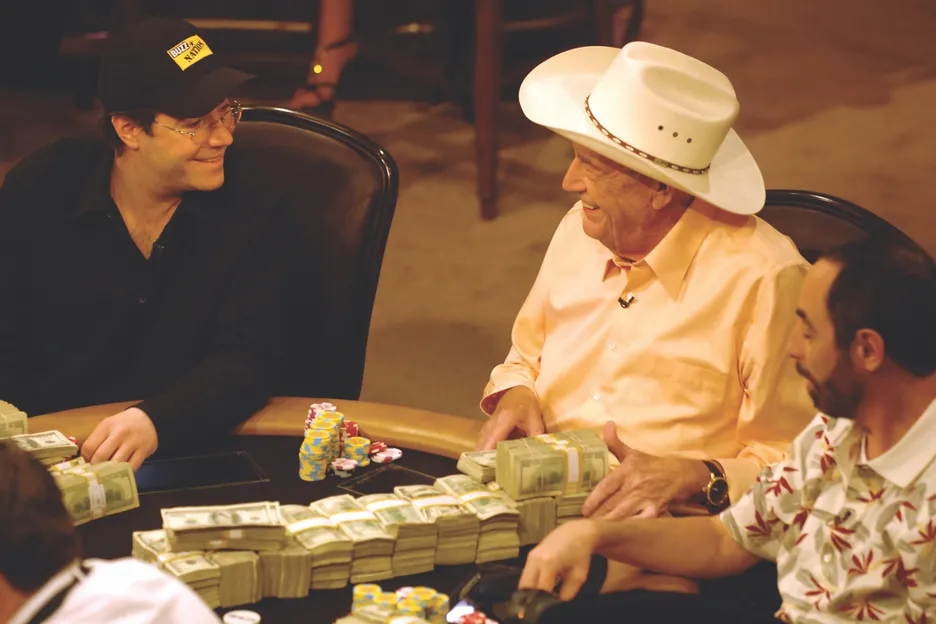
Let's be clear. The old days of poker, pre-Moneymaker and before the TV cameras, were not pretty. Many of the names that we revere, names that are enshrined in the Hall of Fame, those guys were straight-up cheaters and thieves. There was damn little money in poker – people who made their living in the game followed Canada Bill Jones's axiom that, "It's immoral to let a sucker keep his money."
Pre-online poker, live poker is all there was, and tournaments played a much smaller role in the poker ecosystem (Chris Moneymaker won his Main Event bracelet in a field of 839 players). Live cash was all they had, so that's where the cheaters worked. Collusion via signaling, marked cards, mechanic dealers, coolers (the real kind), whatever it took. Casino poker rooms, including some managed by the aforementioned legends, were infamous for raking as much money as the dealer could slip from the pot without getting caught.
Of course, once online poker exploded, all that stuff was penny ante. The cheaters logged in along with everybody else, and it was the Wild West on steroids. Multi-accounting, collusion, chip dumping, account purchasing, credit card fraud, transfer scams, and who knows what else. On the other side of the server, we had Absolute Poker, Ultimate Bet, Lock Poker, and the biggest smoking crater in the ground, Full Tilt Poker.
Since UIGEA and Black Friday, we're in a post-apocalyptic landscape, with civilized outcroppings in a handful of regulated states. Gray market sites and 'app games' have proliferated. Security is minimal, if it exists at all, and the app games are a nightmare of shadowy 'agents' moving money around (and sometimes disappearing with it). On the live cash side, private games have taken over the medium-high stakes market. If you're in a hotel room, an office complex, or somebody's house, all bets are off.
So right now the safest place to play poker is in a public card room or a regulated online poker site. If you stick to those, you're much safer and more secure than you would have been in even casino poker rooms 25 or 30 years ago.
I'm not sure it's better – just different.










Training is way better, some players are way better
It's no secret that the quality of poker training has increased by orders of magnitude since the boom years. I won't go into that subject – consider it settled fact.
But here's a point that a lot of people miss: it is true that the top 20% of players in 2026 would destroy the top 20% of players from 2005. But the bottom 60% of players in 2026 would basically break even against the bottom 60% of players in 2005.
As Carlos Welch likes to put it, "Most poker players are still in 2009." Oh, the 2026 crowd throws around phrases such as 'Polar' and 'Balanced.' But mostly they're just parroting things they've heard or seen on YouTube – they have no idea what those words really mean, or how to apply them.
The great majority of poker players are just as bad now as they were 20 years ago.
Therefore, poker is way better. Why? Because it's much easier to truly improve at the game than it used to be. Training is more efficient, better organized, and more accurate. But unless you're choosing to pick top-20% competition, your opponents are still awful. If you go sit the $10/$25 NLH game at MGM National Harbor, Scott Seiver's $1k/$2k mixed game at the Bellagio, or some $50k Triton tournament, you'll encounter a quality of play that simply didn't exist in 2004. But you're not sitting those games, and if you are, you already know all this.
If you are playing in 99.9% of public poker room games across the US, 80% of the players are no better than they were in 2006. Which means that with a reasonable amount of study and discipline, you can have a much bigger edge on the field than you'd have had those 20 years ago.

We are a kinder, gentler community
I'm ending with the improvement I consider most important. That might seem odd since I just wrote above, "It's a lot easier to make money at poker." But most poker players are not profitable – they come to the table for fun and recreation.
Which means that a safe and welcoming environment is the soil that poker needs to thrive and grow.
The poker environment, the atmosphere in which we all played 25 or 35 years ago, was toxic. There's no other word.
Racist, homophobic, xenophobic, and similarly egregious speech was standard, and accepted. I reserved 'misogynistic' for its own sentence because that was, if possible, far worse. Sexual innuendo and harassment of female players and dealers was the norm, not the exception. Players berated dealers and staff, sometimes escalating to physical assault. And they got away with it.
We've come a long way since then. That's not to say we don't have a long way to go. People Men still get away with language that would have serious consequences in the real world. But as improbable as it might seem sometimes, things have improved a lot. I've been sitting at public poker tables since the mid-1980s. The things I heard and saw 30 or 40 years ago would make your hair curl today.
Poker's boom years played a vital role in making the game safer and more inviting to all. Operators realized that if they wanted to grow and get more players into seats, they had to make those people feel welcome and comfortable. At least a few of them realized that one obnoxious jerk could chase away half a dozen other customers. The TDA, bless their hearts, put in black and white that tournament players had to behave like civilized humans. Finally, the broadening of the poker demographic has demanded a higher level of inclusion and tolerance.
Poker is a much bigger tent than it was 20 or 30 years ago.
As far as I'm concerned, that's the only thing that really matters. Are we as a game and community more attractive to a greater portion of the population?
The answer is "Yes," and, "Imagine if..."
We are indisputably a bigger, more inclusive tent, and thank god. But for starters, check out this statistic: 40% of pickleball players are women. What if three or four players at every poker table were women? Imagine the change in vibe. Visualize the size of tournament fields and the explosion of cash games. Hint: 30-40% growth is a reasonable first guess.
We've come a long way, and still have a long growth road ahead. I look forward to walking that road as long as my feet hold out.