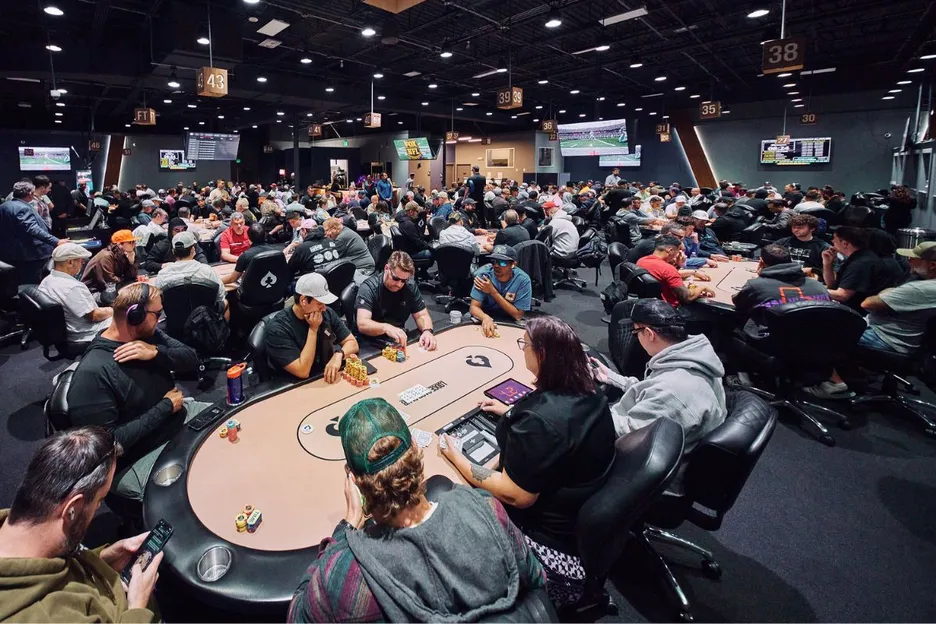


A month ago, poker vlogger KDog said that games in Texas are drying up because of an influx of 'Euros.' These for-profit players are coming in for a few months at a time and grinding long days, perhaps ten hours at a time. The result, he argues, is that game conditions are miserable, nobody's having fun, and all the action is dying. He made a video arguing that such players should be banned from the Texas poker rooms.
Our own Sarah Herring even made an episode of the Showdown on the topic.
My zwei pfennigs
I'll give you the short version now, and you can read further if you wish...
It is absurd to suggest that any player, group of players, or player demographic should be banned from a 'public' poker room.
First, some vocabulary. I'm not comfortable with 'Euros' being a catch-all phrase for for-profit players who come into town, get temporary quarters, and grind full days of work for long periods, perhaps until their tourist visas expire. Let's call them 'For Profit Tourists' ("FPTs").
With that out of the way, there are two prongs to my argument opposing any kind of restriction on FPTs in public poker rooms.








Keeping FPTs out is wildly impractical
Public poker rooms, those licensed by any state regulator, would be on the thinnest of ice trying to ban such players. They wouldn't want the regulatory (and perhaps legal) drama that would come with such actions, so it's a non-starter.
Even 'social clubs' (like The Lodge and Texas Card House) fall under a category of clubs that essentially operate as public accommodations. That is, there's little screening of members, they market themselves broadly to the public, etc. Very specifically, a Texas card club could not reject somebody's membership based on gender, nationality, or race. I'm not a lawyer, but I wouldn't bet on a Texas card club successfully preventing somebody from playing there because they're from Spain and have an 8% 3-bet stat.
Furthermore, once you start down that path, where do you stop? Do you ban FPTs from out-of-state? Outside the metroplex of the club in question? Do you ban only winning players?
This whole idea sounds a lot better in a five-minute video than it does in practice. And that's if you think the idea sounds good at all, which I don't.

Banning FPTs is naked protectionism
This is a cry as old as commerce: "Those people are coming to take our jobs – stop them." And yet the FPTs are doing exactly what every little capitalist has been taught from grade school: study hard, work hard, out-compete the other guys and gals – then you will succeed and flourish.
Protectionism has never worked, because you can't stop innovation, hard work, creativity, persistence, and intelligence. You can try to halt it at this border or that, but it's a futile exercise. All you're doing is holding back the growth and improvement within your own market.
My message to KDog and others: you are not entitled to sole access to a pool of weaker players. That's not how it works. You are entitled only to sit at the table with your buy-in and compete with everybody else. If the FPTs are outplaying you, then study harder, put in more volume, fix your IRL leaks, and get more sleep. Whatever, don't ask the management of the club at which you play to lock the doors and leave you alone with a pool of weaker players. It's a fool's errand, not to mention downright un-American.
What's the solution to the current problem?
At no point have I questioned KDog's assertion that higher-stakes games are bad in Texas right now. I'm not there and don't know. But I've heard from others that some of the higher-stakes games are filled with FPTs. And that's not just Texas – I'm getting the same reports from other major poker markets.
Honestly, I don't know what the solution is, or even that there is one. I was there for the glory days of online poker in the early 2000s, when any half-decent player could print money. After a while, only the very good players made decent money. The wheel continued to grind, and now in 2026, a relative few elite players are making meaningful money at online poker.
Does the live poker movie end the same way, just a few years phase-shifted from the online version? I don't know. There are reasons that live poker may have a longer lifespan than online, but that's beyond the scope of this piece.
I think the best players will continue to make a living at live poker. But the definition and quantity of 'best players' has continually shifted over the years and will continue to do so. How each of us ranks on that spectrum is up to us and how well we compete. Not what passport we carry.


