



'Improve Your Poker Now!' by Topher Goggin and Alexander Fitzgerald is available as an ebook or paperback from D&B Poker.
Earlier this summer, I discussed the importance of battling to the bitter end when short-stacked. Amateur players tend to throw in the towel when things go awry, punting off their final few chips rather than refocusing. In truth, 'miracle' comebacks happen more often than you think. But you have to earn them.
I wrote the first draft of that article during the closing days of the WSOP Main Event. Little did I realize that Michael 'The Grinder' Mizrachi was about to provide a graphic illustration of the point, rallying from 3BB on Day 8 to pull off one of the most memorable victories in WSOP history. Grinder only got a quick shoutout in the story at the time, but his play is worth a closer look.

Into the abyss and back out alive
24 players remained as Day 8 began, with Mizrachi back in the pack, but not desperate. Perhaps getting a little frisky, he open-jammed 19BB with 
 , only to run into
 courtesy of the slightly shorter stack of John Wasnock. The board brought no help, and Grinder was suddenly chopped down to a miniscule 3BB.
What happened over the next forty-five minutes was a masterclass in short-stacked play. Balancing aggression with patience, Grinder not only proved why you should never give up in a poker tourney, he provided a blueprint for how to maximize your chances of coming back from the depths of despair.
Facing 300K/600K/600K blinds, Grinder went to work with his 1.9 million chip stub. Despite running into aces along the way, he calmly rebuilt a 26BB stack of 15.8 million in less than an hour. And we all know what happened from there. (Spoiler alert: He won.)
If you have time, it is worth finding a replay and watching the entire sequence. For now, here are some key lessons that you can remember the next time your circumstances get dire.








Luck is required, but not THAT much luck
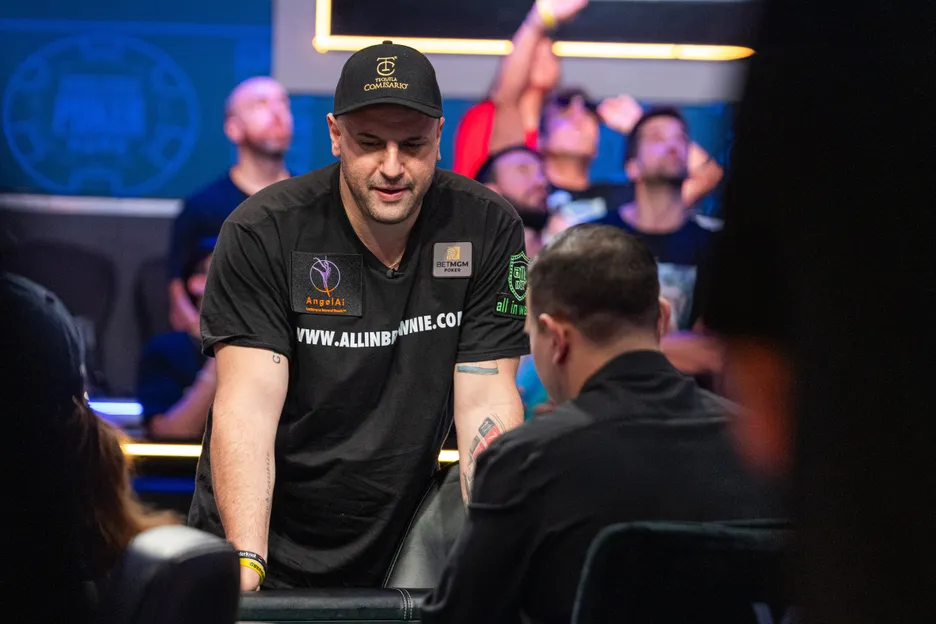
Grinder moved all-in four times during his rally. Only one of those shoves — with A2o from UTG2 — took down the eight-handed pot preflop. The other three times he was put at risk — once as a favorite (AKs vs. ATo), once as an underdog with a decent chance to chop (A6o vs. A7o), and once on the unfavorable side of a coin flip (KJo vs 55). He won all three.
Combining the odds shown on the broadcast when the chips went in (i.e., including card removal), Mizrachi had roughly a 19% chance of surviving all three confrontations. (He was only about 8% to actually win all three outright.) Those aren’t great odds. But they’re also not as terrible as most people might expect from 3BB.
Rallying from a tiny stack is hard, and will never happen without getting lucky. But 19% is roughly the chance of hitting a river flush draw. Comebacks happen. Don’t give up.
Get your chips in first
On all four occasions that Grinder went all-in, he got his chips in first and made the table react to him. He open-shoved all three Ax hands, and rejammed KJo over a cutoff raise.
While he ran into a preflop caller on three out of four occasions, he at least gave himself the chance to take down the pot without a confrontation. This is Short Stacks 101. Even when short, make your opponents wake up with a playable hand before they can push you to a showdown. Play offense whenever possible, and exercise caution before calling off. As my friend Alex Fitzgerald and others say, “Jam light and call tight.”
What you don’t play matters as much as what you do
For most amateur players, this will be the key insight from Grinder’s run. When weak players get whittled down to crumbs, they will often dust off the remainder by chucking their chips in at the first opportunity. Good players stay focused to wrangle as much from their stack as possible.
We can learn as much from the hands Grinder didn’t play as the ones he did. Remember that his comeback took 45 minutes — he didn’t try to do it in five. Though he got a tremendous break to pick up AKs immediately after losing most of his chips, the patience he displayed next was critical to his success.
After the AKs shove boosted his stack to 8.8BB, Mizrachi moved directly into the big blind and faced a min-raise from Tony Gregg in the cutoff. Holding QTo, Mizrachi flatted rather than jamming. He then checked twice after whiffing the flop and turn, and only stabbed for 1.5BB after missing again on the river. When Gregg jammed over the top of that river bet — with slow-played aces — Mizrachi got away in a spot where he easily could have busted by being overly aggressive.
Despite avoiding disaster, that loss could still have taken the wind out of Grinder’s sails. Just one hand after doubling up, he was back down to 2.6 million (4.3BB) and facing the small blind. It was another opportunity to panic, but Mizrachi kept his wits.
That meant folding preflop, multiple times, even with a tiny stack. This included chucking Q2o in an unopened pot while UTG2. With fewer than 4BB, many players would have jammed at the first sight of a face card. Grinder went the other way, folding without much thought.
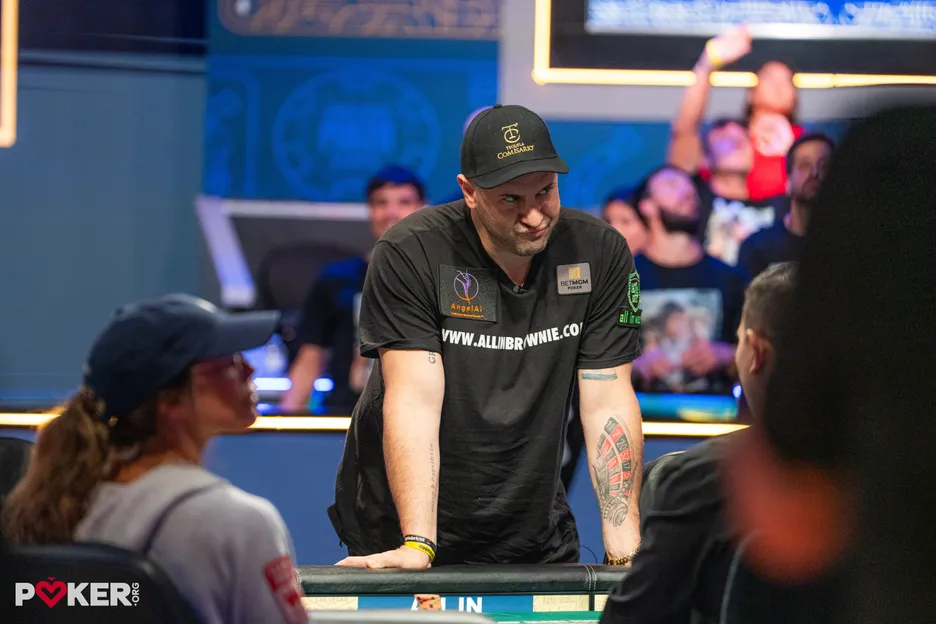
Mizrachi completes his comeback
Checking a push-fold chart shows he was right. His patience paid immediate dividends, as he picked up a more promising  in the next hand. Even though his shove was met by a call from Braxton Dunaway’s chop-worthy
 , Mizrachi got the last laugh when the board ran out with four spades to give him a winning flush.
A final illustration came a round later. After stealing the blinds with A2o, Grinder had clawed back to nearly 12BB. One hand later, he sat UTG1 and faced an under-the-gun open from Daehyung Lee. Mizrachi’s A7o went straight into the muck, avoiding a confrontation that would have found him well behind Lee’s pocket eights.
It is instructive to contrast that fold with the move Mizrachi made shortly thereafter, rejamming KJo from the small blind over a cutoff open from Dunaway. Positional factors made this play much more favorable. In the A7o hand, Grinder was UTG1, facing a strong UTG range while the rest of the table still lurked behind him. Here he faced a weaker range from the cutoff, and the only other remaining player was Lautaro Guerra in the big blind.
The combination of range-driven fold equity and two Broadway cards in a (likely) heads-up pot tipped the scales to jamming. While Grinder was probably not thrilled to get called, Dunaway turned over pocket fives for a flip. Another four-flush board went Grinder’s way, and the return to a healthy stack was complete — now with more chips than where he had started the day.
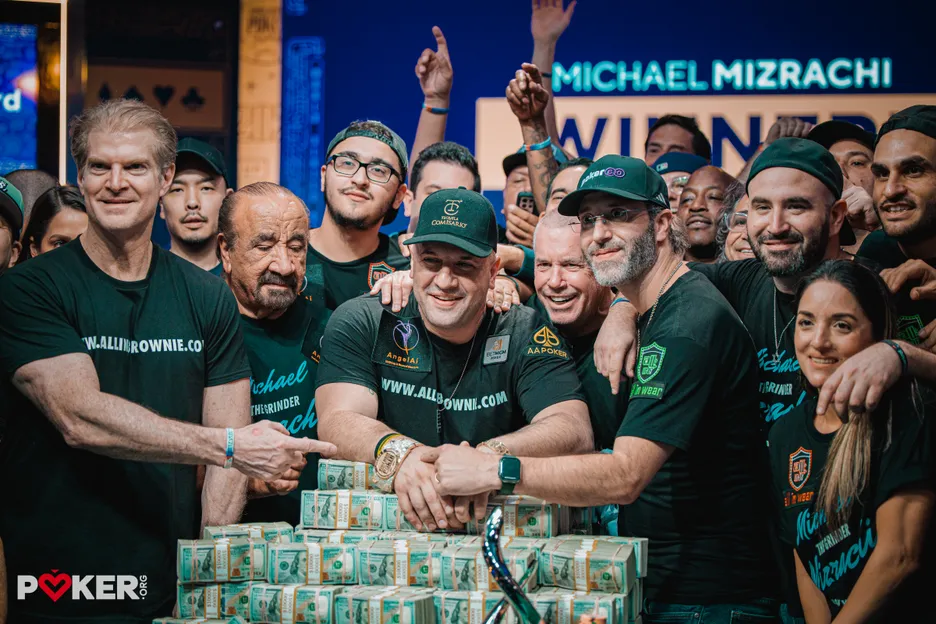
Making your own luck
Without question, Grinder was blessed with good fortune on the comeback trail. Change just one of those runouts and we’re looking at a different Main Event champ. But luck is mandatory in tournament poker.
In some ways, large-field MTTs are like giant raffles — the best players just have more tickets in the hopper. That edge compounds over time, tilting the long-run odds in their favor.
After falling to 3BB, even a player as brilliant as Michael Mizrachi could never guarantee a Copperfield-esque escape. Grinder’s genius was in giving himself the best chance to have the variance gods tip the scales in his favor. And tip they did. The rest is history.


