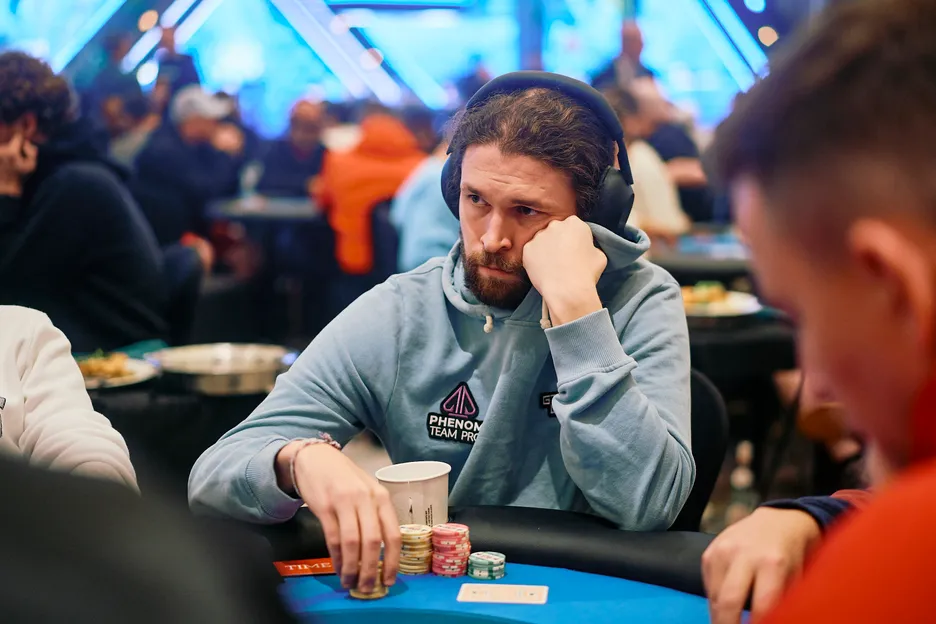


Ben Heath is one of the most accomplished high-stakes tournament players of the last decade.
And, with six Triton events and a $25K Super Main Event featuring a $60 million guarantee and unlimited reentries on the slate, he’s right at home at WSOP Paradise.
He’s got history. He won the single biggest cash of his $35 million+ career in Paradise last year when he placed second in the $500K buy-in Triton Million for $8.16 million.
Heath secured his first cash of the 2025 Paradise series in the $100K Triton Main Event, picking up a ‘modest’ $232,000.
Then he set his sights on the $25K Super Main Event.
“They got me four times already,” Heath says with a small laugh, referring to his early exits from the Super Main Event across the first two starting flights. “The structure is kind of crazy… I could easily be in for 10 bullets.”
He bought back in on Day 1C and found a 2.4 million bag, good for 80 big blinds on Day 2B. Unfortunately, he couldn’t turn that into a cash.
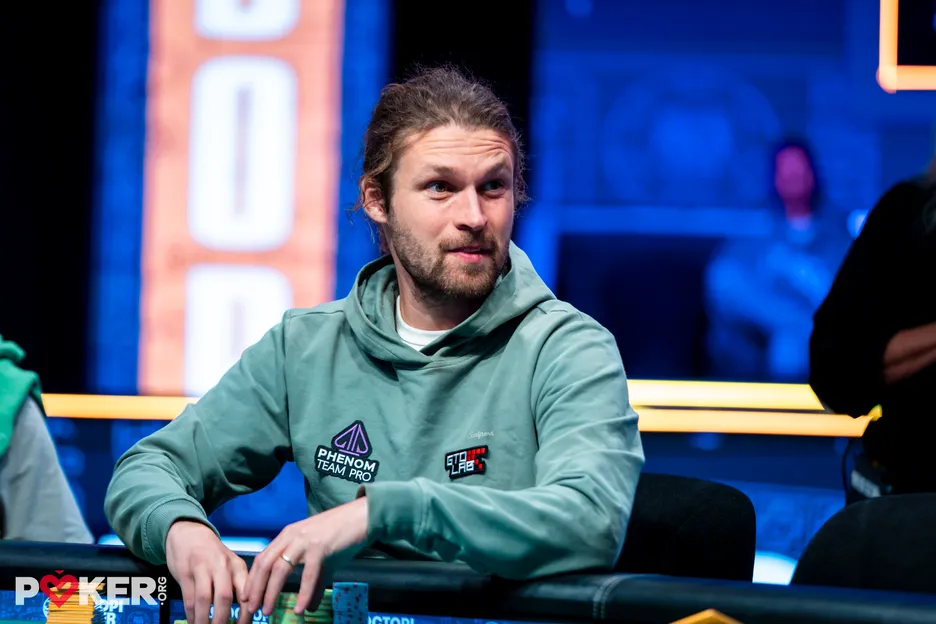
From Triton high rollers to the large-field Super Main
Adjusting on the fly to changing circumstances is a skill all the best tournament players have. Heath shared what it was like running deep in the smaller-field $100K Triton Main Event and then jumping into the massive Super Main.
“The first bullet was a little weird,” he admitted. “There’s an adrenaline dump after going deep in something like that. But it’s still a $25K with a lot of strong players. It’s not like jumping from a $250K to a $1K at the World Series – it’s still the same world.”
Heath’s path to becoming a near-exclusive high-roller wasn’t driven by a single decision. Instead, it unfolded gradually, shaped by lifestyle, relationships, and a shifting view of what poker should look like for him.
“I shifted to mostly high rollers around COVID,” he said. “Before that, I was playing everything and traveling all the time.”
Then came a series of personal changes. Heath met his wife in Barcelona in 2019, and the two spent the COVID lockdown together. During that period, Heath studied heavily and began reevaluating how much of the year he wanted to spend on the road.
“After that, I just started playing higher and not wanting to travel as much,” he explained. “So I only went to stops that really made sense, and those tend to be $25Ks and above. It wasn’t really planned. It just happened naturally over a couple of years.”
That shift brought more than just bigger buy-ins. It required a fundamentally different approach to studying and preparation.









Studying people, not populations
In large-field tournaments, Heath says preparation often revolves around population tendencies and theoretical baselines. High rollers, by contrast, are intensely personal.
“When you’re playing Triton, you’re not looking for population exploits,” he said. “You’re playing the same 50 people over and over. So the question isn’t ‘what are people doing?’; it’s ‘what is this guy doing?’”
That specificity shapes everything, from reviewing hand histories to watching livestreams. With tools like the Triton app, Heath consumes everything available.
“I look at all the big hands when I’m playing,” he said. “And I watch the streams. You get a pretty good sense of what people are doing, even if you’re not formally profiling one person.”
The payout structures also demand specialized preparation. High-roller events often pay as few as 12 to 20 players, a stark contrast to large-field tournaments where hundreds make the money.
“You know exactly what those payout structures look like,” Heath says. “A lot of people study generic spots, but when you’re always playing 16 paid, it’s very specific.”

Obsession over talent
When asked what separates elite high-roller regulars from strong mid-stakes players, Heath doesn’t point to a single technical breakthrough.
“There’s always some luck involved,” he said. “Getting a big score, meeting the right people, and finding a group you improve with.”
But beyond that, he keeps coming back to one word: obsession.
“Most of the people I know at this level do this seven days a week,” he said. “There’s no work-life balance. If someone is doing it four or five days a week, and someone else is doing it six or seven, the difference compounds over ten years.”
Heath explained that natural talent is hard to define. But given similar ability, effort over time is decisive. “That’s how you get there.”
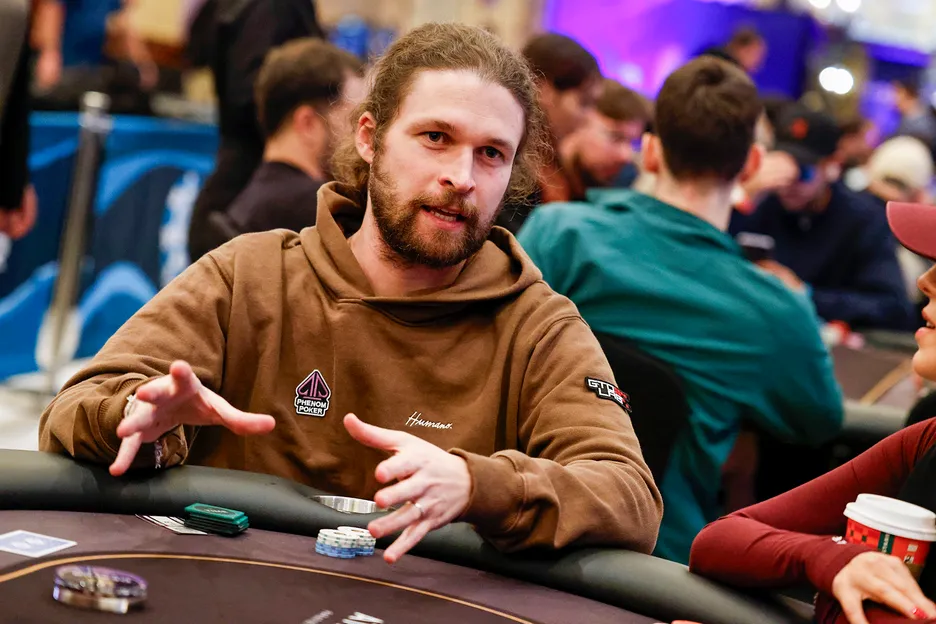
No results-based goals
Despite his résumé, Heath doesn’t measure success through titles or earnings milestones. In fact, he avoids poker goals altogether, at least the kind most players talk about.
“There’s just too much variance,” he says. “These days I might play 100 to 150 bullets a year. You can easily have a five-year bad run, especially with bigger fields.”
Rather than fixating on outcomes, Heath focuses on process. “My goal is just to work hard and enjoy it,” he said. “If I stop enjoying it, or if I don’t have the motivation to work as hard as I need to, then I’ll stop.”
That mindset extends to how he views accolades like WSOP bracelets. “You don’t get to control that,” he said. “You can control how many events you play and whether you’re bringing your A or B game. The goal should never be the result.”
Tournament poker creates extreme emotional swings. Heath is acutely aware of how difficult it can be to transition from that environment back into normal life.
“I like to stop in Miami for a couple days on the way home,” he said. “After these trips, you’re exhausted. Sometimes you’ve won a lot. Often you’ve lost a lot. And you have that adrenaline dump.”
Those buffer days serve a purpose. “You don’t want to go straight from losing $75K in a day into a family holiday,” he shared. “You don’t want to be emotionally switched off when you’re with family.”

Building something different with Phenom
Away from the live circuit, Heath has taken on a different role as an ambassador for Phenom Poker, a community-focused online poker platform built around a crypto infrastructure.
Unlike many sponsorships, this one started with Heath reaching out. “I really liked the idea,” he said. “Trying to do things differently, community-based, rather than feeling like the site is against the player.”
Heath had largely stepped away from online poker after COVID, citing concerns about integrity and quality of games. Phenom’s model, where players retain control of their funds via personal wallets, stood out.
“Even if Phenom had issues, they can’t take your money,” he explained. “Your funds aren’t controlled by the site.”
As for crypto itself, Heath acknowledges the skepticism but sees it as increasingly unavoidable in modern poker. “It looks intimidating at first,” he said, “but once you learn it, it’s simple. And it’s already embedded in mid- and high-stakes poker.”
For all his success, Heath remains grounded in the reality of tournament poker: you show up, you work, and you accept what happens next. Whether it’s a Triton final table or a multi-thousand-player field in the Bahamas, the approach doesn’t change.
He's not chasing a finish line. He's obsessed. For now, he loves being obsessed, and that keeps him coming back.


