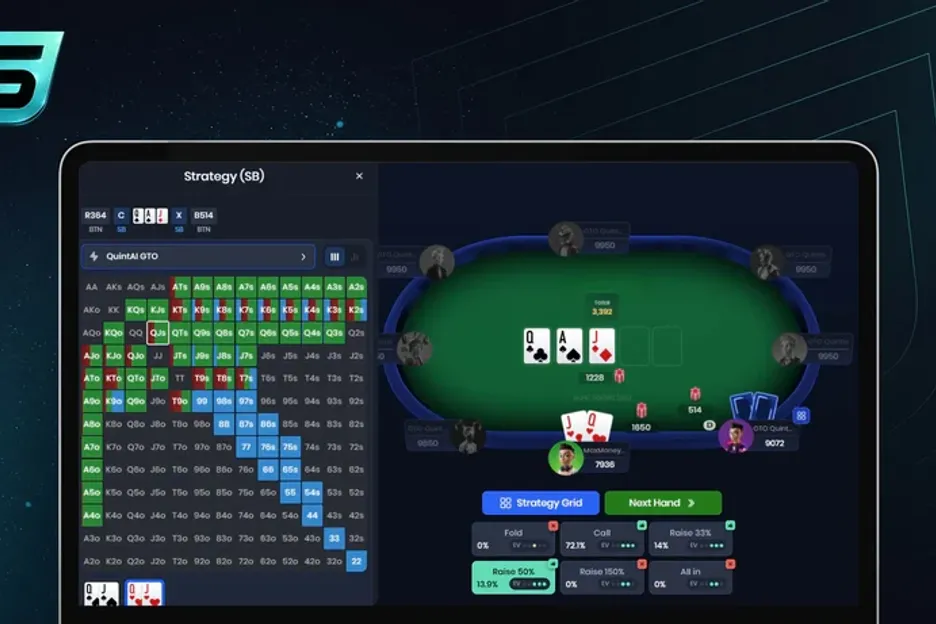


In July, PokerOrg introduced readers to QuintAce – a new free-to-use poker training tool that combines a solver engine with a layer of coaching to help users 'understand the why' behind each output.
PokerOrg spoke with Dr. Thanh Tran, founder and CEO at QuintAce, about the platform’s origins, the overall mission of the company, and how it differs from traditional poker coaching sites.
And, perhaps most intriguingly, how it's using AI to help users better get to grips with the different players and styles they'll find out there in the real world.
The Chess.com of poker?
“The mission for QuintAce is to make poker accessible to everyone by building something that is about playing and learning,” Tran tells us. “The mission is to build something like Chess.com for poker – a better version.”
When Tran and the team at QuintAce looked at the poker market as a whole, they wanted to find the intersection between social poker sites like Zynga Poker or the free-to-play WSOP Poker app and the poker coaching ecosystem.
The problem they identified with the former is that the games aren’t competitive – players tend to just splash around with play chips and the sites are only interested in monetizing users.
As Tran says plainly, “This is not an intellectual game and there’s no learning.”
And so they were faced with a question: “How can we make it good for both the social play, the casual users, as well as providing the features for them to learn?”
It was this question that shaped the approach QuintAce took to its product.









'If you can't quantify progress, why even bother studying?'
When users first come aboard, they are assigned a ranking – similar to the Elo rating system in chess. As they play against the QuintAce AI and learn, they rise through the ranks.
“It’s a lot more elaborate because chess is quite different from poker,” Tran explains. “The first challenge I wanted the team to solve is how to quantify progress."
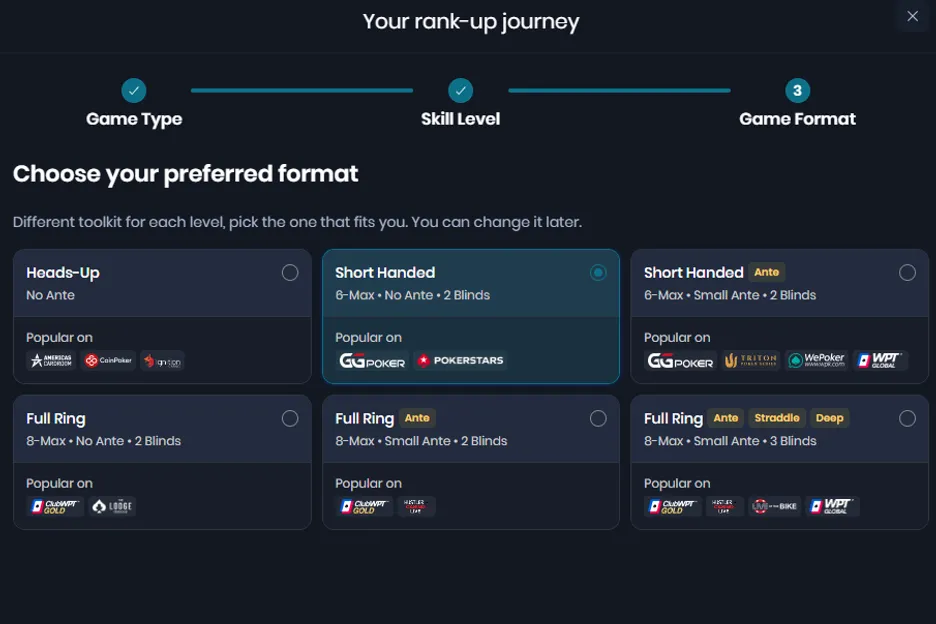
“How do you make sure that when people play and learn, they know that they’re learning? If you use other learning platforms, you wouldn’t know. You can do GTO drills and study GTO charts, but all these students ask the same question: 'how do I know I’m getting better in real world poker?'
“If you can’t quantify progress, why even bother studying?” he asks.
That’s the gap in the market that Tran and his team want to fill.
“That’s very important to me and I think there’s no such thing in the poker world right now,” he says.
Generating the ranking
As the first training platform to offer a comprehensive ranking system that provides poker players with a way to track progress, QuintAce is uniquely positioned amidst the saturated landscape of the poker coaching industry.
The specifics of QuintAce’s machine learning technology – and how they compute each player’s ranking – is one of the keys to its system.
In chess, a player’s Elo rating improves by winning against top opponents. The number one metric of scoring is the actual result of the match. With its extreme levels of luck-based variance, generating a similar ranking system for poker players is a far more complex proposition.

“That doesn’t work in poker because the results have high variance – just because you win this hand, this session, this year, that doesn’t mean you are actually good at poker,” Tran asserts. “With poker, we don’t just look at win rates. We look at individual decisions and score them.
“That’s level one: the decision scoring and comparing your decisions versus an 'optimal' baseline,” he continues.
Still, that’s not enough. As Tran explains, deviations from baseline – both good and bad – are part of the equation as well.
QuintAce’s partnership with various online poker platforms allows them access to anonymized data on player tendencies and trends. With the population data on hand, it can train its machine learning algorithms to score deviations from the mean.
“So, the second level is how to distinguish between good deviations and bad deviations, and you can only do that when you take real population data into account,” Tran says. “You can look at each decision and see how much you gain or lose when you make deviations compared to real world data.”
That’s the second level of QuintAce’s ranking system – and there are others that follow.
“We take all of these signals into account and build the machine learning function to predict win rate,” Tran concludes. “That’s how QuintAce’s ranking works.”
Poker in the real world
The key aspect of QuintAce’s product – the one that perhaps distinguishes it most from competitors – is that it prepares its users how to play poker in a variety of formats and game types in a real world environment.
If you’ve hung around a card room or a tournament series for any length of time, you know that not everyone who sits down at the table is a GTO-studied robot.
“When you want to learn poker, you want to learn about real poker,” Tran tells us. “When you go to QuintAce, you see the tagline: 'GTO. Off-GTO. Exploits. Real Poker.'
“Basically, how to go from GTO to off-GTO, beyond GTO to exploitation, and really deal with the real poker game.”
QuintAce provides students with the baseline knowledge that they need to understand GTO, but it also readies them for situations when they are forced to deviate from that baseline in response to certain player types.
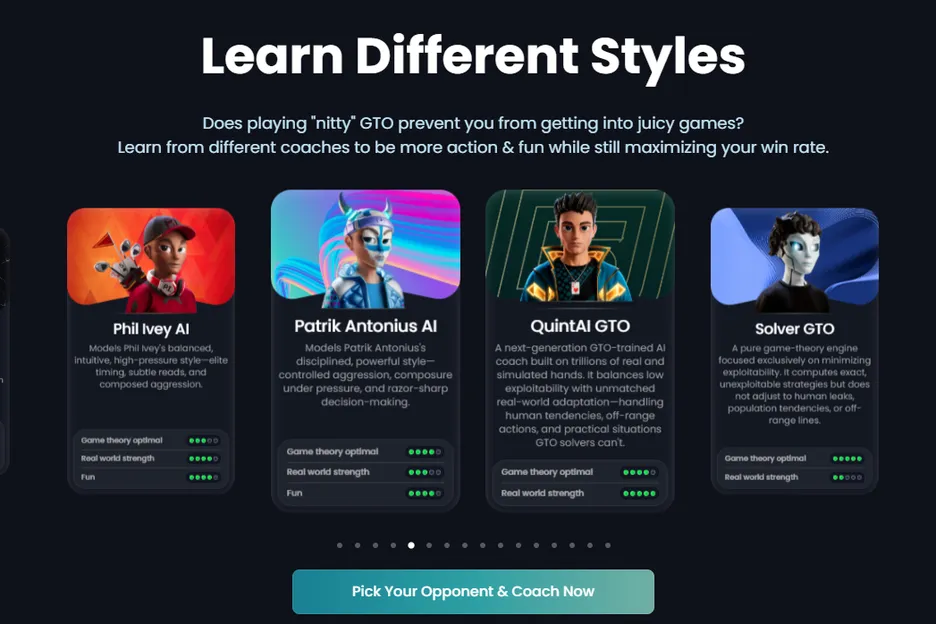
“We can train models, different AIs that emulate real world profiles,” Tran says.
In its beta testing phase, the platform has six base models: 'QuintAI GTO', 'The Closer', 'The Raiser', 'The Caller', 'The Folder', and 'The Maniac'. Each profile reinforces different ideas about how to approach the game – and allows users to test their skills against a variety of playstyles.
Coming soon to QuintAce
Soon, QuintAce will undergo a site revamp.
“We want the beginners and casuals to have a completely different experience from the people who want to learn GTO, which is the more commercial solver experience, and the 'beyond GTO' aspect,” Tran explains.
“It’s going to be three different experiences. Beyond GTO is going to be all about how to play real poker with exploits. GTO will be more like a conventional solver to teach you equilibrium strategy. And then the beginner, casual experience is really about having fun and playing with your friends while you learn a little bit.”
So, whether you’re a newbie to the game looking to pick up the basics or a seasoned wizard of the felt hoping to sharpen your skills against certain player profiles, QuintAce has something to offer – and a lot to teach.
Find out more at QuintAce.