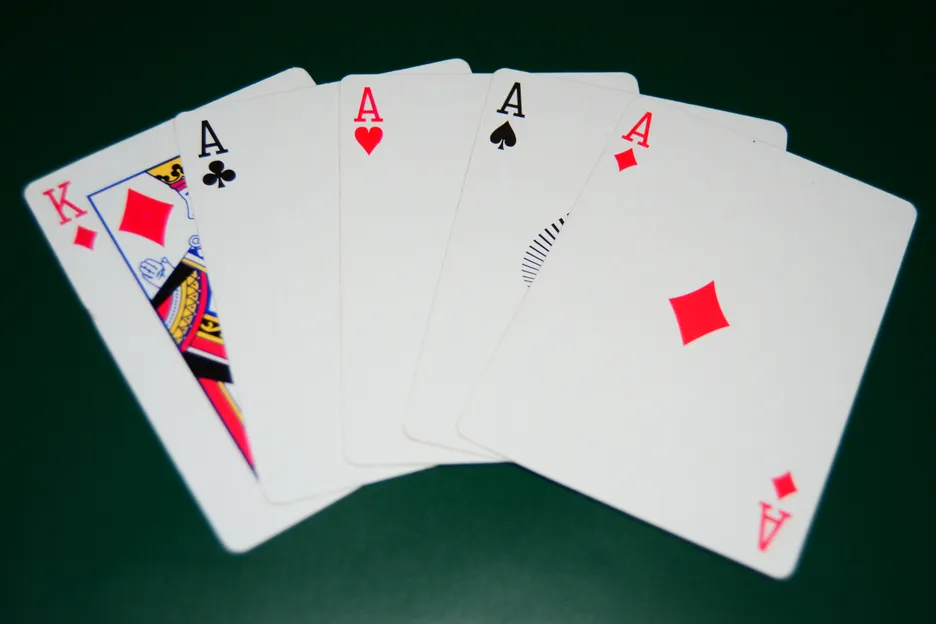


Four of a kind in poker is a hand which contains four cards of the same rank.
As poker hands traditionally comprise five cards, a four of a kind also contains one additional card of another rank, known as a side card or a ‘kicker’.
An example would be 


 .
.
This applies in any poker game in which a five-card hand is made, including Texas hold’em, Omaha and stud.
With the exception of lowball games — where the goal is to make the ‘worst’ possible poker hand — four of a kind is one of the very strongest hands it is possible to make.
Four of a kind is also known as quads: four cards of the same rank plus a side card. It ranks below a straight flush and above a full house.
A quick example
The higher the rank of the four of a kind, the stronger the hand.
Therefore 


 beats
beats  .
.
Does four of a kind beat a full house?
Yes, four of a kind beats a full house, as well as every poker hand below that in the hierarchy of poker hands.
Here’s where four of a kind sits in the full list of poker hand rankings, with the very best hand at the top and the worst hand at the bottom.
Full hand ranking list
- Royal flush, e.g.


- Straight flush, e.g.


- Four of a kind, e.g.


- Full house, e.g.


- Flush, e.g.


- Straight, e.g.


- Three-of-a-kind, e.g.
- Two pair, e.g.


- One pair, e.g.
- High card, e.g.


Why does four of a kind beat a full house but not a straight flush?
The strength of a poker hand relates directly to how difficult, or improbable, it is to make the hand. The more common the hand, the lower it ranks, while rare hands are considered much stronger.
Four of a kind is a rare and difficult hand to make, and in a game of Texas hold’em, for example, you may go a long time without making quads. A full house is more common, and statistically more likely, so ranks below four of a kind.
A straight flush, consisting of five cards in sequence, all of the same suit, is an even rarer sight at the poker tables, and so ranks above four of a kind in the poker hand rankings.
| Hand | Beats | Loses to |
|---|---|---|
| Four of a kind | Full house | Royal flush |
| Flush | Straight flush | |
| Straight | ||
| Three of a kind | ||
| Two pair | ||
| One pair | ||
| High card |
Four of a kind tie-breakers (who wins when both have quads?)
Four of a kind is a rare hand to encounter in a poker game, and more than one player making quads in the same hand may seem highly improbable, but it does happen.
In flop games like Texas hold’em, where players may share up to five communal cards, it’s even possible for everyone in the hand to make quads if four cards of the same rank were to be dealt on the board.
So how do you settle a tie when more than one player has quads?
The primary rule: The higher quads wins
Where multiple players have four of a kind consisting of different ranks, for example one player has quad queens and another has quad kings, the higher ranked quads wins.
Just like how a pair of aces beats a pair of kings — because it is a pair of a higher rank — quads kings beats quad queens.
But what if players have the same four of a kind? For example, if quads are dealt on the board? As with many other poker hands, that’s where the kicker plays.
Kicker logic
The kicker, or side card, is the fifth card in a hand which contains four of a kind. And if both players have the same quads, the player with the highest kicker wins the pot. Aces are high, and deuces low.
If players have identical five card hands, sharing the same quads and the same kicker, the pot is split.

Examples
Let’s run through a few examples. Can you tell which player wins in each hand?
Example 1
Player A:
Player B:
Board: 

Winner: Player B has made quad aces, which beats Player A’s quad eights, so wins the pot.
Example 2
Player A:
Player B:
Board: 


Winner: While both players have made quad fives, Player A has a queen kicker, which is higher than Player B’s jack kicker, so wins the pot.
Example 3
Player A:
Player B: 
Board: 
Winner: Each player’s best five-card hand is quad nines with an ace kicker, so the pot is split between them. The fact that Player A has two aces is not important. Remember: what counts is your best five-card hand.
Quads — What are the odds?
Making four of a kind is obviously a rare occurrence, especially in a game like Texas hold’em or 7-card stud.
There are only 13 possible quads you can make — one for each rank in the deck. Compare this with a straight, for example, which can be made with over 10,000 different card combinations, and you’ll begin to see why four of a kind is such a strong poker hand.
It is more common to make quads in games where more cards are in play, such as Omaha or PLO5, but is still a very infrequent hand to come across.
Let’s take a look at some of the numbers and probabilities relating to making four of a kind in Texas hold’em poker.
Improving with a pocket pair
With two cards of the same rank in your hand, you need two more specific cards to come on the flop, turn and/or river in order to make quads. The probability of this happening on the flop is only around 0.24%.
This is highly improbable, but it’s still much better odds than making quads holding two different hole cards. In that scenario, you’re likely to flop the three other exact cards you need around 0.03% of the time.
From trips to quads
Now let’s say you hit one of the cards you need on the flop, or two cards come down that match with one in your hand; how often will you hit the other one on the turn or river?
You have around a 2.1% chance of hitting your card on the turn, with a very slightly better chance of 2.2% when it comes to the river (given that the deck will contain one fewer card at that point).
Strategy considerations
When you’ve made four of a kind you are almost certain to have won the pot, but there are situations where quads can be beaten.
Of course, quads can only be bettered by higher quads or a straight flush, so you will know you have the nuts in hold’em if:
- There is no straight flush possible on the board
- There is no pair on the board higher than your quads
Losing with quads is even rarer than making four of a kind in the first place, so generally your strategy with quads will involve trying to maximize the value of your hand.
This can be difficult, as a pair will be on the board and you will know for sure that none of your opponents has a third card to make trips — as you will have them both.
The dream cooler set-up
Another player making a full house is the dream scenario, especially if it’s the nut full house using cards higher than your quads.
For example, a player holding  on a board of
  is going to be extremely confident they have the best hand, as there is just one card combination that beats them: . In that situation you can all-but-guarantee winning their entire stack.
Playing fast or slow
Most times, however, you will not run into this dream scenario and will need to tread carefully in order not to scare off the competition.
One way to go about this is to slowplay your hand, manipulating your opponents to build a big pot, before springing the trap at the end with a raise.
Even so, with a dangerous paired board showing, and holding both the cards needed to make trips, it can be tough to get paid off. Inducing a bluff or over-confidence may be your best chance of making your quads pay off.
An alternative line may involve playing your hand fast, rather than slow. If you have  and the board comes
 , for example, acting with aggression may signal a king in your hand rather than a pair of deuces. After all, your opponents may think, would you be so bold as to act aggressively with a near-lock on the hand at this stage?
Poker is a game of risk management, and even when making a strong hand such as four of a kind you will need to balance the risk and reward. Only for the most part, the risk you run will be failing to make a lot of chips from a very strong hand, rather than losing the pot.
Bet-sizing
With quads, you have a very dominant hand and your priority should be building a pot while also avoiding scaring away other players. This is why bet-sizing is an important consideration.
You don’t want to betray the strength of your hand, so making smaller bets that encourage others to call along is often preferable to betting larger (unless you are confident your opponents may read your overbet for a bluff).
The same goes on the river: You will likely have nothing to lose other than the chips your opponents may put in the pot, so try to size your bets to a level that they can call.
Quads on the board
If the community cards in a game of hold’em end up showing four of a kind, everyone in the hand will have made quads. In that instance, the kicker will decide the winner.
Here are a few examples.
Example 1
Player A:
Player B:
Player C:
Board:
Player A is the winner, with four deuces plus a king kicker.
Example 2
Player A:
Player B: 
Board:
Both players have made quad fives, but Player B has an ace for a higher kicker and wins the pot. Player A’s pair is not a factor as their best five-card hand remains four fives with a king.
Example 3
Player A;
Player B:
Player C:
Board:
The best hand anyone can make is four sixes with an ace kicker, so all three players split the pot equally.
Drawing to quads
Finally, it should be clear that drawing to a single out in the hopes of winning a hand is not a profitable poker strategy. If you have trips and are convinced you are beaten by a stronger three-of-a-kind, paying to try and hit a fourth card is not advisable.
In games like stud, where you are able to see other players’ cards, you should also take mental note of the cards in other players’ hands, or that have been folded; you can’t hit a card that’s not in the deck.
Four of a kind vs other hands
Looking for a quick refresher on what beats what, and why? Or maybe you’ve come across some confusing hands where it’s not quite clear who has won?
Let’s take a closer look at some hands for a further explanation.
Quads vs a full house
Four of a kind always beats a full house, even if the full house is very strong and appears at first glance to be the nuts.
For example:
Player A:
Player B: 
Board: 
Player A has an incredibly strong hand, but it’s a full house — and that always loses to quads.
Quads vs a straight flush
A straight flush — including a royal flush — is the only better hand than four of a kind. It will be rare that both hands are made in the same pot, but it’s not unheard of.
The reason a straight flush beats quads is for the same reason that all poker hands are ranked: a straight flush is even less likely from a statistical standpoint than four of a kind.
Many casinos and card rooms offer a bad beat jackpot that pays out if a hand as strong as quads is beaten. There may be stipulations, such as having to use both hole cards to make your hand, and you should never articulate your hand strength in order to collude and trigger the jackpot, or you may forfeit the payout.
Quads vs a flush, straight and lower
Every hand that ranks below four of a kind in the poker hands hierarchy, from a high card up to a full house, does so because it is more probable and more common than quads.
The more probable the hand, the lower it ranks. Quads is a rare sight, so will beat most other hands.
Variants: Hold’em, Omaha/PLO, draw, stud and more
Whatever variant of poker you’re playing, four of a kind is always a strong hand. The advice and information above largely relates to Texas hold’em, but there are some factors to consider when playing different games.
Omaha/PLO
In Omaha — also often referred to as PLO or pot-limit Omaha — players must use exactly two hole cards along with three from the board to create a hand.
This means there can never be a tie where more than one player has the same quads. It also means that if four cards of the same rank come on the board, no one can have quads.
Draw and stud
In these games players do not share cards and each makes their own five-card hand from the cards available to them, and only them. That means it’s possible — though obviously unlikely — for players to have different quads in the same hand.
In this case, the winner is the player with the higher quads. Aces rank as the highest possible quads, and deuces the lowest.
Wild card games
In games which use wild cards or jokers it is possible to make five-of-a-kind. This is generally considered to be the strongest hand possible, ranking even above a royal flush.
Wild card games tend to take place in private home games, where any number of homemade rules may be in effect. Wherever you are, it’s always advisable to be sure of the rules before you play.
FAQs
Q. What is four of a kind in poker?
A. Four of a kind is a poker hand which contains four cards of the same rank, for example kings, jacks or eights, plus a fifth card known as a kicker. Four of a kind is also referred to as quads.
Q. Does four of a kind beat a full house?
A. Yes, four of a kind beats a full house, as well as a flush, straight, three-of-a-kind, two pair, one pair and a high card.
Q. What hands beat four of a kind?
A. The only hand that beat four of a kind is a straight flush, including the best straight flush possible — a royal flush.
Q. How are ties settled with quads?
A. If there is more than one four of a kind hand shown at showdown, the hand with the higher quads is the winner. For example, four queens beats four jacks. If players have the same four of a kind, the higher kicker determines the winner, so four tens with a nine beats four tens with a seven. If players have identical five-card hands, with the same four of a kind and the same kicker, the pot is split between them.
Q. Do kickers matter with four of a kind?
A. Kickers only matter as a way to break ties if more than one player has the same quads. In that case, the higher kicker would determine the winner.
Q. How rare is four of a kind in Texas hold’em?
A. four of a kind is one of the rarest poker hands it’s possible to make, which is why it is also one of the strongest. Only a straight flush is harder to make than quads, which is why it is the only hand that beats it.
Q. Can the board show four of a kind and how is the pot awarded?
A. In hold’em, if the board shows quads then every player still in the hand has quads as part of their five-card poker hand. The player with the highest kicker would win the pot. If players each have the same kicker, they split the pot.
Q. What’s different about quads in Omaha/PLO?
A. Quads is more common in games where more cards are in play, such as Omaha where each player has four hole cards instead of two. That said, Omaha requires players to use exactly two hole cards and three board cards, so if quads comes on the board it means no one has quads.
Q. Should you slowplay four of a kind?
A. The biggest challenge when you make quads is usually how to get the most value from your hand. Slowplaying is a way to keep players in, in the hopes they make a hand which is too good to fold even when the board looks dangerous. By acting too aggressively, you may scare players away when the reality is they have little to no chance of beating you.
Q. How do I choose bet sizes with quads on dry vs wet boards?
A. Your bet sizing with quads should have the effect of building the pot while keeping players in. Any paired board is wet to a certain degree, and the threat of trips will always be in players’ minds. The drier the board, the less likely it is that other players have decent hands with which to call you, so be wary of betting too high and scaring off players who might pay off a smaller bet.
Featured image courtesy of Guts Gaming.


