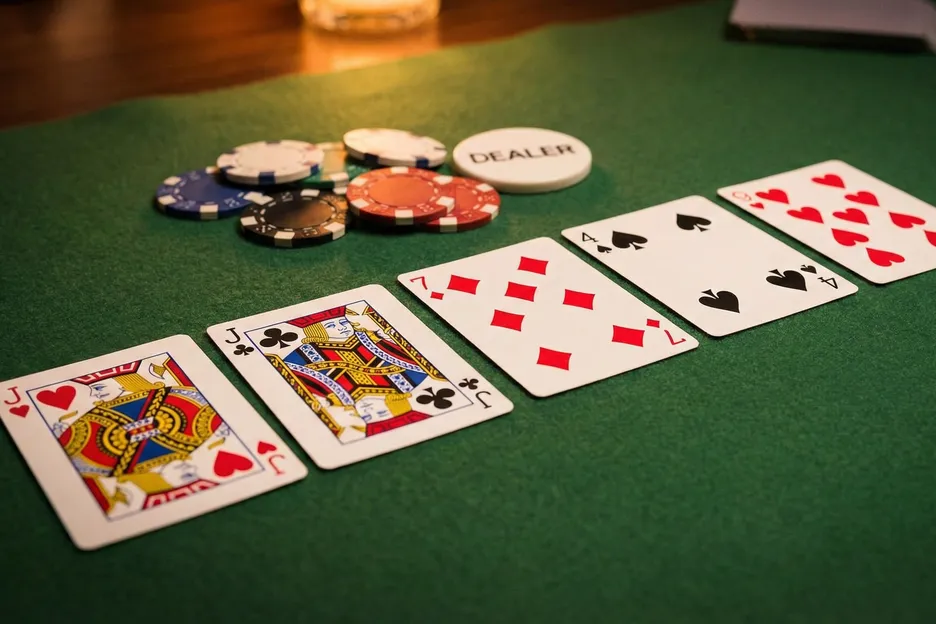


If you’re new to the game or just learning how to play poker, you may be wondering: What is one pair in poker?
One pair is two cards of the same rank plus three kickers. Tie-breakers compare the pair rank first, then the highest kicker, then the next, and the next.
This is because, while making one pair only involves two cards, a poker hand is always made up of your best five cards.
So while your hand may be a pair of jacks, for example, you will always use five cards to make your strongest hand. The three unconnected cards in a one pair hand are known as kickers.
Common subtypes and examples
One pair hands are ranked primarily according to the cards used to make the pair, with aces counting as the highest pair and deuces as the lowest. Kickers are used to break any ties.
While this is the only way to determine a winner between different one pair hands, there are a few different types of pairs to be aware of.
Top pair is a pair made using the highest community card, along with a hole card of the same rank. For example:
Board: 


Hole cards: 

An overpair is made using two matching hole cards, which are higher than the highest card on the board. Here is an example of an overpair:
Board: 


Hole cards: 

An underpair is similar to an overpair, but instead of being higher than the highest card on the board, it is lower. For example:
Board: 


Hole cards: 
Does one pair beat high card?
Yes, one pair beats a high card in the full order of poker hand rankings, but it is the only hand it can beat. One pair is one of the weakest hands it is possible to make in poker, but that doesn’t mean it doesn’t win a lot of pots.
Complete hand rankings
- Royal flush, e.g.


- Straight flush, e.g.


- Four-of-a-kind, e.g.


- Full house, e.g.


- Flush, e.g.
- Straight, e.g.


- Three-of-a-kind, e.g.


- Two pair, e.g.


- One pair, e.g.

- High card, e.g.


Why does one pair beat a high card but lose to two pair?
The hierarchy of poker rankings is determined by the probability of making each particular hand.
For example, a royal flush is extremely rare, and requires a very specific combination of five cards, which places it at the top of the rankings. A single pair, on the other hand, is one of the most common possible card combinations, so it occupies a place much lower down the list.
Two pair is more difficult to make than one pair, and occurs less frequently, so ranks higher than one pair.
Unusually, in Texas hold’em a high card hand (five cards with no pairs, straights or flushes) is actually less probable than one or two pair. However, in games such as 5-card draw and 5-card stud, which preceeded hold’em and other 7-card games by some time, high card is the most statistically probable hand. It continues to rank as the lowest possible hand in the hand rankings list used for most poker games.
| Hand | Beats | Loses to |
|---|---|---|
| One pair | High card | Royal flush |
| Straight flush | ||
| Four-of-a-kind | ||
| Full house | ||
| Flush | ||
| Straight | ||
| Three-of-a-kind | ||
| Two pair |
One pair tie-breakers (who wins when both have a pair?)
As with other poker hands, card ranks are the primary method for determining a winner if more than one player shows the same hand at showdown.
For example, with a flush the highest ranked card in the flush determines the winner; the highest ranked three-of-a-kind beats a lower three-of-a-kind; and with a straight the rank of the card at the top of the straight dictates which of multiple straights takes the pot.
This is also the case with one pair hands.To determine which one pair hands beats another, use this checklist:
- Compare the rank of the pair: the highest wins. If tied…
- The highest kicker wins. If tied…
- The next highest kicker wins. If tied…
- The next highest kicker wins. If tied…
- The pot is split equally.
Aces are considered the highest possible pair, with deuces the lowest. Suits never break a tie in poker.

Shared pairs
In flop games such as hold’em or Omaha, any pair that comes on the board can be shared by all players. This means that, if players cannot make a hand stronger than that pair, kickers must be used to determine a winner.
Let’s look at a few examples. Can you tell which player wins in each hand?
Hand 1
Board: 

Player A:
Player B:
In this example Player B has an ace kicker, which is higher than Player A’s king kicker, and so wins the pot.
Hand 2
Board:
Player A: 
Player B:
Here both players have a pair of fours with a jack kicker (on the board), so the next highest kicker must be used. Player A has a ten in their hand, and so can make 4-4-J-T-9, while Player B has a 6 and so their best possible hand is 4-4-J-9-7 (playing every card from the board). Player A wins thanks to their second-highest kicker.
Hand 3
Board:
Player A:
Player B:
Neither player can make a hand stronger than the five community cards, so each ‘plays the board’. As their hands are completely identical, they split the pot equally.
Odds and combinatorics
With one pair poker hands there are a few useful odds and probabilities to be aware of.
Odds of improving unpaired hole cards
Unpaired hole cards are the most common hand you’ll be dealt, and the chances of flopping a pair with either of them is around 32%, or 2-to-1. Assuming you will see all five board cards — if you’re all-in preflop, for example — that probability of making a pair rises to close to 50%.
Odds of improving one pair
With a pair in your hand, you will flop a set — three-of-a-kind using a pocket pair — just less than 11% of the time.
By the river, a pocket pair will improve to three-of-a-kind or better around 20.3% of the time.
Odds of improving with overcards
Flipping things on their head, let’s imagine you are up against one pair, but with overcards that will give you a stronger pair if they hit.
On the flop, with six outs, you have around a 24% chance of improving by the river. On the turn that drops to around 12%.
Strategy: Top pairs, overpairs and underpairs
There are 72 different combinations of cards that make one pair, but many more ways to play them. As such, there’s no such thing as a strategy guide on how to play one pair in poker, but there are some general concepts to bear in mind.
Top pairs
Top pair can be a powerful hand, but is never unbeatable. Board texture is a key element to be aware of — what other hands or draws are possible? — and may help dictate how you choose to play top pair.
Let’s say you have and the board comes  .
.
Now, imagine you have the same hole cards but the flop is .
In both hands you have top pair, but one board is much more dangerous than the other. With possible flush and straight draws, there’s a case for betting more aggressively to protect your made hand. Your decision will need to be informed by your knowledge of your opponents, their ranges and playing styles.
Another potential pitfall with top pair is your kicker. With a weak kicker you might think you’re in the driving seat, but could be up against a dominating hand.
Overpairs
An overpair can be a well-disguised hand. Imagine raising with J-J and seeing a 9-high flop; opponents may put you on high cards that failed to connect, and should one of them have A-9, for example, you could feasibly win a large pot from them.
Again, board texture is a key consideration. The potential dangers you face from cards to come will help dictate whether you should be playing the hand for value, or trying to shut out drawing hands that could overtake you.
Underpairs
When you have a pocket pair like 2-2, 3-3 or 6-6, it’s highly unlikely you will see a flop that feels safe. That is, unless you flop a set.
Set-mining — seeing the flop with a small pair in the hopes of making three-of-a-kind — can be a very profitable move, especially given sets’ well-disguised qualities.
If an underpair does not connect with the board, its value is generally that of a bluff-catcher; it doesn’t have great showdown value, but beats a bluff.
Protecting showdown value
In every poker hand, the goal is to get worse hands to put chips in the pot, and better ones to fold.
It can be tough to know exactly where you are when playing a single pair, but a lot of the context will be provided by the board texture.
When you’re confident in your pair, on a dry board, you want to keep worse hands in to extract maximum value. For example, if you have on a board of  .
.
On a wet board, with potential for a one pair hand to be outdrawn, you may want to bet more aggressively to fold out drawing hands. For example, if you have those same black kings but the board shows  .
.
Doing the latter is known as protecting your hand, or protecting showdown value. Understanding what odds, or price, a drawing hand needs to continue will help you force opponents into mistakes, so be sure to check out our guide to poker odds.
Decisions like these are heavily case dependent, and underscore why it’s so important to know how your opponents think, their ranges and weaknesses.
One pair vs other hands
As explained above, the ranking of poker hands is generally dictated by the probability of making each hand.
Let’s look at one pair in comparison with other poker hands, and why it beats one, but loses against the others.
One pair vs high card
Who wins? One pair only beats one poker hand, and it’s a high card.
Why? While the chances of making one pair by the river in hold’em are actually greater than only making a high card, the latter represents the worst hand in poker. This is because when only five cards are used (as opposed to the seven used in hold’em) high card is the most common hand, and the convention of ranking high card below one pair is one that continues to this day.
One pair vs two pair
Who wins? Two pair beats one pair.
Why? It feels natural that two pair should be better than one, and the math backs this up. At 23%, the chance of making two pair by the river is almost half as likely as making one pair (43%).
One pair vs three-of-a-kind
Who wins? Three-of-a-kind is the winner in this match-up.
Why? Three-of-a-kind is a pair plus another specific card, so is clearly more difficult to make than a single pair.
One pair vs a straight
Who wins? A straight wins.
Why? The odds of making a straight by the river, whatever poker game you’re playing, are a fraction of those involved in making one pair.
One pair vs a flush
Who wins? A flush.
Why? In hold’em you’ll make a flush by the river only around 3% of the time, compared with the 43% chance of making a pair.
One pair vs a full House
Who wins? Any full house beats any pair.
Why? When you consider that making a full house involves making one pair, plus three-of-a-kind, it’s easy to see why a full house beats both of these other poker hands.
One pair vs four-of-a-kind
Who wins? Four-of-a-kind.
Why? Four-of-a-kind, or quads, is one of the rarer poker hands you’ll see at the table, and your odds of making quads by the river in hold’em is around 594-to-1. Compared with the 1.28-to-1 odds of making a pair, four-of-a-kind is far less probable and so ranks much higher.
One pair vs a straight/royal flush
Who wins? Any straight flush beats one pair, including a royal flush.
Why? Statistically speaking, a straight flush is the hardest hand to make in poker, while one pair is one of the easiest.
Variants: Hold’em, Omaha/PLO, draw, stud and short deck
Despite not being one of the stronger hands in poker, one pair is often enough to win a hand of hold’em. But how does it fare in other popular poker variants?
Omaha/PLO
In pot-limit Omaha all players receive four hole cards, rather than two, which means many more card combinations. As a result, winning hands are usually stronger than they would be in hold’em, so a single pair is rarely enough to take down the pot.
It’s also a requirement to use exactly two hole cards to make your hand, so a single pair in your hand will need some help to improve. Consider the chances of improving a pocket pair, with just two outs to a set, compared with four unpaired cards — especially those that combine well for flush and/or straight draws.
Omaha is a game where draws and redraws are particularly important, and pocket pairs have limited ways to improve.
5-card draw/7-card stud
In 5-card draw you’re likely to be dealt a pair around 42% of the time, so on its own it’s not very strong. However, you’ll get nothing but a high card some 50% of the time, so it’s certainly better than that!
Draw poker is about understanding your odds to improve, as well as paying close attention to the betting and drawing patterns of your opponents. Someone drawing 2 cards almost certainly has at least a pair, so if that’s all you’ve got you should be aware that you may be up against a higher pair or better.
Stud poker is very different to draw, in that many of your opponents' cards will be dealt face-up. Take careful note of what your opponents are showing, and what could be behind any aggression they show with their bets.
With everyone holding seven cards each by the end of the hand, the chances of a single pair taking down the pot — particularly in a multiway hand — are not great.
Short deck
When you remove all cards ranked 5 or below, as in short deck hold’em, it becomes easier to make pairs.
To illustrate this point, imagine a four-suit deck with cards ranked up to 200: would you feel confident in being dealt a pair? Now imagine a deck of only five ranks, and consider how many more pairs you’d be dealt.
It’s an extreme example, but it shows how the fewer ranks there are in play, the more frequently pairs will occur. As a result, a hand like a full house will usually rank below a flush in short deck, and a single pair is all-but-worthless.
FAQs
Q. What is one pair in poker?
A. One pair in poker is a hand containing two cards of the same rank, for example two kings, as well as three other unpaired cards.
Q. Is one pair better than high card?
A. Yes, one pair beats a high card in poker — other than weaker pairs, it’s the only other poker hand it beats.
Q. How are ties broken when both players have one pair?
A. If more than one player has a one pair hand, the rank of the pair is the primary way to determine the winner. Aces count as the highest pair, and deuces the lowest. If players have the same pair then the highest kicker breaks the tie; if these are also tied then the next highest kicker is used, and so on. If players have identical hands, the pot is split.
Q. What’s the difference between top pair, an overpair and an underpair?
A. There is no difference in terms of hand strength — they are all one pair — but these are terms for describing different types of pairs. Top pair is a pair made using the highest communal board card plus a hole card, an overpair is a pocket pair that is higher than the highest board card, while an underpair is a pocket pair that is lower than the highest card on the board. An overpair beats top pair, which beats an underpair.
Q. How often do you make a pair with unpaired hole cards?
A. With two unpaired hole cards you will flop a pair around 32% of the time. Your chances of making a pair by the river is closer to 50%.
Q. When should I bet top pair vs check?
A. Betting decisions such as these depend on various factors, such as your opponents’ tendencies and board texture. If you are confident you are the favorite to win the pot, you should encourage your opponents to put chips in the pot, but if your hand is too vulnerable it might be better to try to win a small pot than lose a big one. This not only involves making the right decisions on when to bet, but how much.
Q. Is one pair strong enough to stack off?
A. This is highly dependent on context. In a multiway pot a single pair is more vulnerable, but heads-up one pair can be a big favorite. Whether you want to play for your entire stack depends on factors such as these, stack sizes, the stage of the tournament, and more.
Q. How do kickers affect one pair showdowns?
A. If more than one player has the same pair then kickers are crucial in determining the winner of the pot. This is a bigger factor in games such as hold’em and Omaha, which use communal cards.
Q. Does one pair work differently in Omaha?
A. No, one pair in Omaha ranks the same as in hold’em and most other poker games. However, the addition of extra hole cards in Omaha means the average strength of the winning hand is higher, so one pair is rarely strong enough to drag the pot.
Q. How can I estimate my equity with one pair during a hand?
A. To evaluate your relative hand strength, and chances of winning the pot, it is important to determine your opponents’ ranges with accuracy. If you are confident in the hands you are up against, you can estimate your odds of improving to beat them, or vice versa. Check out our page on how to calculate poker odds for help.
Featured image created using AI.


