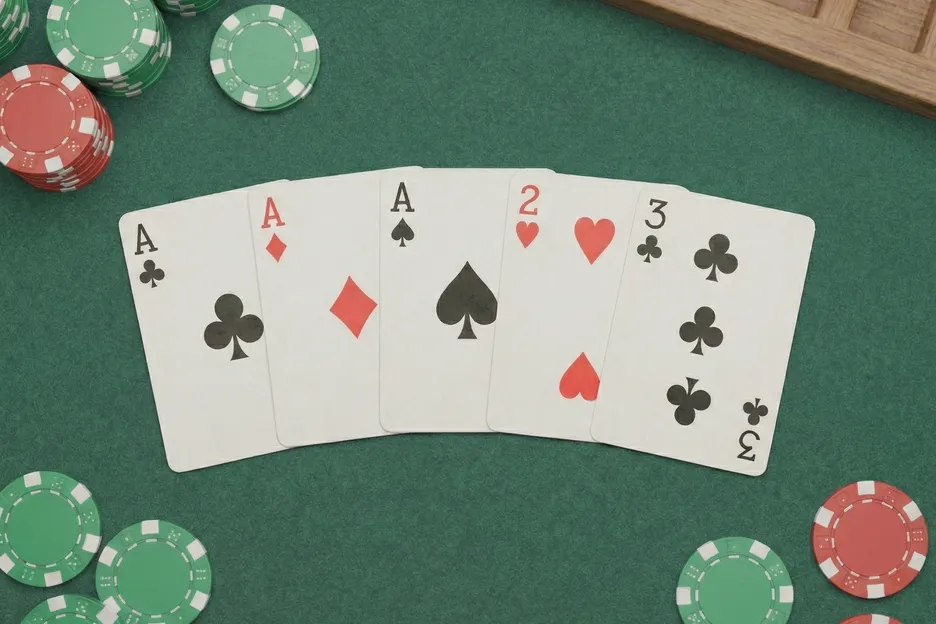


Three-of-a-kind in poker is a hand which contains three cards of the same rank, plus two other non-paired cards.
An example would be 


 .
.
It’s a hand which you’ll find in any five-card poker game, such as hold’em or Omaha, as well as lesser-played three-card poker games where it is known as a 'prial'.
This hand is also called ‘trips’ or a ‘set’, although there is a subtle but important difference between these two terms.
This is because in flop games with shared community cards there are two ways to make three-of-a-kind: either by using a pair in your hand and one community card (a set), or by using a pair of community cards with one hole card (trips).
This is an example of a set:
Board: 


Hole cards: 

Here’s an example of trips:
Board: 


Hole cards: 

A set and trips are both three-of-a-kind, and neither outranks the other, although a set is a more desirable hand for a couple of reasons:
- Its strength is hidden. A set is technically possible on any board, even with the driest texture and no obvious draws, making it a good hand with which to trap. On the other hand, trips requires a paired board, which is always potentially dangerous.
- As your opponent cannot hold the same pair that you do — given that a third card of that rank is on the board — a set will never split the pot or lose to a better kicker. With trips, two players could easily hold a third card to go with the pair on board, making each vulnerable to being outkicked, or their opponent pairing their other card for a full house.
Does three-of-a-kind beat two pair?
Yes, because three-of-a-kind is a more difficult hand to make than two paid and occurs less frequently, so ranks higher in the hierarchy of poker hands. Here’s where three-of-a-kind sits in the full ranking of all poker hands.
Full hand ranking list
- Royal flush, e.g.


- Straight flush, e.g.


- Four-of-a-kind, e.g.


- Full house, e.g.

- Flush, e.g.


- Straight, e.g.


- Three-of-a-kind, e.g.

- Two pair, e.g.


- One pair, e.g.

- High card, e.g.

Why does three-of-a-kind beat two pair, but not a straight?
A hand’s position in the poker hand rankings is dependent upon how easy or difficult it is to make the hand in a game of poker.
For example, one pair is a very common, easy hand to make, and so ranks very low, while a straight flush requires a very specific combination of cards and so is a rare occurence, ranking very high.
Three-of-a-kind is rarer than a high card, one pair or two pair, but more common than a straight and those hands higher up the ranking.
| Hand | Beats | Loses to |
|---|---|---|
| Three-of-a-kind | Two pair | Royal flush |
| One pair | Straight flush | |
| High card | Four-of-a-kind | |
| Full house | ||
| Flush | ||
| Straight |
Three-of-a-kind tie-breakers (who wins when both have trips?)
Just like with pairs, flushes and other poker hands, card ranks are used to determine a winner when more than one player has the same hand.
This means that three queens beats three jacks, for example; the two kickers are irrelevant. Aces are high, which means three aces is the best possible three-of-a-kind (with a king and a queen as the best possible kickers).
When a player has a set they cannot split the pot, but it’s not the case with trips. If two players each have a third card to match a pair on the board, the kicker will play.
For example:
Board:
Player A: 
Player B:
Here, both players hold a king, so both have trips, but Player A’s kicker beats Player B’s .
Where players share the same kicker, the next kicker can be used to break a tie, as in the example below.
Board: 

Player A:
Player B: 
Both players have three sixes, and an ace on the board is their best kicker. However, Player A has a king to go with it, so their best hand is . Player B’s best hand is , so they would lose the pot.
If both players have the same trips and identical kickers — whether using cards from their hand or community cards — then the pot would be split equally.
Here’s a quick way to determine who wins if two players have three-of-a-kind:
- Compare the rank: the highest wins. If tied…
- The highest kicker wins. If tied…
- The second highest kicker wins. If tied…
- Split the pot.

Odds and combinatorics
When it comes to poker odds, the most useful numbers to know with three-of-a-kind is how likely you are to improve from a pair.
Improving to a set
When you start with a pocket pair, you have around a 10.8% chance of flopping the card you need to make a set.
If you don’t make it on the flop, you then have a 4.2% chance of hitting it on the turn, and a 4.3% chance of making it on the river.
Altogether, you have around a 20.3% chance of improving a pocket pair to three-of-a-kind or better by the river.
Improving to trips
With unpaired hole cards your odds of flopping trips are much worse than if you already had a pair, and you can expect to flop three-of-a-kind only around 1.35% of the time.
If you do pair a hole card on the flop, your chances of improving on the turn and river are the same as if you started with a pair: 4.2% and 4.3%, respectively.
Strategy: Set-mining, board textures and the trouble with trips
The strategy of set-mining involves seeing the flop with a non-premium pocket pair, in the hopes of flopping a set.
As described above, sets can be very strong and effective given that they are naturally well-disguised hands. Given the right board texture they can be the nuts, yet still get paid off by one or two pair hands.
On very wet boards, though — such as those with straight and flush potential — sets can be more problematic as it can be difficult to get worse hands to call or better hands to fold. Add the fact that, if the board then pairs, you would have a full house and beat all straights and flushes, and sets can be difficult to fold given you can still improve (though the odds may not be in your favor to do so).
When set-mining, the preflop pot odds will rarely give you the right price to call (9-to-1), but it’s important to remember the implied odds. Flopping a set often gives you the chance to win a very large pot, and you’ll need to factor in any potential chips you can win on later streets when weighing up your preflop decision: the initial call may not be mathematically correct in isolation, but when those later streets of value are taken into consideration, the value of set-mining is clear.
Board texture
This term refers to the community cards and what type of hands are likely to be made. When flopping a set, ideally you don’t want better hands to be possible.
Compare these two flops, for example, if your hole cards are .
Flop A:
Flop B:
Which of these flops would you rather see? If you think Flop A looks more dangerous, you’re correct: opponents could already have a made flush or straight, which would leave you behind and needing to improve. Flop B, on the other hand, gives you the second nuts, behind only pocket aces.
That’s why board texture is a key consideration when it comes to how to play a set.
Trips trouble
Trips and a set are both three-of-a-kind, but they can play very differently.
Imagine this scenario, on the turn:
Board: 

Your hole cards: 
You slowplayed your trips on the flop in position, an opponent bets the turn and you spring your trap with a big raise. She then puts you all-in.
How confident are you that a) she doesn’t also have an ace, and b) if she does, she doesn’t have a better kicker?
That’s part of the reason why it's much harder to win a big pot with trips with than a set. Another consideration is that, while a set can be the nuts, trips can never be. If there’s a pair on the board, there are potential full houses out there. Look back at the scenario above. I’m sure you’d prefer to have A-K than A-5, but wouldn’t it be better to have 9-9?
Trips is a strong hand, but it’s not as strong as a set — even though technically they’re the same hand.
Three-of-a-kind vs other hands
The ranking of poker hands all comes down to which hands are more frequently made, with rarer and more difficult hands ranking above those which are more probable.
Let’s look at how three-of-a-kind fares against other poker hands, remembering that the odds of making three-of-a-kind by the river is around 4.83%.
Three-of-a-kind vs. one pair
Who wins? Three-of-a-kind.
Why? The odds of making one pair by the river is around 48.3%, much greater than the probability of making three-of-a-kind.
Three-of-a-kind vs. two pair
Who wins? Three-of-a-kind.
Why? The odds of making two pair by the river is around 23.5%.
Three-of-a-kind vs. a straight
Who wins? Straight.
Why? The odds of making a straight by the river is around 4.62%, making it slightly less frequent than three-of-a-kind and therefore a stronger hand.
Three-of-a-kind vs. a flush
Who wins? Flush.
Why? The odds of making a flush by the river is around 3.03%.
Three-of-a-kind vs. a full house
Who wins? Full house.
Why? The odds of making a full house by the river is around 2.6%.
Three-of-a-kind vs. four-of-a-kind
Who wins? Four-of-a-kind.
Why? The odds of making four-of-a-kind by the river is around 0.168%, making it one of the most improbably and rare poker hands possible.
Three-of-a-kind vs. straight flush/royal flush
Who wins? Straight flush.
Why? The odds of making a straight flush by the river is around 0.00279%, with the chance of the top straight flush — a royal flush — only 0.0032%.
Examples and edge cases
With three-of-a-kind there are several scenarios that often crop up in poker games where it pays to be prepared.
Sets vs. trips
As described above, while a set and trips are both three-of-a-kind the two types of hand can play very differently.
A set can be a great way to win a huge pot, due to its disguised strength. A set is possible on any flop with any card, making it very difficult to predict. Flopping a set versus top pair, for example, can be extremely profitable.
With a set you also do not need to worry about your kicker, given that only one player can make any particular set given they have two cards of that rank in their hand. With trips, on the other hand, a weak kicker can cost you a lot of chips if another player has made the same trips with a higher side-card.
Board-paired chaos
When the board pairs and you have a third card to go with it — trips — you may be in danger of being outkicked. This is more likely if the other cards on the board are low.
In this example the board has brought low cards, and so Player B’s kicker plays to win the pot.
Board:
Player A: 
Player B:
But let’s look at a board with higher cards, and how that affects where the pot is pushed.
Board: 
Player A:
Player B:
In this case both players have trip 6s, with an ace and king as kickers, for a split pot.
Another thing to be aware of with a paired board is that trips may be no good if a player has a pair which matches one of the other cards, or has paired their side-card, giving them a full house.
In this example Player A flopped trips, while Player B also flopped trips but turned a full house. However, Player C has them all beat thanks to a pocket pair that matches an overcard on the board, making an even stronger full house.
Board:
Player A:
Player B:
Player C:
Monotone and highly connected boards
Board texture — what type of hands or draws are possible on a given board — is always an important consideration, but can be particularly relevant with three-of-a-kind.
The term monotone board refers to a flop, or board, where all cards are of the same suit. This is one way a board can be highly connected, or ‘wet’, with straight possibilities one of the other main dangers.
Let’s say you raise with , get two callers, and the flop comes . While your set is strong, anyone with two spades in their hand is well ahead with a flush, leaving you to try and catch up by pairing the board or hitting the fourth ace.
What’s more, anyone with a single spade in their hand is drawing to a better hand, should another spade come on the turn to fill their flush. This poses an interesting problem: do you slowplay your set and avoid giving away your hand-strength, or do you play more aggressively to push out drawing hands and protect your own?
Now let’s imagine you have those red aces but the flop is . This type of unconnected flop is much safer for your top set, and it’s hard to imagine a hand a player would call a preflop raise with that would overtake you on the turn, whatever may come.
It’s much safer to slowplay this flop compared to the previous one, while another consideration would be: what could an opponent have that would call a big bet in this spot? There are few holdings they could have that will pay off your strong hand, so showing too much aggression on this flop is unlikely to see you win a big pot.
Always pay attention to board texture and the potential dangers that lurk — whether they’re draws that could kill your hand, or situations that could kill your action.
Variants: Hold’em, Omaha, draw and stud
Most of the advice on this page relates directly to no-limit hold’em, as it’s the most popular poker variant in the world, but three-of-a-kind is a hand you’ll also run into when playing other games.
Three-of-a-kind in Omaha
In Omaha games each player receives four hole cards rather than the two dealt in hold’em, giving everyone more card combinations and the ability to make more hands.
As a result, three-of-a-kind is a more frequent sight in these games, as is the dreaded ‘set-over-set’ cooler.
In this scenario more than one player hits a set, and as it can be difficult to fold such a strong hand — not to mention to spot another set out there — the end result is often very damaging to the player with the lower set, and very profitable for the one holding the highest one.
Remember that in Omaha every player must use exactly two hole cards to make their hand, so double-paired boards do not always mean someone has made a full house. This also means that if two players each have trips, the only kicker used to break the tie is their other hole card. If these are identical, the pot is split.
Another thing to remember is that if you hit trips you will have up to three other cards in your hand which will make a full house if hit, and so will your opponents. For this reason, trips at the river is not as strong a hand as it would be in hold’em.
Imagine Player A flops trips with some very high kickers, taking the lead in the hand against Player B.
Flop:
Player A:
Player B:
Player A is in the lead, but any 9, 6 or 2 that comes will see Player B make a full house. Trips in Omaha is a hand you must play with caution.
Three-of-a-kind in 5-card draw
It’s impossible to tie a hand holding three-of-a-kind in 5-card draw, as there are no community cards. If more than one player has three-of-a-kind, the winner is the highest-ranked, with aces counting as high.
This also means it is difficult to put an opponent on a hand. You’ll need to use betting patterns and the number of cards they draw to try and narrow down their range.
Three-of-a-kind in 7-card stud
Again, players cannot tie with three-of-a-kind in 7-card stud due to the lack of shared cards, but the fact that most cards are face-up means a lot of information is available — though, crucially, not all.
If someone is showing a pair, there is always the chance that they have a third hole card to go with it. But whatever you can see, three-of-a-kind is always possible. The strongest start for a stud hand is three-of-a-kind, using two down cards and one up card of the same rank.
This can remain a strong hand but, just as with board texture in flop games, you’ll need to pay close attention to your opponents’ cards for warning signs that they may have overtaken you with a straight, flush or another better hand.
Three-of-a-kind in short deck
When all cards below a six are removed, as in short deck hold’em, there are a few effects that impact the frequency of certain poker hands — and therefore can alter the poker hands hierarchy.
With fewer card ranks in play, straights and pairs become easier to make, while cutting the number of cards in each suit from 13 down to 9 makes flushes less common.
As a result, many short deck games will rank three-of-a-kind above a straight, and a flush above a full house.
Note that some short deck games keep the existing poker hand rankings, for the sake of simplicity, so always double-check the rules before playing.
FAQs
Q. What is three-of-a-kind in poker?
A. Three-of-a-kind is a poker hand that contains three cards of the same rank, for example queens or 7s, as well as two unrelated and unconnected cards.
Q. Is three-of-a-kind better than two pair?
A. Yes, three-of-a-kind is a stronger poker hand than two pair. The ranking of poker hands is determined by how likely every five-card hand is to be made or, in other words, how frequently they occur. Three-of-a-kind is a much rarer and infrequent hand than two pair, so will beat it in any poker showdown.
Q. What beats three-of-a-kind?
A. Three-of-a-kind in poker is beaten by a straight, flush, full house, four-of-a-kind and a straight flush (including a royal flush).
Q. How are ties resolved with three-of-a-kind?
A. To determine a winner when more than one player has three-of-a-kind in poker, first compare the rank of the three-of-a-kind, with the highest being aces and the lowest deuces. If these are identical, the highest kicker — a non-three-of-a-kind card in the hand — determines the winner. If these are also identical then then 5th card in the hand is used, with the highest card taking the pot. If all five cards are identical, the pot is split.
Q. What’s the difference between a set and trips?
A. Trips and a set are different ways of making three-of-a-kind in hold’em and Omaha. With trips, you use one of your hole cards and two identically ranked board cards to make three-of-a-kind, while with a set you use two hole cards and one board card. While neither is technically stronger in terms of hand rankings, sets are generally considered less tricky to play for reasons explained above.
Q. What are the odds of flopping a set with a pocket pair?
A. You have around a 10.8% chance of flopping a third card to go with your pocket pair to make a set on the flop. This increases to approximately a 20.3% chance of improving a pocket pair to three-of-a-kind or better by the river.
Q. Should I slowplay a set?
A. Whether or not you should slowplay a set often depends on the board texture. On dangerous looking boards, particularly where straight and flush draws are possible, you may want to bet to protect your made hand from drawing hands, and avoid giving free cards to players seeking cards to fill draws which will beat you. On very safe looking boards, with no immediiate draws, slowplaying can be a way to trap players into overvaluing hands you can beat.
Q. How do kickers work when both players have trips?
A. When two players have trips — with each holding a third card to match a pair on the board — the deciding factor on who wins the pot comes down to kickers, the two other cards in their five-card hand. The highest kicker determines the winner, and if these are identical the next kicker plays. If these are also identical, the pot is split between them. In hold’em, kickers can either be board cards or their other hole cards, but in Omaha, where players must use precisely two hole cards, the kicker is the other card in their hand.
Q. How should I size bets with three-of-a-kind on wet vs dry boards?
A. The size of your bets is often a function of whether you want your opponents to stay in the hand, or fold. With a dry board, showing few or no danger signs, you want to keep your opponents in so you can win as many of their chips as you can, and betting so big that they fold would be a mistake. On a wet board, which has possible straights or flushes that beat three-of-a-kind, you don’t want to make it cheap for your opponents to hit any cards that they need to beat you. In these cases, you should consider betting with more aggression.
Q. Does three-of-a-kind work differently in Omaha?
A. Three-of-a-kind is the same hand in both Omaha and hold’em, beating and losing to the same hands and constructed in the same way. However, Omaha has a few key differences that affect how three-of-a-kind might be played. Each player has more cards to choose from, so stronger hands are more likely and set-over-set is a more frequent occurrence. What’s more, when players make trips in Omaha they have many more other cards in their hand they can pair to improve to a full house.


