


Ben ‘bencb’ Rolle is the founder and head coach at Raise Your Edge and the winner of the 2025 WSOP Online Main Event that netted him $3.9 million. This is part 2 of a series on Short Stack Supremacy – read part one.
I have a strong sit & go background, especially in the hyper-turbo 6-max streets. I’ve spent thousands of hours with math wizards trying to solve these 5–8bb spots.
It's still not solved today because it’s too complex.
Yes, future game simulations with HoldemResources Calculator (HRC) can help you a bit, but it's not enough.
Why is this?
ICM doesn’t account for blind increases. The more short-stacked you are, the more this impacts you.
ICM doesn’t consider that within one minute, the blinds increase, causing a significant drop in your stack. A blind increase might drop your stack by 25% immediately in big blind (bb) terms.
ICM also doesn’t consider your position at the table. If you’re in MP and in three hands time you will have to go through the blinds, it doesn’t factor that into the value calculation of your stack.
So what does this mean?
ICM overrates the value ($EV) of your stack
In ICM, there is always a consideration of risk and reward.
ICM might say, "Your stack is worth $10 now, and if you go all-in and lose, it’s worth $0." But it doesn’t factor in that in two minutes, the blinds increase, and your stack’s value drops to $9.
Your stack, therefore, will be worth less, meaning you have less to lose, and you can push wider. The less you have to lose, the wider you can push.
So how do I try to solve these spots? I use logic.
When it says you have a breakeven push with 8bb, it's likely a bit positive. Therefore, the rule of thumb I use is that for 10bb stacks, I take every break-even jam. When shorter than that, I start to take marginally losing spots.
Hold on, Ben… why would I ever want to take a negative EV spot?








Let me show you an example
This is a very interesting final table spot.
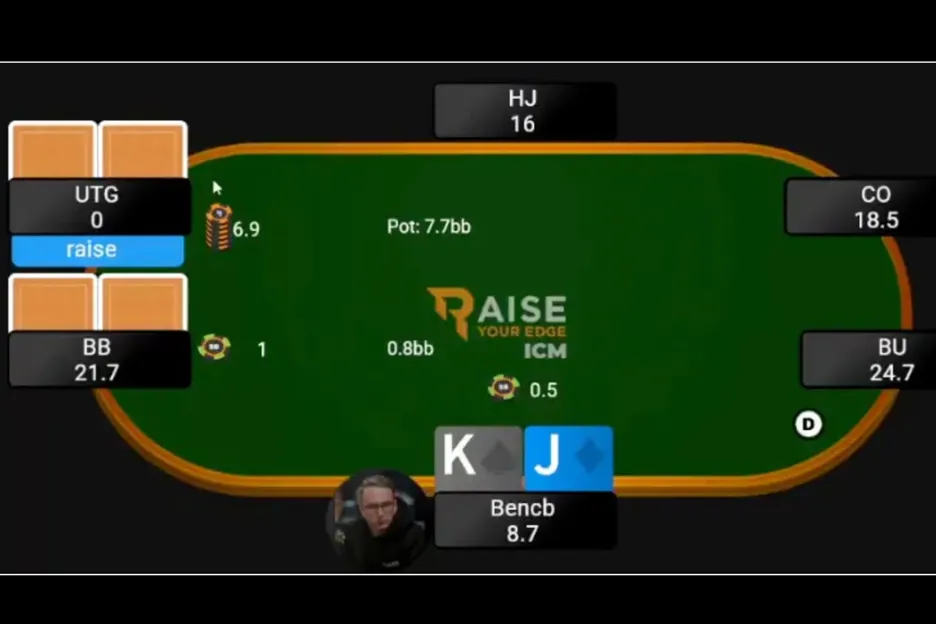
As UTG with 7bbs on this final table, this is our RFI (Raise First In) range.
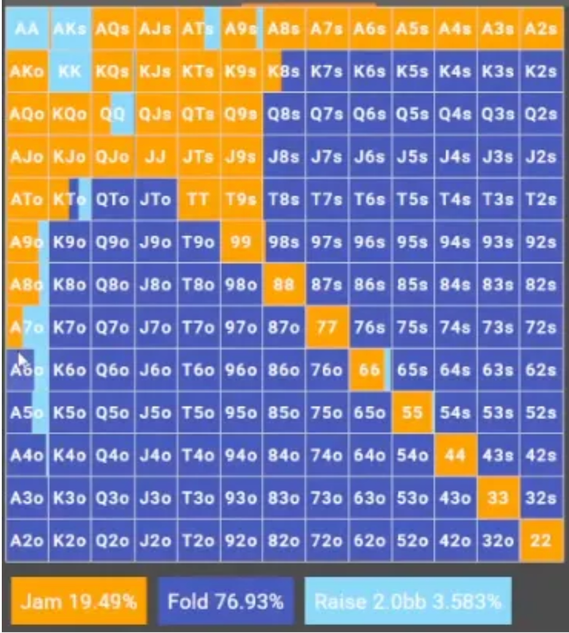
So this is how I start to think about these spots where we’re getting into the danger zone.
Here, with 7bb on the final table, I would definitely be jamming everything that is break-even.
If there were some 3-5bb stacks, this might not be the case. But, if I know KTo is going to be close (mixed frequency between jam, raise, and fold) then I always jam. A7o? JAM.
Then I would start adding hands that might be marginally -EV. Maybe not here as we have another short stack with 9.2 bbs. But let's say they had 20bbs; in that case, I will likely shove wider because the ICM impact on us is less.
I would even consider jamming K7s & A6o here.

The impact of player dynamics on your strategy
Another factor that influences my decision-making process here is the guy to my right in the BB. He is one of the bigger stacks, and as we know from population analysis, big stacks tend to be playing too loose.
This means I am going to get a lot fewer RFI spots, and he is going to be shoving on me, where I will need to find a hand to continue. This is a very important concept to understand.
The looser and more aggressive the big stacks are, the more you want to take the first-to-act opportunities.
You have to develop this mental process to be thinking about future game. Thinking about how the players in front of you impact your shoving strategy.
Don't just focus on the range and think, "This is what I'm shoving." Pay attention to the players at your table too.
This also means that if you see that the players at the final table are just bingo players, then avoid taking marginal -EV spots. They can easily bust each other.
3 things to consider in your short-stack shoving
To wrap up, consider these three factors in your short stack shoving decision-making:
- The blinds
Understand that ICM overrates short stacks as it doesn’t consider the blind increases. In a couple of minutes, the number of blinds you have can be significantly reduced without playing a hand due to a blind increase. Similarly, when you are in MP, ICM doesn’t consider that in a few hands, you will have to go through the blinds, which represent a significant part of your stack. - The players to our right
If they are looser than they should be, we’re not going to get as many RFI spots. When we find K8s, which will be an easy jam when folded to us, we’re not going to be able to make it as often as the looser big stacks have beaten us to the pot, and we can’t reshove or call. We don’t get to realize our K8s equity. Therefore, when we get the opportunity to RFI, we want to shove wider, even if it's slightly -EV. This is completely fine to do because, again, ICM overrates your stack. - Player profiles
If you have a final table of bingo players, who may not understand ICM and there’s a high likelihood that they bust, then don’t take the small loss spots. Wait for a better spot and they may bust each other or double you up.
That’s it! I hope you feel more confident about winning a tournament, even when you're short-stacked. Your short stack is not an inevitable defeat. It can be a powerful winning weapon.
You can learn how to play all stack sizes in the Tournament Masterclass, the world’s most popular tournament course.
Then apply what you have learned with our poker trainer. It uses realistic ranges of how opponents are actually playing, not just GTO.
10 minutes practice a day is all it will take to be playing perfect preflop poker, at all stack sizes.
Ben ‘bencb’ Rolle is the founder and head coach at Raise Your Edge.
Raise Your Edge is a poker training school that specializes in teaching an exploitative, winning approach in both tournaments and cash games. Their flagship membership, ‘The Champions Tier,’ is not just another poker course, it’s an all-in-one solution to becoming a long-term winning player.
Join The Champions Tier today.


