


This exclusive extract from '100 Essential Tips to Master Pot-Limit Omaha' by Fernando 'JNandez' Habegger explores how position can transform the value of your starting hand – and why the same cards can be a fold from one seat and a call from another.
Another concept that dramatically changes the value of your hand in PLO is position.
Position doesn’t change the cards you’re dealt, but it changes how effectively you can use them. Acting last gives you more information, more control over the size of the pot, and more freedom to decide whether a hand is worth continuing.
In a game where equities often run close, those advantages matter a great deal.
When you’re in position, hands with marginal strength or draws become far more playable. You can check back and realize equity, apply pressure when opponents show weakness, and avoid committing large amounts of money when the situation turns unfavorable. Even modest hands can perform well when you’re the one making decisions with full information.
Position allows you to turn potential into profit.
Out of position, the same hands often struggle. You’re forced to act without knowing what your opponent will do, pots tend to grow without your consent, and realizing equity becomes much harder.
Hands that look reasonable on paper may lose value simply because they’re played from the wrong seat. Just as stack size determines how a hand should be played, position determines whether a hand can be played comfortably at all.
In this chapter, we’ll look at how position alone – without changing the hand, the board, or the stack size – can turn a difficult situation into an easy one, and an easy one into a costly mistake. The importance of position starts early.
Why position changes which hands you can play
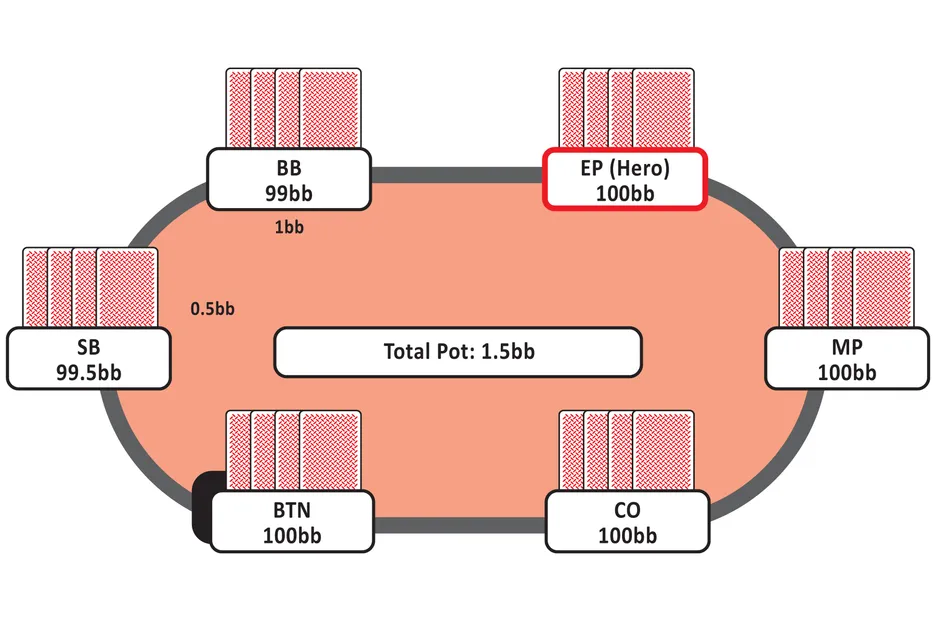
We’re in early position. Do we open-raise the following hands?


- A: Yes.
- B: No.
Answer: B – No.


- A: Yes.
- B: No.
Answer: B – No.


- A: Yes.
- B: No.
Answer: B – No.


- A: Yes.
- B: No.
Answer: B – No.


- A: Yes.
- B: No.
Answer: B – No.
Every one of these hands – 6-5-4-4, K-Q-10-10, A-K-8-5, A-J-10-6, 10-9-8-6 – looks playable. They’re connected, they have high cards, pairs, or suits. And that’s not an accident: all of them become open-raises a couple of seats later, as early as the cutoff. Yet from EP, they’re all folds.
What they have in common is that they make a lot of 'almost' hands. They flop pairs, weak two-pairs, dominated straights, or draws that aren’t to the nuts.
That’s survivable when you’re likely to play heads-up and act last, but from early position, that’s not the reality. You’ll often be out of position, and you’ll often be facing more than one opponent.
In those situations, these hands lose big pots by making the second-best hand.
If opponents call too much, which is common in softer games, these hands actually get worse. More players mean more chances someone makes a stronger version of what you make, while you’re left guessing OOP.
Just two seats later, everything changes. More players have already exited the pot, multiway risk drops, and position lets these hands realize their equity. That’s why they move from folds to opens so quickly.
TIP: Early position demands hands that can survive pressure from multiple opponents. The closer you are to the button, the more room your hands have to breathe.









The same hand, a different decision
EP opened and it folds to us in the SB. What do we do?
- A: 3-bet.
- B: Call.
- C: Fold.
Answer: C – Fold.

- A: 3-bet.
- B: Call.
- C: Fold.
Answer: C – Fold.
Now we’re on the BTN. What do we do?
- A: 3-bet.
- B: Call.
- C: Fold.
Answer: B – Call.
- A: 3-bet.
- B: Call.
- C: Fold.
Answer: B – Call.
EP opens, and we’re facing a decision with K-K-10-9 or A-K-5-4. These hands look close, and that’s exactly the point.
EP’s opening range is tight, which immediately rules out 3-betting. Neither hand is strong enough to build a big pot preflop, especially against a range that contains a lot of A-A, which both hands perform poorly against.
Postflop is where these hands get exposed. A-K-5-4 misses a lot of the common middling boards, and even when it pairs, it’s often up against a better ace or better kicker structure.
K-K-10-9 can flop an overpair or decent straight pieces, but without suits it lacks backup that turns a good flop into a big favorite.
Both hands make plenty of almost spots: playable in theory, but uncomfortable under real pressure. That’s why the small blind is the wrong place to take them.
Out of position, you don’t get to wait and see: you’re the one facing bets, with players behind you, and you have fewer clean ways to control pot size. These hands need time and information to succeed, and from the SB you get neither, so they become clear folds.
The same hands on the button become easy calls as you get to decide the flow. On most non-A-high boards, EP has to check because of stack depth and positional disadvantage. That gives you the option to check back, realize equity, and choose when, or if, the pot gets bigger. These hands sit right outside the top tier, and that’s exactly where position matters most.
TIP: Position makes marginal hands playable. When a hand needs time and information to succeed, being last to act is everything.
'100 Essential Tips to Master Pot-Limit Omaha' by Fernando 'JNandez' Habegger will be published on October 26, 2026, and you can pre-order from D&B Poker.