


Or at least I am. And if you’ve been doing what I’ve been doing, you are too. Let me explain.
A friend of mine messaged me having been surprised at a GTO Wizard output. He was looking at a simple continuation bet spot against himself in the big blind on a K44 rainbow flop having defended preflop.
In GTO world it turns out that we do a huge amount of check-raising when facing a bet here, but that we are only supposed to face a bet around half the time.
If middle position opens, and the board comes K44r or similar, they are only meant to c-bet around 50% of the time. This number varies depending on what the high card is, what the pair is, the position of the raiser and the ICM/stack distributions.
That’s a lot of factors to consider. We’ll take it one step at a time.
For example...
I’m going to talk you through one specific scenario that you can use as a bit of a launchpad to further analyze this situation. Here’s the spot:
25% of the field remaining in a 200-runner MTT.
The button opens off 25bb, and the big blind defends off 45bb.
The first thing to note is that on the flop of K44r in this setup there are quite a lot of leads from the big blind, and I’ll talk about this more later in the article.
When checked to, the button is only meant to c-bet this board 45% of the time.
I typically play $22-$109 tournaments. I’d be willing to wager that the population c-bet frequency here is north of 75%, and I know my own c-bet frequency is way higher than 45% here. Someone with population data could verify this, I’m sure!
The reason the continuation bet frequency is so low in GTO Wizard in these situations, is the big blind's abundance of trips. They defend lots of suited hands with a four in them that the opening raiser does not have, putting them at a nut advantage.
Now here is the wild part. When facing a bet, the big blind almost never calls. They fold 53% of the time and raise to 3.5bb 45% of the time! I’m not sure I’ve encountered a check-raising frequency this high before.
Please note this does not occur on every paired board and from every permutation of positions, but it does seem to happen a fair bit. No calling, only check raising or folding. This is not the approach population is taking, so some exploitative plays are in order.
On K44r 45% seems a huge check-raise frequency to me. The value portion of this is mostly obvious, every 4x and every Kx check-raises. But a lot of the rest of the range is not intuitive at all. The big blind check-raises 32s if it has a backdoor flush draw. The big blind continues with QTs without a backdoor flush draw sometimes. That hand is no pair, no draw, no backdoor flush draw and not even an over card and it check raises!
A6 offsuit is continuing with a check-raise, along with every other Ax hand. I’m not the only one who hasn’t been finding that check raise am I? You can see the entire range in the image below.
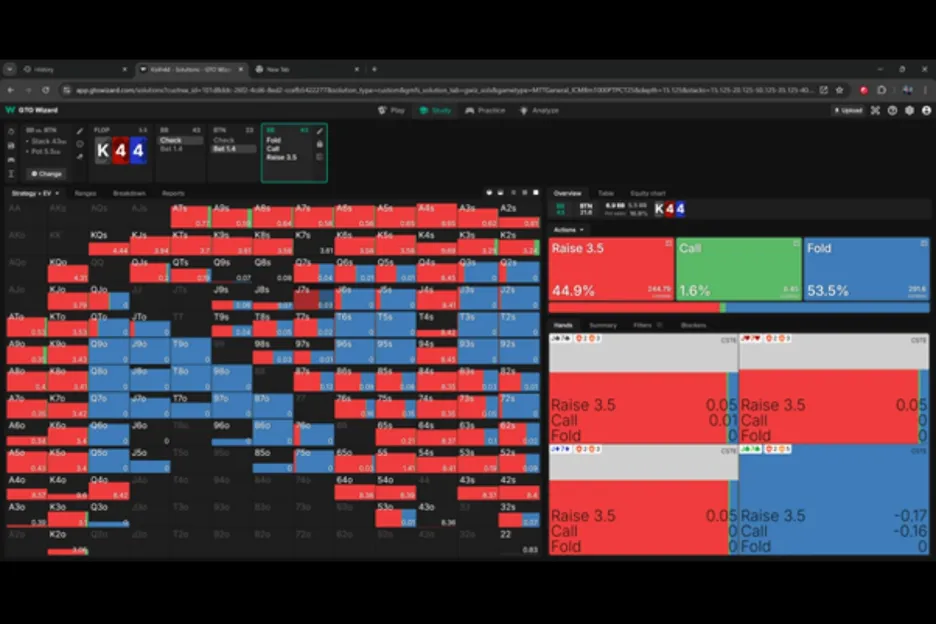
Facing this small check-raise, the button calls 75% of the time and folds the rest of the time. They fold the worst Ax hands like A7 and A6, but stick around with A3o with the backdoor wheel draw and ace high. They’re also meant to float with QTs even with no backdoor flush draw. They’re meant to float T7s with a backdoor flush draw some of the time too.
The EV of many of these calls is close to zero, I hasten to point out, but they continue nevertheless.
In short, the in-position player is supposed to be incredibly sticky. That QTs without a backdoor flush draw I mentioned is actually ahead of a huge part of the big blind's check-raising range. Remember, the big blind check-raises a lot of hands, like 87hh.
Understand why your strategies are working
I’ll pause there before I go down a rabbit hole of what we’re supposed to do on the plethora of turn cards and rewind back to the flop. Most people in the big blind are not check-raising 45% of the time here. In fact, I imagine that number is much closer to around 15/20%.
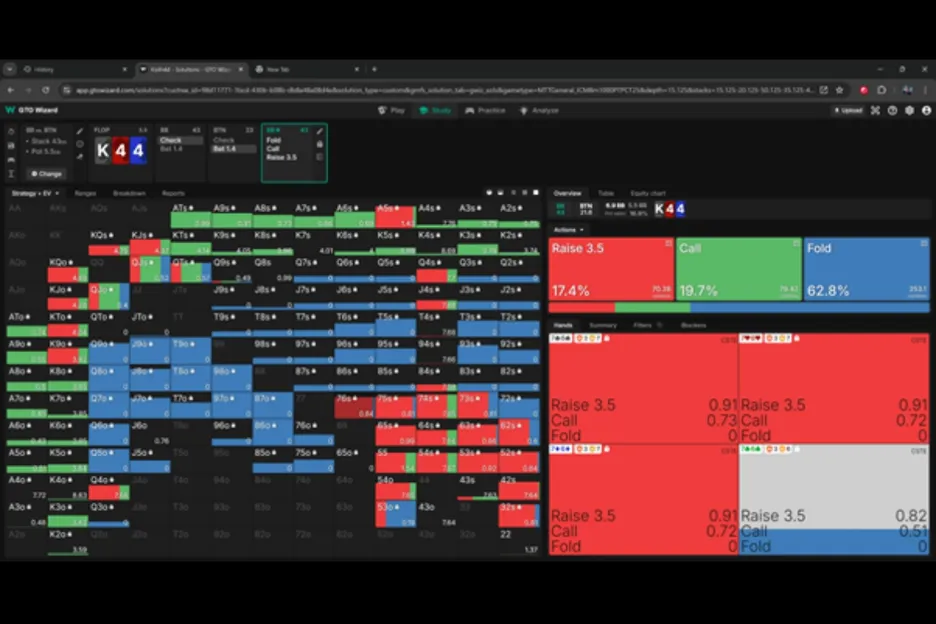
In the above image, you can see that I’ve played with the node locking feature that GTO Wizard has. I’ve forced the big blind to check-raise much less often and fold a lot more too. I believe most players aren’t finding the A7o check-raise on this board, or the continue with QTcc, so I’ve tried to reflect that by giving the big blind a whole lot of auto-folds and a bunch of calls.
It probably won’t surprise you to hear that against the big blind playing in a much more passive manner, the button opener now gets to c-bet 93% of the time. That is because we get to realize our equity so much more effectively vs. a passive player who won’t check-raise us off our hands.
So, if you’ve been c-betting these boards much more than 50% of the time, that is technically not approved by GTO Wizard. But if your opponents aren’t punishing you for it, it is actually the better exploitative strategy.
Nevertheless, it is so important to understand why your strategies are working rather than just blindly applying them. The check-raise size picked by the AI is very small, but because of the risk premiums involved, it gets a disproportionate amount of folds. Whilst in position, it does look like they are continuing very wide, it is actually less than the minimal defense frequency because of ICM, so the small check-raise accomplishes a lot.
Big thank you to my coach Gareth James for the insight here, as I was struggling to get my head around this!
Who is your opponent?
The trick to becoming an outstanding player is taking a moment to assess who your opponent might be and formulating the best exploitative strategy against them. If it’s a top reg, we cannot c-bet as frequently as we can against a recreational player who doesn’t know to check-raise this board with the barest bit of backdoor equity.
Another exploit to bear in mind is that when we are the big blind, we are meant to donk bet around 20% of the time. This occurs because the opening raiser is only meant to continuation bet 45% of the time, and it sucks if they check back when we have a monster. But if your opponents are c-betting this board to a much higher than GTO frequency, then we are better off not leading as often and letting them put money in bad with their c-bets.
Additionally, if you are the in-position player, and our opponents aren’t donk betting as often as they’re meant to, our c-bet frequency plummets. Sometimes to an extent that we check our entire range!
Now here’s the bad news. This is just one scenario. We’ve got paired boards of every type to study. We’ve got to factor in the ever-changing ICM landscape of the event we are in. GTO Wizard can let us look at paired boards 200 big blinds deep at the start of the tournament, and it can also let us study them on final tables when we are 10bb deep or less. AND everything in between. I haven’t dared look at what we do in PKOs yet.
Some rough guidelines
I’ve come up with some useful heuristics to help you (and myself!) at the tables. These are not bulletproof strategies that are perfect for every scenario, but a decent guideline.
- When we are in the big blind, the bigger the pair on the flop is, the less often we lead, and the less often we check-raise. The smaller the pair on the flop is, the more we lead and the more we check-raise. This is because of the disparity between the amounts of those cards in each of the ranges. A button opener won’t have very many twos in their range, but a big blind might have every suited two. However, if the pair is, say, jacks, then the opener has a lot more of those comparatively speaking, so their range is stronger than on a low-paired board.
- When we are the original raiser, oftentimes small pairs on the flop will make us c-bet less often, whilst paired Broadway cards often mean we bet with our entire range.
- On disconnected boards like Q66r you need to use hands like 78hh to check-raise with. That’s because you don’t have direct straight draws to use. But on a board like 998r you have lots of gutshots and open-ended straight draws to utilize. We still check-raise some 3-flush/3-straight hands, but they tend to have an overcard to strengthen their equity. We won’t check-raise 74s on 998r, but we will on A55r, for example.
- Whoever has the most chips can be more aggressive, either with leading or check-raising from the big blind or c-betting as the in-position player. This is because they cannot be eliminated by a shorter stacked opponent, giving them a smaller risk premium to worry about. This particular phenomenon can skew ranges drastically in high ICM situations.
I’m a firm believer that the best players in the world are the ones who can node lock the best in the heat of the moment. Practicing with that feature in GTO Wizard is something I am going to prioritize going forward!
Ian Simpson is a UK-based poker pro and an ambassador for 888poker. Watch him play at his YouTube channel.


