


In the first part of this article pair, I did a brief survey of 'carnival games' – the poker side games that have become popular as 'games within the game' in no-limit hold'em cash games.
Here, I touch briefly on strategy, and outline some thoughts on their effect on poker as a whole.
Carnival game strategy
This section will be very short, specifically because I know almost nothing of correct strategy for these different games. However, I'll make two observations, one of which is probably true, the other is definitely true.
Probably true: People spend far too much money trying to win kitties/bounties.
Definitely true: People spend far too much money trying to 'defend' against another player winning the kitty or a bounty.
Too much spent on winning kitties/bounties
Everything I see on the live streams and vlogs indicates that people will go to enormous lengths to win bounties and kitties. You watch somebody dust off (or try to dust off) $10K trying to win $2K worth of bounties from the table, and think, 'That can't be right'.
Of course, if the bounty/kitty becomes large relative to the stacks at risk, this extra effort is simply good poker.
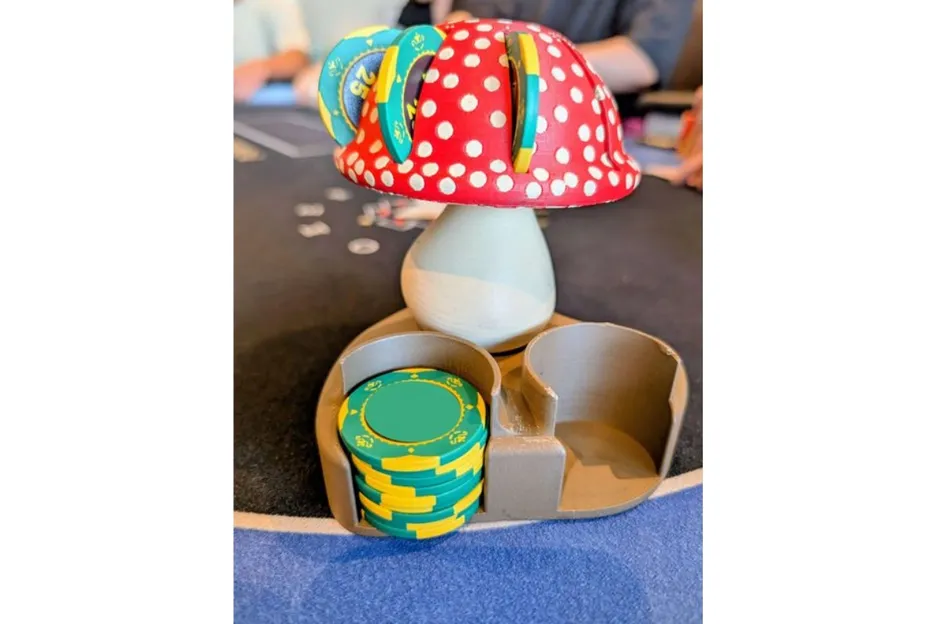
Consider the 'mushroom game' I described in the previous article. In a game where the big blind is $5, if the stacks are $1,000-$1,500 (200-300bb) and the kitty balloons to $1,500, then the player eligible to win the kitty may find herself shrugging and shipping in her $1K stack with very little equity.
The ability to win the pot plus the $1,500 kitty makes folding a terrible mistake.
Too much spent on 'defending' the kitty
This is mathematically provable. There is no logical basis for any one or two players 'defending' the kitty (or blocking a bounty hunter) on behalf of their table-mates.
Let's suppose we're playing the mushroom game, and the kitty is $1,500. Nine-player table. I have 40% equity in a heads-up pot against the button, who is eligible to win the kitty.
To a first approximation, my EV in the kitty is (0.4 x $1500)/8 = $75. Not nothing, but certainly not worth 'defending' with a meaningful stack. The correct math is to add that $75 to the actual poker pot (oh yeah, that) and then do the calculations to see if I have the right price to continue.
Of course, that's ignoring the 0.4 x 7/8 x $1,500 = $525 in EV shared by the rest of the table. But guess what – I have no interest in defending EV for the other players at my table.

I think the part that confuses people is that the button is playing for the main pot plus the kitty. As the putative 'defender,' I cannot win the kitty – just the main pot.
Our incentives are extremely unbalanced, but there you have it. If my table-mates want to succumb to the FUD (fear, uncertainty and doubt) and over-defend the kitty on my behalf, that's great, because they're spending their money to defend my EV. I, however, will not make that mistake.
How do carnival games affect the poker game and the ecosystem?
As somebody who has spent most of four decades involved with the poker industry, I have seen the good, the great, the bad, and the awful. What I can say for sure is that a healthy vibrant poker ecosystem isn't a given, and it's well to think about how changes will affect the game as a whole.
My overall sense is that low-impact carnival games don't do any harm and might actually be good for a game. The seven-deuce game is a perfect example. It encourages people to get out of line once in a while. It also inserts some niggling doubt into players about their opponent's range ('Could this be the time they have 7-2?').

It creates humor moments at the table, and generally livens things up. I'd be more than happy to play the seven-deuce game or similar, assuming everybody at the table agrees.
I've never played the stand-up (nit) game, but with reasonable penalties (and this is important), it adds interest and action. If nothing else, it takes the 'starting hand charts in trench coats' (hat tip to Charlie Wilmoth) out of their comfort zone.
As much as I honor and defend a poker player's right to play the way she wishes, I don't think poker is served well by people who wear headphones, don't speak, and do anything necessary to scrape the last $0.25 of EV off the table. If the nit game forces them to actually think about the game, and maybe crack a smile now and again, I'm all for it.
At the far end of the spectrum, we have massive mushroom, as described previously, where the kitty can be 300bb or more; and squid game, where you have to do (within reason) whatever is necessary to not pay out the bounties.
What is the appeal of carnival games?
The first question to ask is, 'Why are these games popular?' I'd say there are three prime reasons:
First, poker players want to emulate their heroes. When they see squid game being played on the Venetian livestream, they want to emulate what they see JRB, Berkey, and all the cool kids doing.

Second, people love lotteries. For proof, see the multiple billions of dollars being spent on lotto tickets in the US every year.
Sitting at a nine-handed table playing $5 big blind no-limit hold'em is a fine way to pass a few hours. But if you glance over at the mushroom on the button, and see $1,500 which you can win in just two quick hands, man, that looks like a new 65" TV.
Finally, and this is the big, perhaps insidious, one. Poker is getting harder. Thanks to books, videos, training sites, solvers, and all the rest, good players are getting better. Bad players are, well, bad players don't really improve much.
Thus the gap between good and bad players continues to grow. On some level, even most of the weaker players understand this.
They see the starting hand charts in trench coats. They hear the three nerds at the table talking about polar 3-bet ranges and minimum defense frequencies (those three are idiots, by the way). The weak player doesn't know what those words mean, but they're pretty sure that it doesn't bode well for their chances to win.
They realize, even subconsciously, that lack of knowledge is their friend. Anything that is new, different, or wacky – if the nerds don't know how to play it correctly, then suddenly the playing field is more level. They get that once stacks go in the middle, the deck, not skill, decides the winner.
Are these games good for poker?
These side games, carnival games, whatever you call them – are they good for poker as a whole?
My opinion: the smaller 'lighter' carnival games (e.g. 'seven-deuce') don't harm the game, and may actually be good for action, and more importantly, people having a good time.
Conversely, the heavier ones, e.g. 'squid' and 'mushroom,' destroy the balance of the underlying game.
Of course, the parameters of the carnival game matter a lot. But consider the mushroom game I described in the first article, where the kitty is seeded with 45bb, and 5bb is added every hand. After one nine-player orbit, assuming the kitty isn't won, it contains 90bb.
At this point, the small blind and the button (if she's eligible) should be blind shoving a significant portion of their range, for any sane stack size. In fact, each player is highly incentivized to end up with a short stack when they're in the small blind, so they can blithely ship it in, hopefully win, and thus be eligible to win the mushroom kitty on the next hand.
Does this sound like a fun poker game? It sounds like a chaotic mess to me – if I want to gamble like that (I don't) I'll go to a roulette or craps table.
Pulling the car back onto the road
Livestream games often feature hi-jinx, craziness, and tomfoolery – they get clicks. But when that tomfoolery leaps through the screen and lands on the table at Alice's Thursday night $1/2 game, it's not good.
Alice isn't trying to get clicks – she's trying to host a pleasant recreational poker game. If stacks are going into the middle every other hand, that plays havoc with Alice's game. People bust out quickly and leave. Or they find themselves sitting on way more money than they want to risk on the next flip, and suddenly remember that they have to pick up their daughter from a movie in 20 minutes.
Pretty soon, the people who just want to contest $50 or $150 pots are going to leave, likely to re-form somewhere else. They want to play poker, not risk a constant series of flips for stacks.
The same is true for 99% of public games. Maybe the highest rollers agree to play squid or similar because they're gamble-crazy, and can afford it. But the huge majority of players want to play the relatively sedate game of no-limit hold'em (which really isn't all that sedate) and watch the squid carnage at the Venetian on their phone.
Fortunately, the public game environment can't really support the crazier carnival games – either for logistical or regulatory reasons, it just isn't possible.
Those of you hosting private games: if everybody at the table wants to play 'seven-deuce' (for a sane bounty) that sounds great. But I think you'll be better off without the craziest of the carnival games. I can't prove this, but I suspect your player pool will shrink ('reduced liquidity,' as we say in the business) as people go off in search of a no-limit hold'em poker game.
Poker is a gorgeous game, but it lives by a relatively delicate balance between skill and luck. On the skill flank, there are chess and Go. On the luck flank, there are lotteries, slot machines, and the pit.
Poker has thrived for centuries because of this balance – be deeply mistrustful of anything that pushes it out of whack.


