


If you're a cash poker player, by now you've almost certainly been introduced to 'side games' or 'carnival games.'
That is, games that are played within the confines of a regular cash game. It might be something as simple as two players agreeing to bet $5 on the color of the flop, but can get as complex as, well, stand by.
I'm not aware of any formal history of carnival games, which might be too bad, because the field is becoming rich with variants. I find it deeply ironic that after the WPT/Moneymaker boom of the early 2000's, poker has all but devolved into all no-limit hold'em (NLH) all the time, and yet people are inventing myriad carnival games to play while they're playing NLH. You could actually just play pot-limit stud/8 or triple-draw badugi, but I digress.
I suspect many people 'of a certain age' were introduced to side games by watching the prop bets on Poker After Dark and other cash game TV shows of the Golden Era. I distinctly remember Phil Ivey and Doyle Brunson (below) betting on the flop color and composition for absurd amounts of money, seeming more interested in those prop bets than the actual poker being played.
In recent days, the carnival games have exploded on livestreams, inevitably creating demand for them in home games, and even some casinos and regulated poker rooms.

Prop games
The simplest and easiest forms of these games are simply side bets on something game-related, usually with zero skill involved. Ivey and Brunson's flop color game is, at least theoretically, zero EV for both players, but such games usually involve a 'sleeping' penalty, in that you have to announce that the flop is 'yours' to collect.
Thus if you're bad about remembering that you have 'red,' but your opponent never forgets that they have 'black,' you're taking much the worst of it. Which is why I would never participate in a game like this.
Prop games have the feature that they can be done by two or more players without involvement by the rest of the table. For instance, Alice and Bill can agree that Alice has 'jacks and tens' and Bill has 'nines and eights.' If the flop contains two of Alice's cards, Bill pays Alice $10, and vice versa. Maybe there's a bonus if the flop is all Alice cards or Bill cards.
These games are relatively harmless, with the only downside that they often cause Alice and Bill to slow the game down while they're sorting out their prop bets, taunting one another for sleeping the prop, etc.








Kitty games
A common side game template is to create a kitty that can only be won by a specific player.
For instance, consider a $2/5 NLH game. Every time a player gets the button, they have to add $5 to the kitty. However, only the player in the small blind can win the kitty. As the kitty grows, the small blind player becomes more incentivized to win the pot, and correct strategy for them revolves around winning the kitty.
Kitty games are popular because they're a form of a lottery – for sufficiently large kitties, you can get unstuck from a very bad session simply by winning one. But if the kitty reaches that size, then the game will largely devolve into a battle for the kitty, in whatever form that takes.
For example, I just learned about a kitty game called the 'mushroom game' that is found in Australia (which also has more venomous snake species than any other continent).
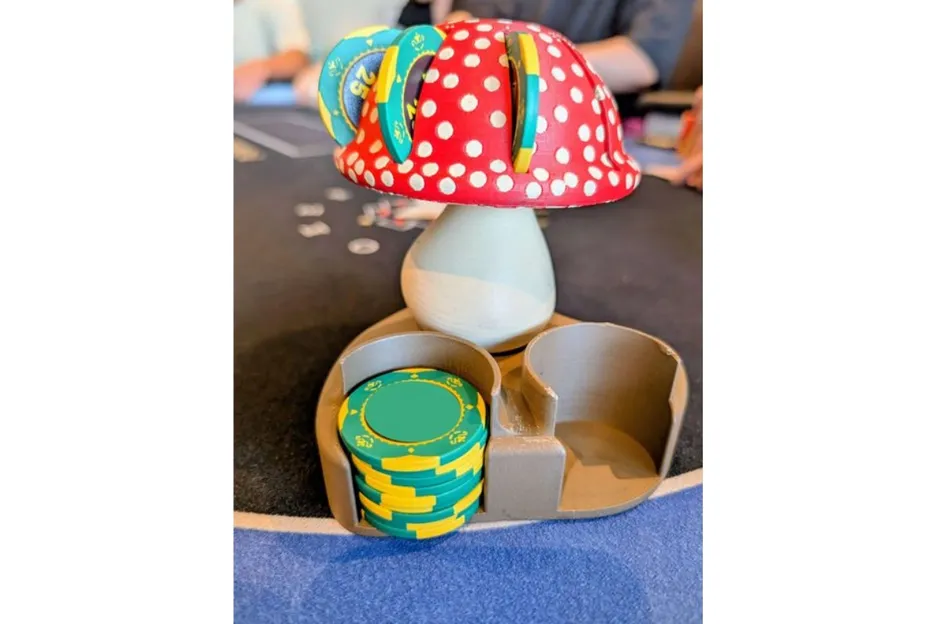
It's a $5 blind game, but the kitty is seeded with $25 (5bb) by each player. Every time you get the button, you have to put another $25 in the kitty. To win the kitty, you have to win successive hands from the small blind and button.
Kitties of $1,500 (300bb) are not uncommon – when the kitty is that big, correct strategy for the SB, and even more so a qualifying button, completely revolves around winning the kitty. The supposed $5 big blind no-limit hold'em game is now the side game.
Bounty games
Bounty games come in two different forms: a bounty for winning the pot with a certain (usually awful) poker hand, or a bounty for winning N pots in a row. In either case, all players at the table have to pay a pre-decided bounty to the pot winner.
The most popular one-hand bounty game is the 'seven-deuce' game – if you manage to win a pot with seven-deuce, you get a bounty from each player. If I were to be a carnival game nit, I'd suggest that the 'trey-deuce' game would put an even heavier burden on somebody trying to win a pot – a pair of 7's is not a terrible hand in hold'em – but I digress.
The 'Win N hands in a row' game is pretty straightforward, with 'three' being the most common bounty qualifier. More extreme versions of the game continue to increase bounties as a player wins a fourth, fifth... straight hand.

Stand-up/Nit games
One of the most popular carnival games is the 'stand-up' or 'nit' game. All players are given a special button. When a player wins a pot, they give their button back to the dealer. The last player left with a button has to pay a bounty to every other player. This, of course, incentivizes aggressive play, particularly when just two or three players have buttons.
A relatively recent, and extreme, version of the nit game is called the 'squid game.' In this variant, players start with no buttons, and are rewarded with a button for each hand they win. When a pre-determined number of buttons have been distributed, any player with no button owes one bounty per button to the players with buttons. You can easily see that the cost of losing a round of squid is enormous.
Bomb pots
I will argue that bomb pots aren't a carnival game per se. They're a completely different poker game, frequently interleaved into a 'regular' poker game. Proof because poker rooms can, and do, offer tables that are nothing but bomb pots. That's no different than offering a table of PLO or deuce-to-seven triple draw.
Bomb pots have some of the same features as carnival games, mostly higher variance and bigger pots, but they're not carnival games for the purposes of my discussion here.
Stick with me for a follow-up article later this week in which I'll give a couple of thoughts about carnival game strategy, and reflect on whether such games are good for poker as a whole.
Additional images courtesy of WPT/APT.


