


'Improve Your Poker Now!' by Topher Goggin and Alexander Fitzgerald is available as an ebook or paperback from D&B Poker.
With the 2026 WSOP in the books, it’s time to see what lessons we can take forward to next year.
When I wrote an article like this in 2025, I got to focus on things I did well en route to making a pair of Day 2s during a week-long Vegas visit.
While I had another fun trip this July – including cashing the Gladiators of Poker event for the second year in a row – this year’s stop on the self-reflection bus requires a harsher personal assessment.
Mistake du jour
Prolific coach Alex Fitzgerald, my co-author on 'Improve Your Poker Now!' recently published his own article about ways players sabotaged themselves at the Series. Number one on his list? Calling down too much.
Put me on the list of offenders. Twice I busted (non-desperate) stacks on purely self-inflicted wounds, succumbing to an error that plagues many recreational players: Being unable to get away from a hand despite overwhelming signs of trouble.
Alex’s admonitions about calling down too widely are good advice in countless poker spots, but I want to focus on a specific subset of those errors: Falling in love with a hand early and failing to do the mental analysis that could avoid potholes on later streets.





The recipe for disaster
To think about specifics, here’s how these catastrophes usually play out:
- The hand starts in a promising fashion, perhaps with a big pair or a quality flop, especially against an opponent that we subconsciously feel extra motivation to 'beat.'
- Mentally, we conclude that “THIS is it. THIS is the hand where I’m banking chips.”
- The board takes a turn for the worse on later streets, and suddenly the villain comes out firing. Caution lights are flashing.
- Our attachment to the hand from steps one and two prevents us from honestly analyzing the new developments, leading to unjustified decisions that are often disastrous.
Getting ahead of myself
To see this in action, let’s look at one of my mistakes.
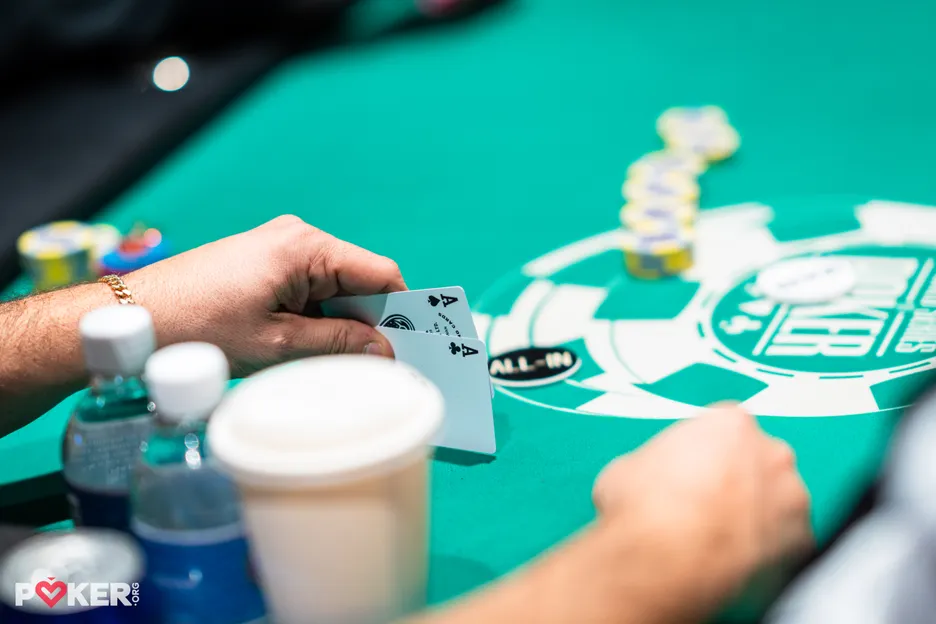
A few levels into a small buy-in bracelet event, I picked up 
 on the button while facing an early-position open. I had slightly below starting stack after recently losing a decent-sized pot, so the mental bells started going off that those chips were coming back. (This was my first error. Even though my errant play came later, my poor thinking started here by getting ahead of myself.)
I three-bet from the button, and was delighted when the big blind cold called. This particular player had run hot early, and was now playing nearly every pot. When the original raiser folded, I was in a dream scenario: Heads up, with aces, in position with the betting lead, in a large three-bet pot against a player with a weak big blind range. Score.
The flop came 

 and the big blind checked. It was a scary board for sure, but I followed through with a c-bet, which the big blind called. A lot of two-pair-plus hands would raise on a coordinated board like this, so I was likely still ahead. Rooting for a brick, I was rewarded when the
  hit the turn. Committed to chasing maximum value, I bet again, and my opponent came along once again.
The river brought the unwelcome  , making the final board . That would have been enough for me to tap the brakes and check. But as you’ve surely anticipated, the villain moved all-in, leaving me to contemplate a pot-sized call for the rest of my chips.
Of course, I didn’t really contemplate, and that’s the problem. If I had, I would have realized that the villain had very few plausible value hands I could beat. Bluffs were equally unlikely, as a huge percentage of the possible draws had either connected or made two pair on the river.
But I didn’t think about any of that. I had aces and had already decided this was MY hand. I may not have been mathematically 'pot committed', but I was mentally pot committed beyond the point of no return. Even though some part of me knew it was a mistake, I tossed in my chips, only to see my foe predictably turn over 
 for a soul-crushing, tourney-ending flush.

Breaking it down
It’s worth noting that a lot went right at first. I got the big blind, who I had correctly diagnosed as wildly loose, to passively cold-call a three-bet out of position with . He then called two value bets while behind. Those calls were fine – he made them with a flush draw and overcard on the flop, and picked up a pair on the turn. But I was still getting money into the pot with a solid equity edge. These are the types of plays that win tournaments against weak players that call too often.
Some people would say everything went in the dumpster when the ten of hearts hit the river. I disagree. The arriving is just poker. The hand went to hell when I failed to stop and think before I acted. I fully understand that low-stakes players don’t bluff enough, and that bluff catching is rarely profitable absent a mountain of missed draws. But that information isn’t worth much if you don’t pause long enough to think about it.
My problem was not getting the above analysis wrong. It’s that I didn’t do the analysis in the first place. That’s the take-home lesson here. I allowed my emotional attachment to the situation to pull me out of my routine. That’s a form of mid-hand tilt, and I paid the price.
These kinds of errors snare everyone, but they happen a lot less frequently to top players than weak ones. (They’re also precisely why Alex and I advocate value betting as the best way to make money against amateurs. Recreational players are waiting to impatiently pay off, just like I did here.)
Stay on target
If you want to be a consistent poker winner, you must ingrain a routine so you will follow it every time. No hand is over until the dealer pushes the pot. Prematurely committing to a course of action 'no matter what' is a recipe for missing opportunities of all kinds.
Those could be opportunities to salvage a hand that looked lost, or like here, a chance to escape from a beat with your stack intact. As we all begin the long countdown to the 2027 World Series, learn from my errors and commit to making your best decisions no matter the circumstances.


