


In the virtual streets of the online poker arenas, there's no shortage of approaches one can take when it comes to an overall strategy for multi-table tournaments (MTTs).
And, with an action-packed weekly schedule currently running on PokerStars on FanDuel, it's not a bad time to revisit the fundamentals.
Before that, a quick word on that schedule – it's chock full of high-value events.
There's the $100 Nightly Stars with a $20K guarantee and the $200 Battle Royale with a $15,000 guarantee – both of which come as part of the packed slate on Mondays. The Nightly Stars also runs Tuesdays, Wednesdays, Thursdays, Fridays, and Saturdays.
On Tuesdays, the $50 Mini Super Tuesday and the $200 Super Tuesday dominate the schedule. With respective guarantees of $10,000 and $17,500, both events provide heaps of value at a reasonable price point.
Thursday follows a similar pattern with the $50 Mini Thrill and the $200 Thrill – with $10,000 and $18,000 guarantees, respectively.
And then Sunday brings the big guns:
- $75 Sunday Marathon, $8,000 GTD
- $50 Sunday Mystery, $10,000 GTD
- $100 Sunday Dynasty, $75,000 GTD
- $30 Sunday Shield, $25,000 GTD
- $250 Sunday Storm, $35,000 GTD
- $150 Sunday Cooldown, $7,000 GTD
And, of course, the fabled Sunday Million – one of the most famous tournaments in the online poker world.
MTT 101: Class in session
Now, let's get down to the strategy.
When it comes down to it, there are four key stages:
- The Early Stage
- The Mid-Game
- The Bubble
- The Late Stage & Final Table
Now, how you approach each of these various stages is up to entirely up to you – and, as they say, there's more than one way to skin a cat. Or, in other words, play however you want to.
With that said, we've put together a solid baseline strategy for anyone looking to improve their tournament play or simply brush up on the basics.

The Early Stage
In the opening frames of a multi-table tournament, stacks are deep – typically upwards of 100 big blinds to start. With so many chips to work with, you can take a couple different approaches.
If you want to play a loose and aggressive style to see as many flops as possible, that's one way to go. It's always a good idea to pick up chips, but even more so in the early goings. As the tournament runs on, a big stack becomes increasingly valuable – building one early by battling hard in the streets is never a bad idea.
On the other hand, you can take a more tight-aggressive approach and protect your starting stack. Remember, you can't win a tournament at the beginning – you can only lose.
The Mid-Game
During the middling stages of a tournament, stacks grow increasingly shallow as the blinds rise.
With that, it might be a good time to tighten up to a certain degree – play fewer speculative hands and focus on waiting for good spots to put chips in the pot. During this time, stack sizes at the table will vary widely and moves that weren't recommended earlier in the tournament – a pre-flop all-in against a single raise when short-stacked, for example – become much more viable.
At the same time, your opponents are experiencing the same pressure and ramping up the aggression might yield dividends.
In many ways, the key to a winning tournament strategy lies in your ability to adapt to varying stack sizes – both your own and your opponents'.
The Bubble
Here's where it gets a little tricky. As the field whittles down, your chips become more and more valuable. Now's not the time to get out of line with wide opens or big bluffs. In some ways, it becomes a waiting game. With each passing elimination, your tournament life becomes more important than picking up chips.
Unless, of course, you're on a big stack. If you've got the ammunition, now's the time to use it. With pressure mounting and short stacks likely abound, there will be plenty of uncontested chips ripe for the taking.
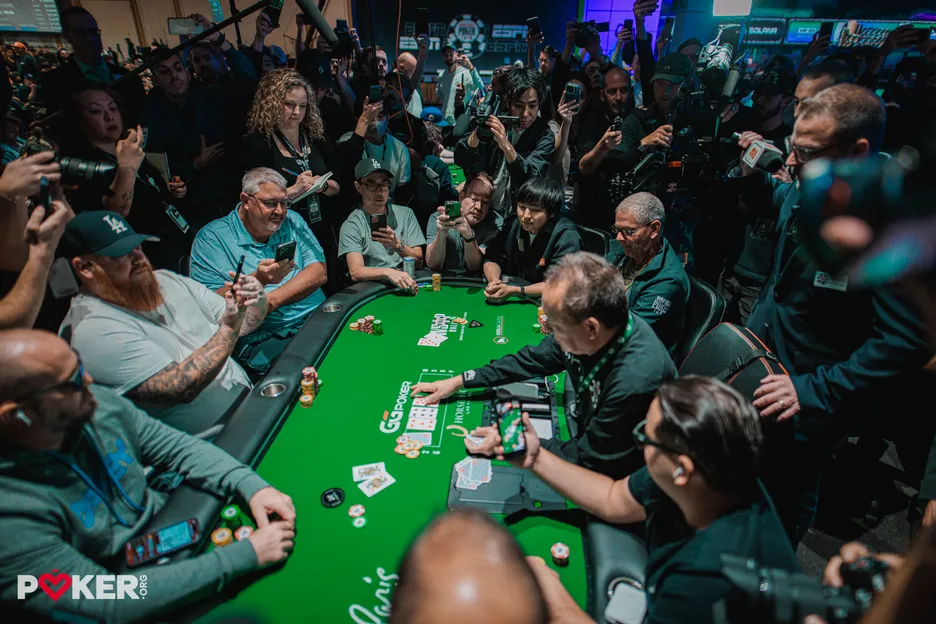
The Late Stages & Final Table
Once you're in the money, it's time to accumulate. If you were on a short stack during the bubble, now's the time to spin it up.
And if you were one of the big stacks, remember that you can't abuse the chip disparity between your stack and your opponents' as effectively anymore. While pay jumps can be significant in certain spots, the pressure to ladder up isn't as extreme as the pressure to make the money was.
If you reach the final table, the independent chip model (ICM) becomes the governing body for many decisions. At this stage, each elimination comes with a significant pay jump – outlasting the shorter stacks at the table becomes increasingly valuable. With that in mind, it's important to tighten your ranges to a certain degree as you pursue the win.









Cheap tournaments to test your mettle
PokerStars on FanDuel currently offers plenty of chances to take on MTT fields for just $5.
Try these daily tourneys to hone your skills for real cash prizes, without busting your bankroll (all times ET)
- $5 Morning NLHE (8am)
- $5 Morning Bounty (9am)
- $5 Morning PLO (10:30am)
- $5 Afternoon PLO (4:30pm)
- $5 Mini Starter (6:15pm)
- $5 Daily Duel (7:30pm)
- $5 Big KO Duel (8:45pm)
For more strategy fundamentals, check out our complete guide to poker strategy for beginners.
And to put your strategies into action, try PokerStars on FanDuel.