

Welcome to another installment in our regular series of articles using Octopi Poker to examine key hands from the world's biggest tournaments, and celebrating great players making incredible plays.
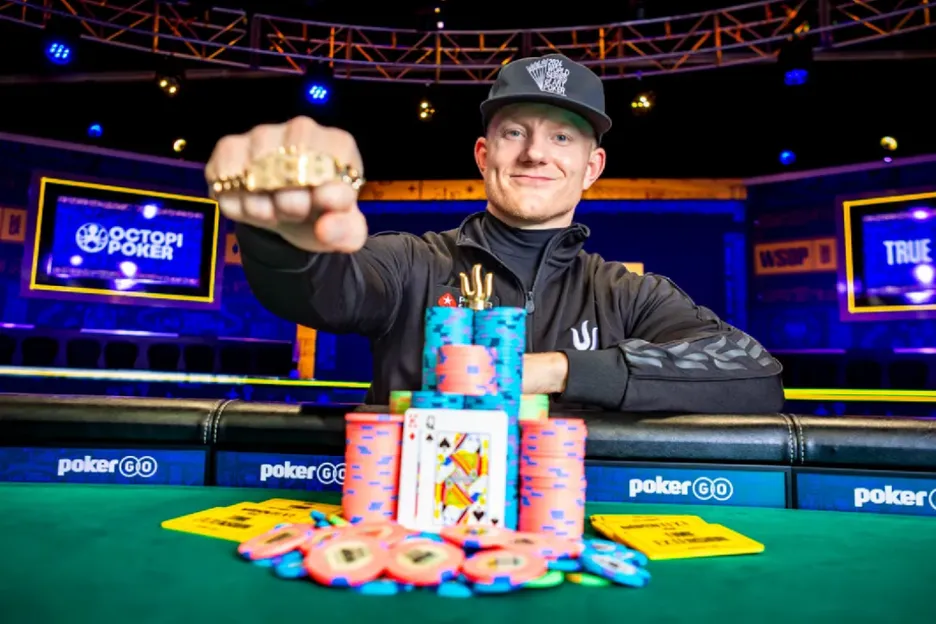
This time, we examine a particularly interesting hand from the $50,000 High Roller at the 2025 WSOP, one of several pivotal pots that helped Jason Koon secure his second World Series of Poker bracelet.
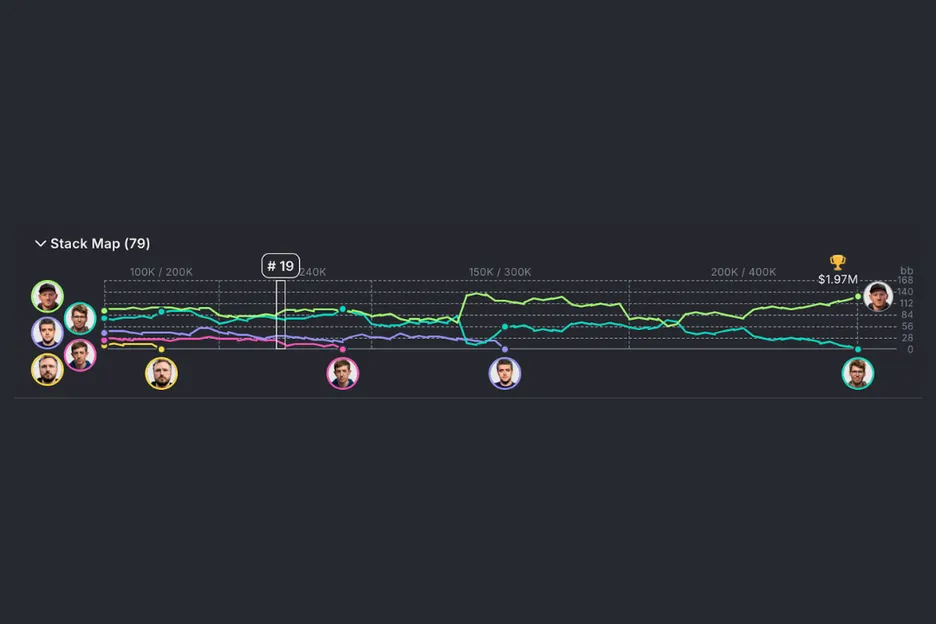
Jason Koon has added another title to his illustrious resumé, capturing his second World Series of Poker bracelet in Event #32: the $50,000 High Roller, and $1,968,927. The prestigious tournament drew many of the game’s elite, generating headlines across the poker world as top professionals battled for a multi-million dollar prize pool.
Today, we analyze a hand from the final table where Jason Koon battled with a talented Brock Wilson holding the same hand, that illustrates just how thin the margins for error can be at this level — and how significant deviations from GTO strategy can quickly prove costly.
This hand, along with related preflop and postflop simulations, can be found in the Octopi Vault (professional subscription required).
Payouts, ICM implications and risk premiums
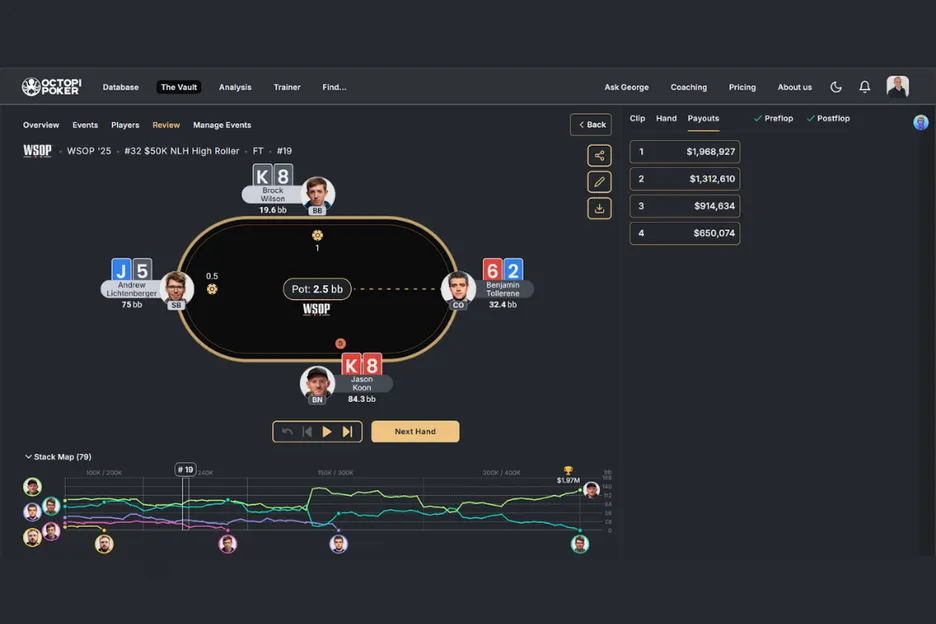
The hand begins with four players remaining, with 2 big stacks belonging to Jason Koon (84.3bb) and Andrew Lichtenberger (75bb), a medium stack of 32.4bb of Ben Tollerene and the shortest, yet still quite playable stack of 19.6bb of Brock Wilson. All four remaining players are the High Roller elite, experienced and studied in ICM dynamics.
The payouts grow progressively from $650K for 4th to almost $2M for 1st. Let’s take a look at the Risk Premium matrix that highlights the 'ICM pressure' the players can exert upon each other, enabled by their stack differentials:
CO: Ben Tollerene, 32.4bb
BTN: Jason Koon, 84.3bb
SB: Andrew Lichtenberger, 75bb
BB: Brock Wilson, 19.6bb
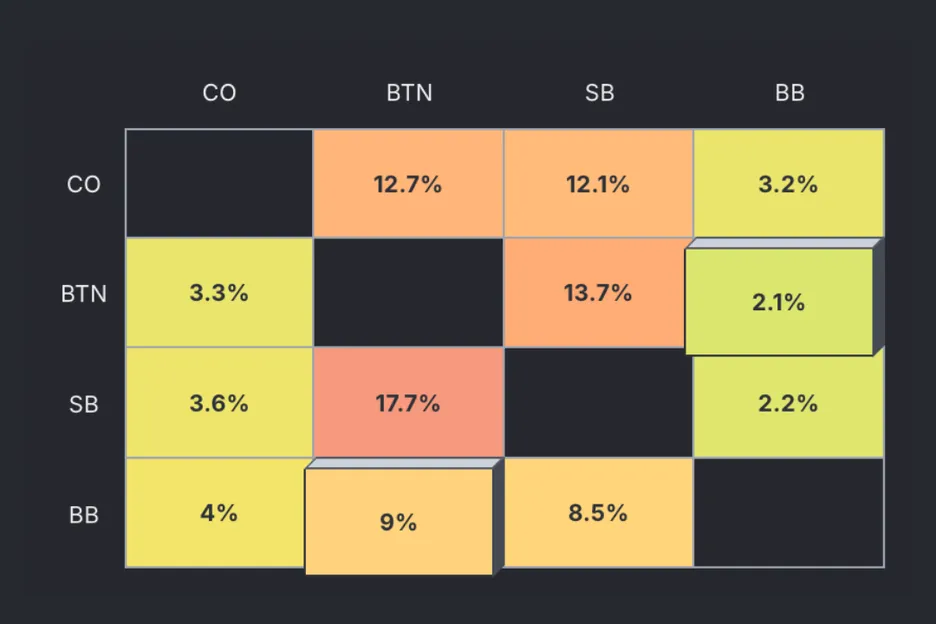
In tournament poker, risk premium measures how much extra equity (percentage of the pot) relative to a raw equity of the hand is needed to justify calling an all-in. Busting terminates the player’s ability to win top prizes while doubling doesn’t automatically assure a higher payout; therefore winning chips is not as 'important” as losing them all. The amount of risk premium is driven by the differentials between the stack sizes of all remaining players.
We can see that the highest 'ICM pressure' is from BTN (84.3bb) to SB (75bb) - a whopping 17.7%! If SB were to bust BTN in a presence of 2 much shorter stacks, it would be an ICM disaster.
However, if SB were to double through BTN, reaching 150bb and crushing the chip leader down to 9.7bb, it would also be an ICM disaster, so the risk premium in the opposite direction is the second highest, at 13.7%. In the close 3rd, both BTN and SB can pressure the middle stack of CO to the tune of 12%.
The lowest risk premium is from the shortest stack to the biggest two, as they will not lose too much of their potential by doubling the shortest stack.
In a nutshell, the higher the risk premium, the tighter you must call or commit chips.









Preflop action
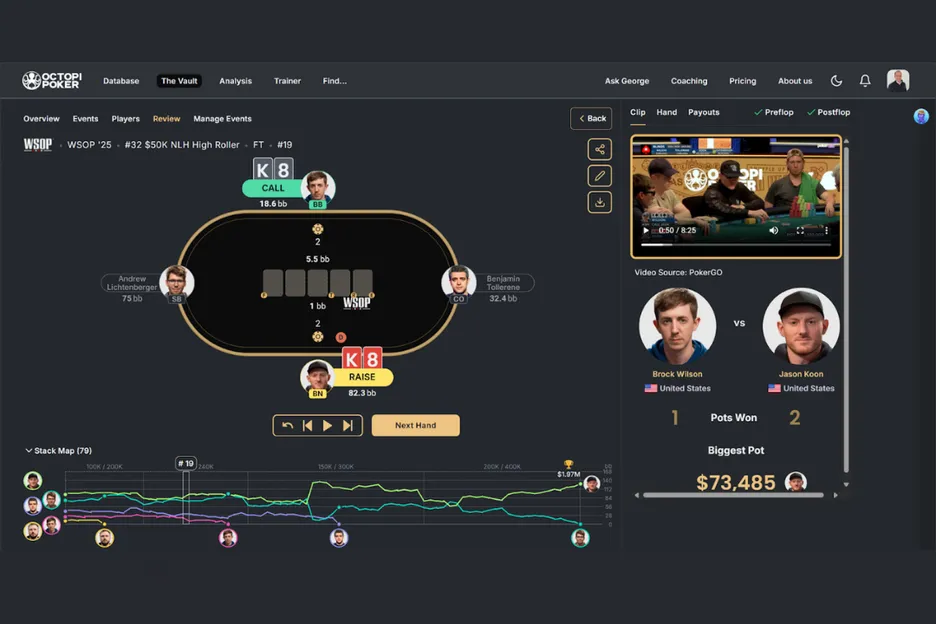
The hand begins with blinds of 120K/240K and a 240K ante. Jason (BN), holding 84.3 big blinds, opens to 2 big blinds with 
 . Brock (BB), the short stack with 20.6 big blinds, calls holding the same hand —
 — differing only in suit.
We can analyze their strategies using the custom sim from Octopi Vault to determine if they played correctly and to glean insights into their ranges for post-flop analysis.
Preflop range analysis
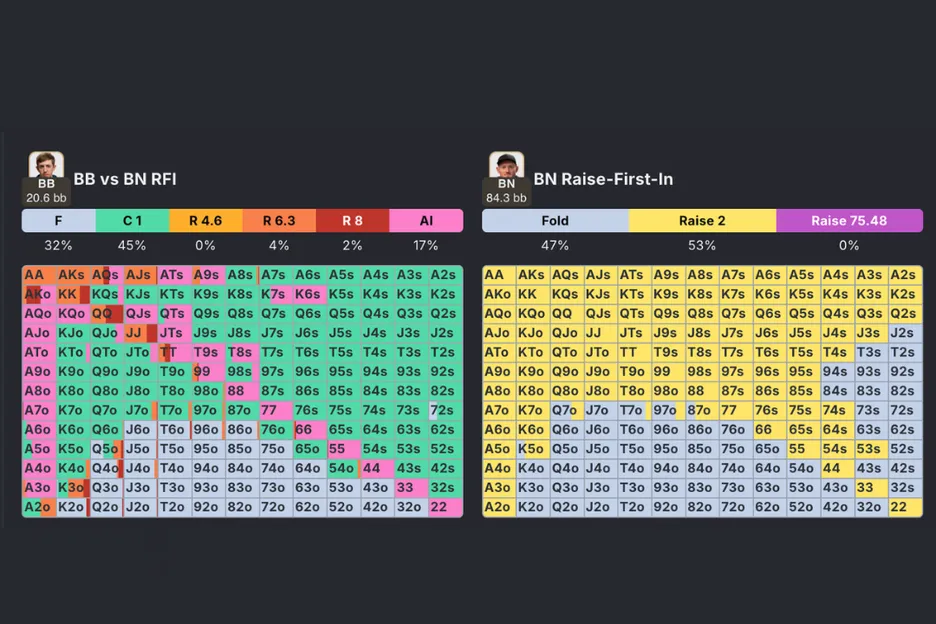
As a chip leader, Jason can open to a min raise of 2 bbs about 53% of the time, similar to chipEV. He doesn’t need to size up since Brock in BB is not incentivized to get involved due to a risk premium of playing against a stack that covers him by so much. is a clear raise.
As the short stack in the Big Blind, Brock employs a linear strategy by:
- Re-jamming high equity hands with low playability or good blockers (pairs, Ax, suited broadways) low to middle pairs, A3o–AQo, ATs/A9s, and select suited connectors and one-gappers (QJs, QTs, JTs, T9s, T8s, K6s),about 17% of his range.
- Raising the very best hands (JJ+/AJs+), about 6% of the range
- Folds bottom 32% and calls the rest
K8s is a clear call.
The flop
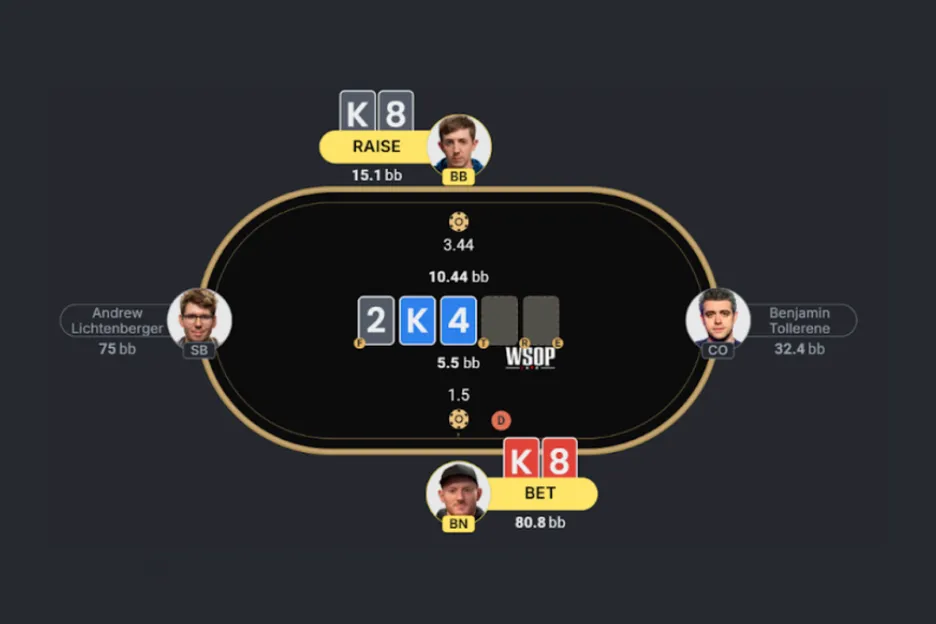
Brock, BB: check
Jason, BN: bet 1.5BB, 27% of pot
Brock: raise to 3.44BB, 23% of pot
Jason: call
The 

 flop is a K-high dry, disconnected board with a diamond flush draw. BTN will have a significant range and nut advantage. Since BB lacks any pairs as hole cards, they can only have a top pair, A high, and a flush/straight/combo draws at their disposal, while BTN can have better everything. Using Octopi’s Side-by-Side Range Explorer, we can see the flop equities and related strategies for both players:
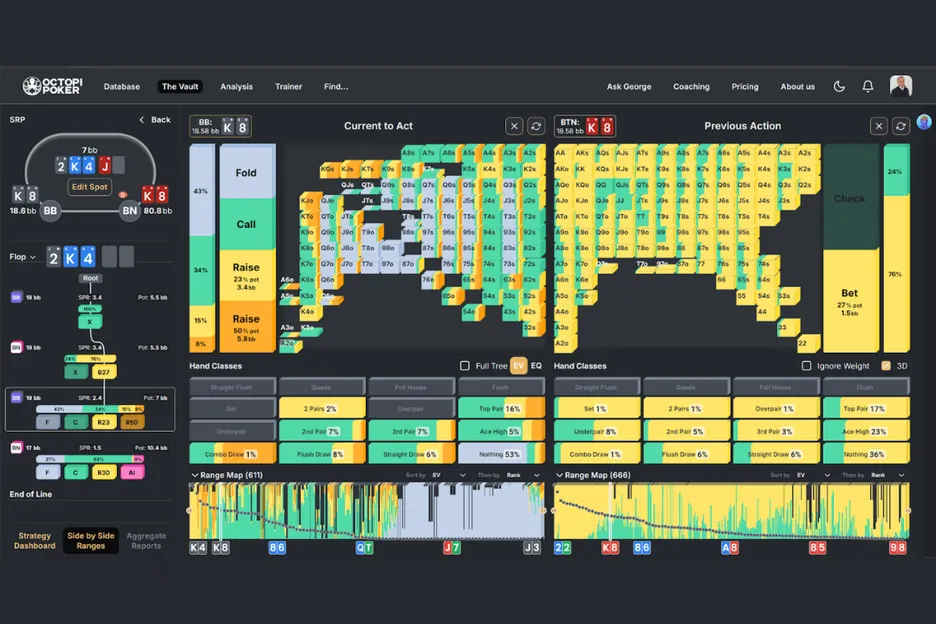
Unsurprisingly, BB has a range check and BTN can c-bet 76% of the time, using a small sizing of around 27% of the pot. His check-backs mainly consist of underpairs to the king, some A-highs, and occasionally draws or top pairs to protect his checking range. With he’s meant to bet 68% of the time, which he does.
Versus a small c-bet, Brock:
- Folds about 43% of his range outright (all the nothings)
- Calls pairs, A-high and draws
- Raises all 2 pairs, best top pairs and some draws
- Small raises around a quarter of the pot are reserved for 2 pairs and draws and a bigger raise of 50% is used primarily to raise the strongest top pairs and some of the weakest bluffs
K8s, especially with a backdoor flush can mix calls and small raises. Brock elects to use the small raise size. Back to Jason: facing a check-raise, his range:
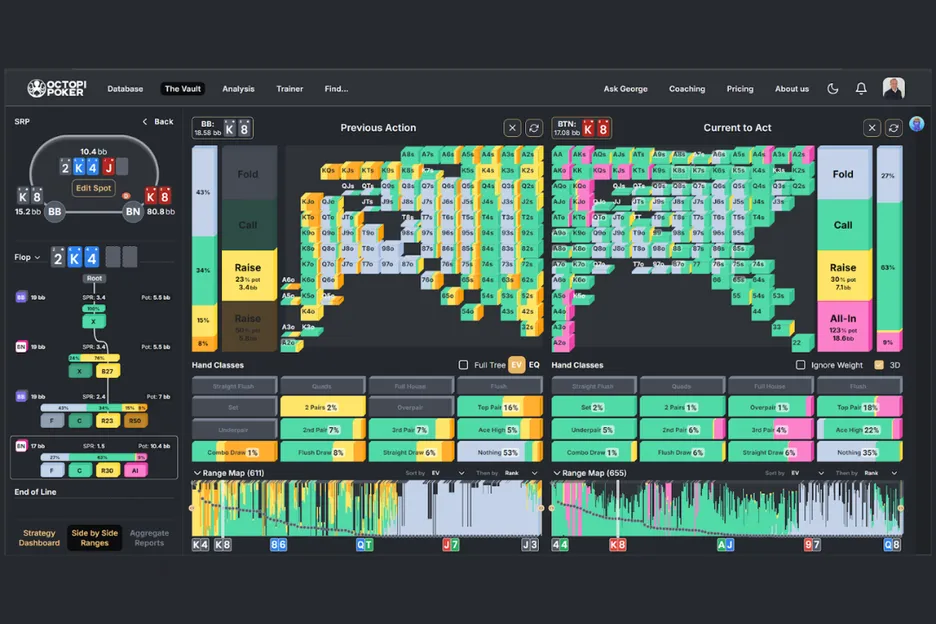
- Folds 27% of the bluffs
- Rejams 9% of his best top pairs for value, and 2nd/3rd pairs/draws as bluffs
- Calls the rest
K8s is a clear call.
The turn
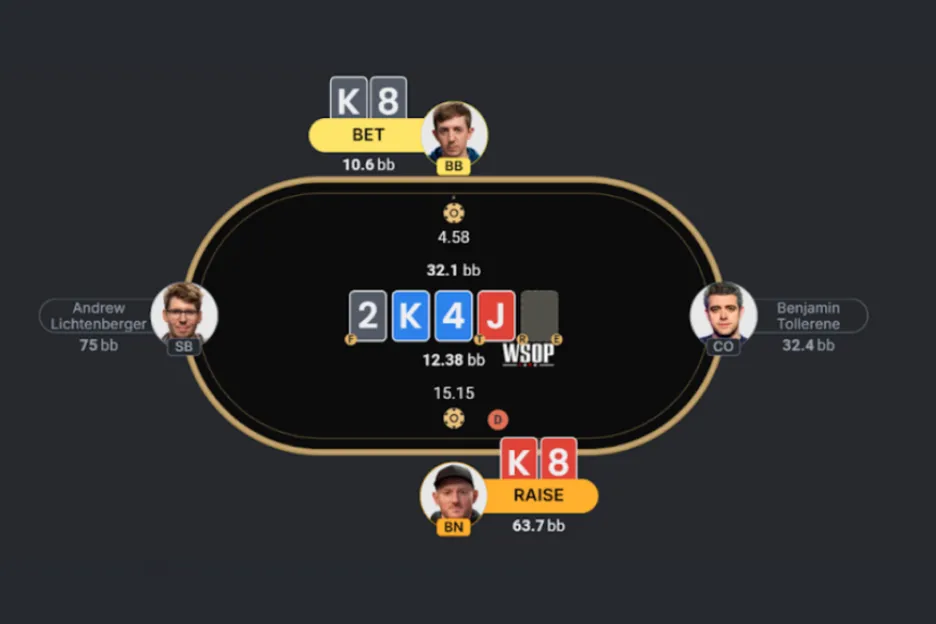
Brock, BB: bet 4.58BB, 37% of pot
Jason, BN: all-in
Brock: fold
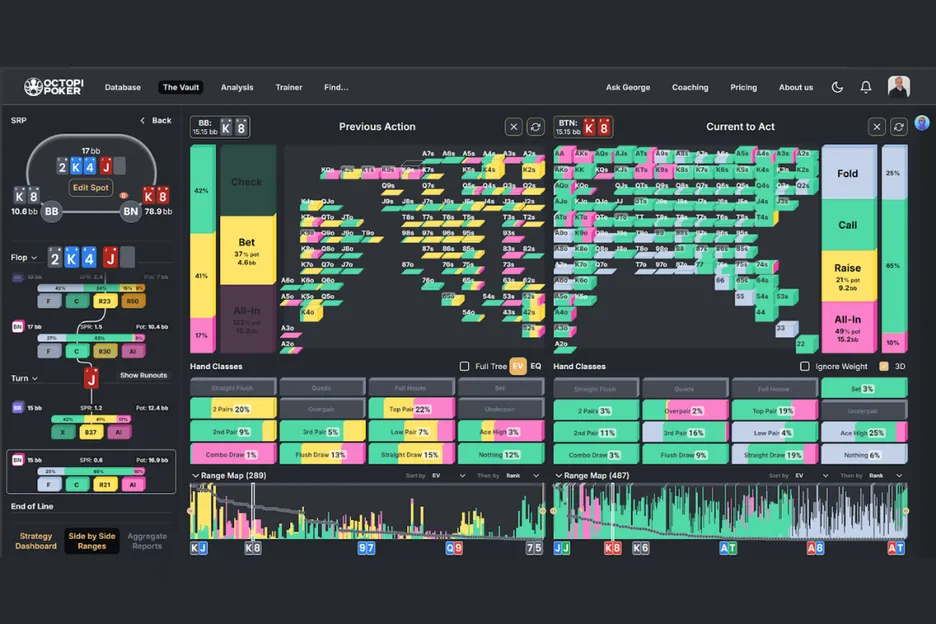
The  rarely hits BB range, apart from KJ specifically, and an occasional bluff with backdoors. For the BTN, it hits slightly better the broadways that floated the small check-raise, like AJ/QJ/QT, but never strong enough to defer a top pair from betting.
K8 is so high in BB range that it must continue barreling and be willing to stack off, splitting the aggression between a non-all-in bet, setting up a half-pot river jam and an outright jam. Brock chooses to bet non-all-In for 37% of the pot.
Jason’s range again prefers to continue by calling about 65% of the time, folding only the weakest portions — such as some low pairs, ace-highs, and complete trash — roughly 25% of the time.
Around 10% of the time, he wants to jam in this spot for value and to deny equity against the semi-bluffs in Brock’s range.
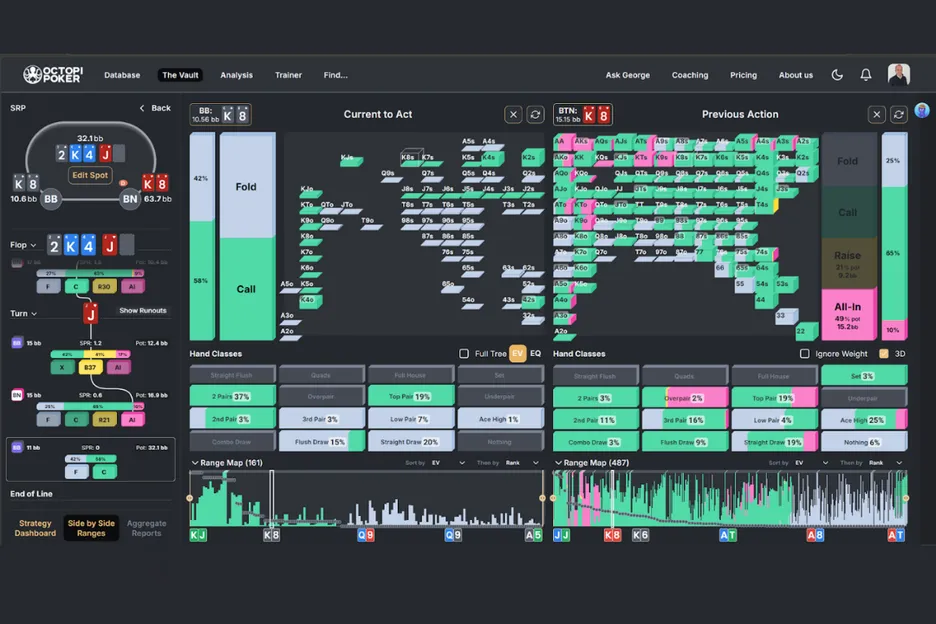
Jason’s decision to jam the turn
Jason correctly recognized that this class of hands does in fact want to jam at a decent frequency. However, K8 was just a pip too wide. K9/KT are in there though, along with AK, AA, and some slow-played KQ. A few gutshot straight draws with an ace blocker are included for balance, while sets and two pairs continue to be slow played. Shoving with K8 is a minor mistake, all things considered.
Brock’s decision to fold
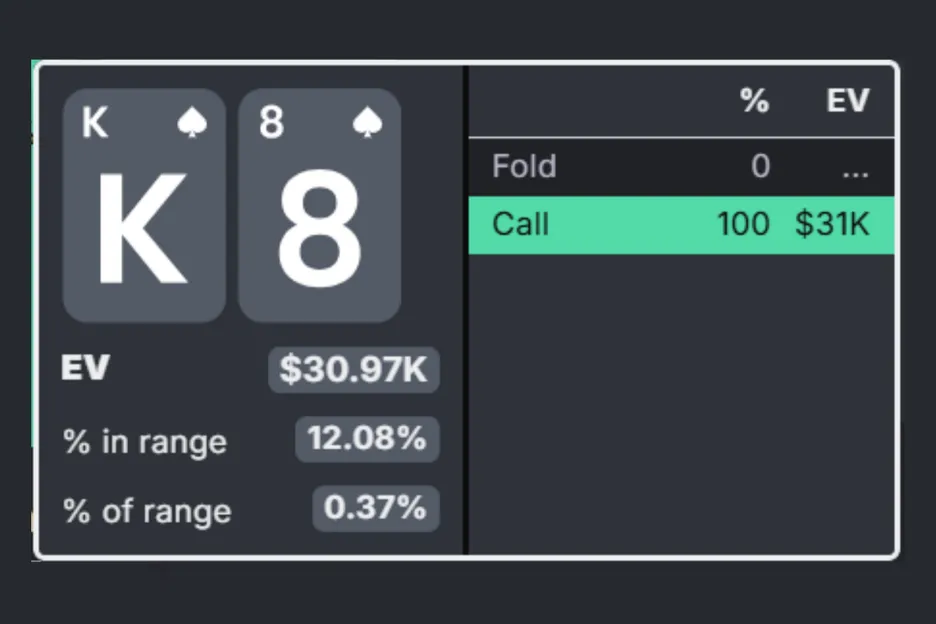
Facing the turn re-jam, BB’s strategy is crystal clear. They are calling every Kx, and every remaining J with a flush draw as well. Folding a top pair is losing $31K!
Given that Jason actually shoved too wide, the EV of calling would very likely increase even more. Rewatching the clip and listening to Brock’s expressed thoughts after Jason’s shove, it’s clear he underestimated how frequently Jason should be fast-playing the flop in position here. Or maybe he didn’t give Jason enough credit for mixing in some semi-bluffs or slowplaying his top-range hands again.
Brock feared exactly the hands Jason was representing on the turn — strong holdings like AK, KQ, KJ, and KT — that would have put him behind. After several minutes of careful consideration, Brock ultimately made the incorrect fold, missing out on a split pot that could have improved his chances of advancing even further in the tournament.
Conclusion
Both Jason and Brock played the hand perfectly up until the turn, and then both made a mistake on their last action. Jason’s mistake was to shove wider, while Brock’s mistake was not giving the opponent the correct shoving range and folding a hand that’s too strong to fold. In absolute value, Brock’s mistake was bigger.
As often is the case with poker in general, and especially so at the highest stakes, the over-aggression has over-performed, while the over-folding was harshly punished. While the decisions are often close and nuanced, the mistakes are costly. In the eventual outcome, left with 11bb Brock finished 4th while Jason rode to victory.
Octopi Poker aims to revolutionize poker training making it fun, accessible and affordable, with low subscription tiers for everyone, from beginners to elite pros. Choose from Community (free forever), Personal ($25 a month) or Professional ($65 a month).
Try Octopi Poker Trainer for FREE today!