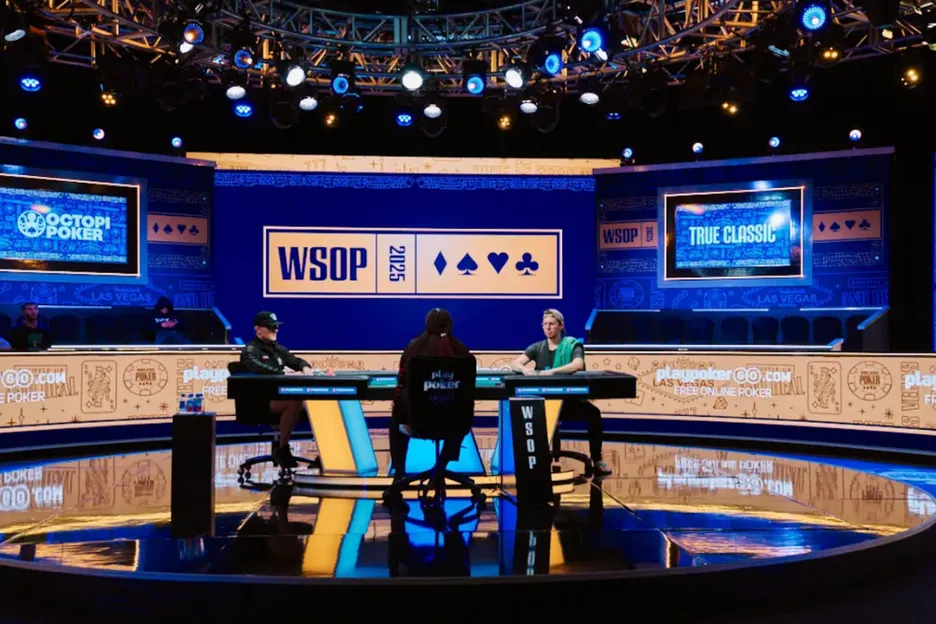


Welcome to another installment in our regular series of articles using Octopi Poker to examine key hands from the world's biggest tournaments to celebrate great players making incredible plays.
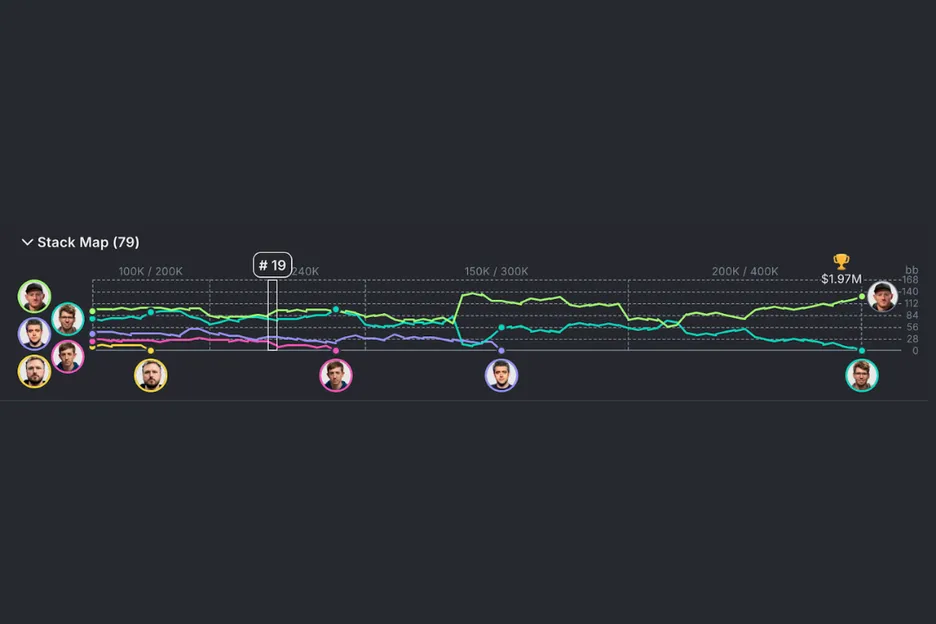
This time, we examine a particularly interesting hand from the $50,000 High Roller at the 2025 WSOP (Event #32), one of several pivotal pots that helped Jason Koon secure his second World Series of Poker bracelet.
Jason Koon has added another title to his illustrious resumé, capturing his second World Series of Poker bracelet in Event #32: the $50,000 High Roller, along with $1,968,927. The prestigious tournament drew many of the game’s elite, generating headlines across the poker world as top professionals battled for a multi-million dollar prize pool.
Today, we’ll break down a pivotal hand from the final heads-up match, where Jason Koon made an outstanding call against a bold bluff from Andrew 'LuckyChewy' Lichtenberger.
This hand, along with related preflop and postflop simulations, can be found in the Octopi Vault (professional subscription required).
The spot
Jason, the chip leader, starts on the button with 76.6 BB, first to act. Andrew sits in the big blind with 49.3 BB. The payouts at stake: $1,969,000 for first and $1,313,000 for second.
Click here to view the complete hand history, chip movement breakdown, and video replay.
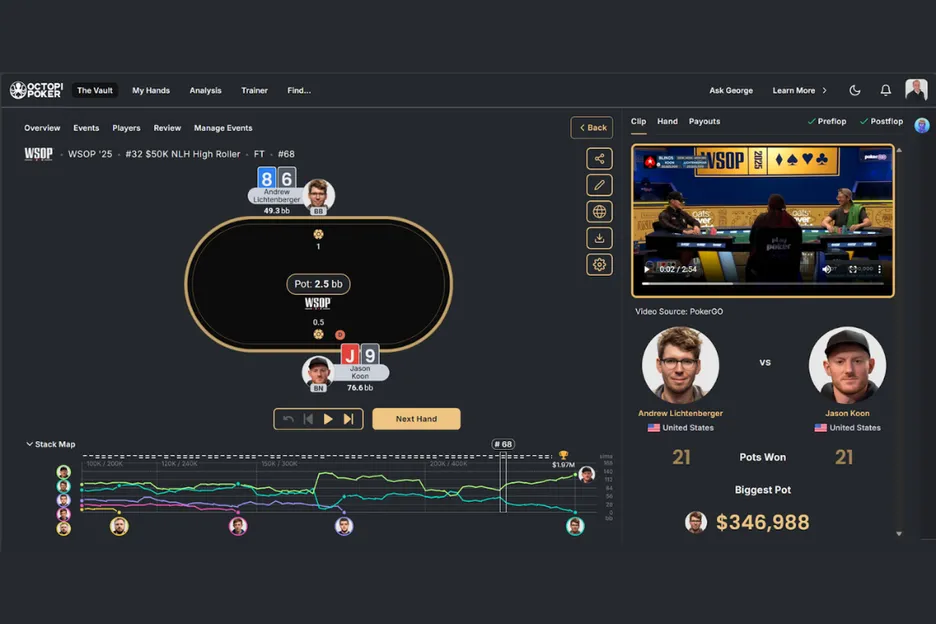
For Andrew, a $656,000 pay jump and a WSOP bracelet are on the line. Jason, currently with a decent chip lead, risks losing control of the match if he loses a big hand.








Preflop action
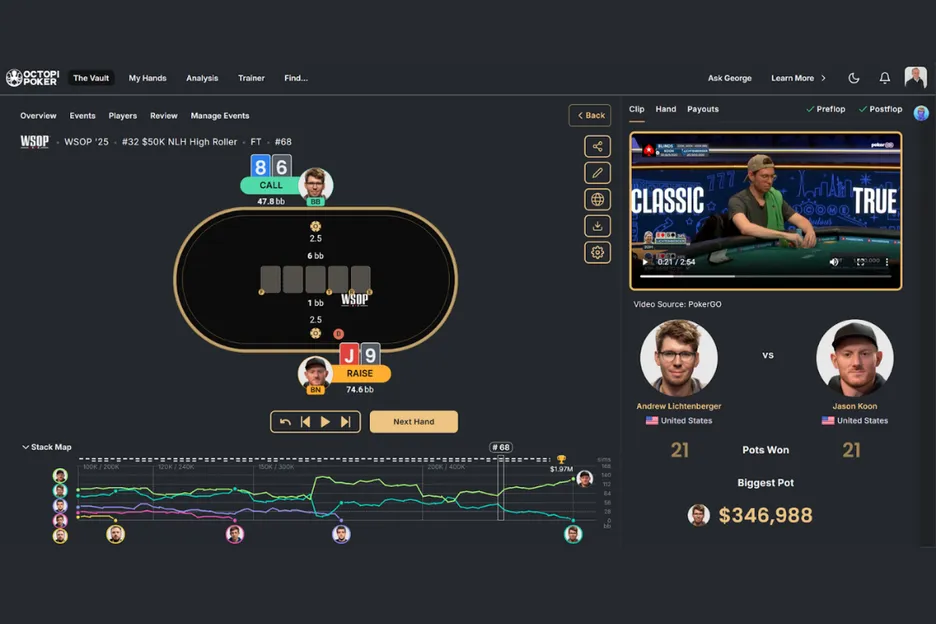
The hand begins with blinds at 200K/400K and a 400K ante. On the button, Jason opens to 2.5 BB with 
 . In the big blind, Andrew calls with
 .
.
We can analyze their strategies using the custom sim from Octopi Vault to determine if they played correctly and to glean insights into their ranges for post-flop analysis.
Preflop range analysis
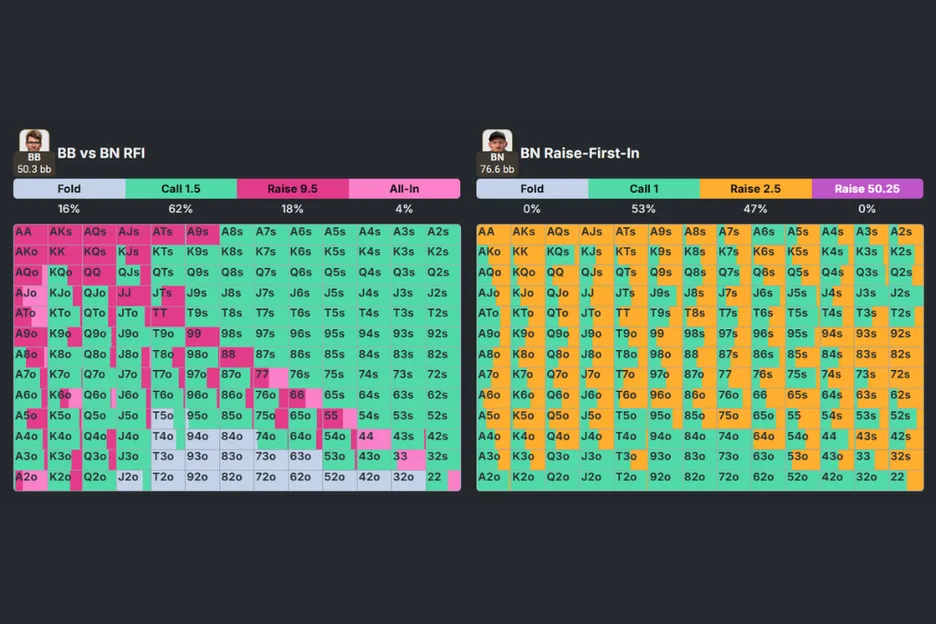
Jason's button strategy
- On the button, Jason never folds. He takes full advantage of the pot odds created by the big blind ante, ensuring that every hand is played in some form.
- Around 53% of his range is played as a limp. This approach lets him see flops cheaply while allowing his stronger hands to protect the weaker ones from big blind aggression. When faced with raises, he can respond with calls or re-raises, backed by enough strong holdings to keep his range balanced.
- The remaining 47% of the time, Jason raises to 2.5 BB with a wide variety of combinations, maintaining pressure and maximizing his positional advantage.
Andrew's big blind strategy facing a raise
- The most common action (62%) is to call and see the flop. This part of his range includes the middle-strength hands that aim to realize their equity, all suited holdings, and most decent offsuit combinations.
- Folding occurs only about 16% of the time, and almost exclusively with his weakest offsuit 'trash' hands.
- Around 18% of the time, he 3-bets with premium holdings such as 88+, KQs, KJs, and his best AQo+ and A9s+ combinations — hands that are comfortable stacking off after further aggression. These are balanced by Ax and Kx blocker 3-bets, which are folded if met with resistance from the BTN.
- About 4% of the range jams, typically with low- to mid-pocket pairs, along with hands like AJo, ATo, A2o, and K6o.
Preflop range analysis takeaways
Jason’s raising range is uncapped, covering everything from premium holdings to complete 'trash'. Andrew’s calling range is also wide, containing many strong suited combinations, but it lacks all pocket pairs and the very top of his range.
The flop
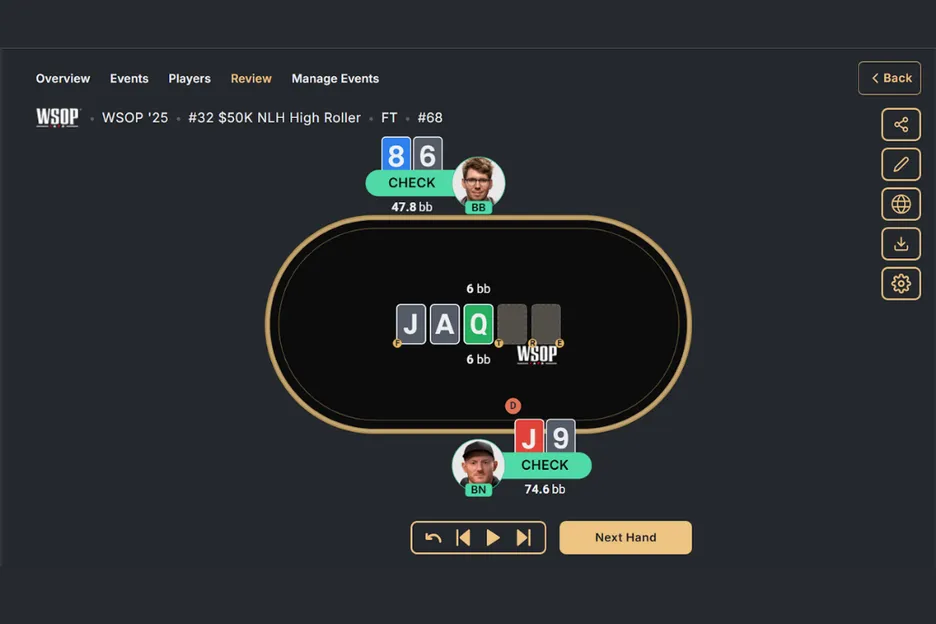
Andrew, BB: check
Jason, BN: check
The 

 flop is an ace-high connected board with a spade flush draw. The button holds a slight range and nut advantage, as the big blind lacks all sets and the strongest two-pair combinations. However, the current nuts — KT — is represented equally in both ranges, so Jason can’t go overboard in this spot.
Using Octopi’s Side-by-Side Range Explorer, we can see the flop equities and related strategies for both players:
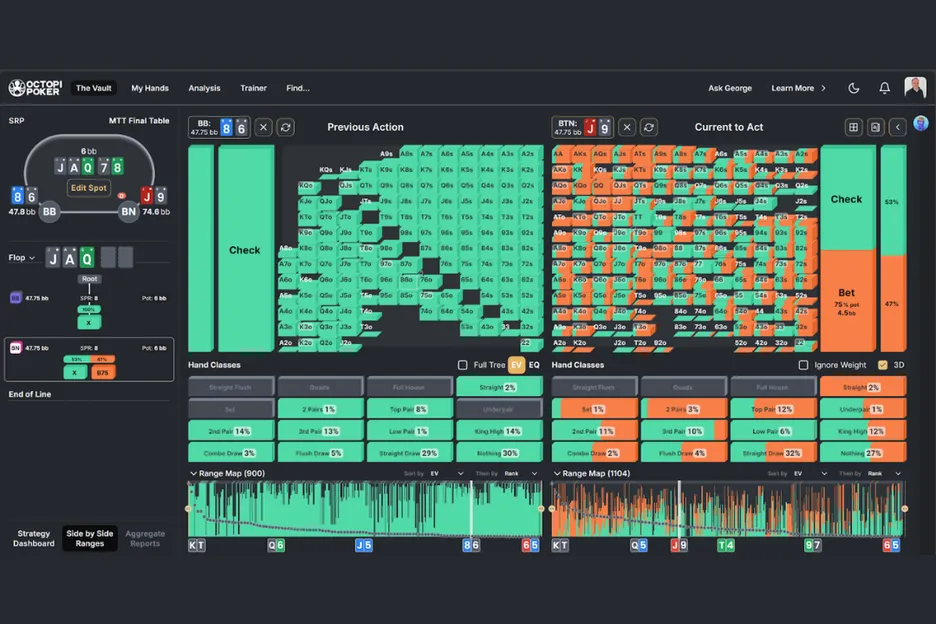
Andrew checks his entire range, while Jason adopts a mixed strategy — checking some hands and betting 75% pot with much of the top of his range, a good portion of his draws, and occasional low-equity bluffs. To protect his checking range, he includes many of his weakest Ax holdings, some second and third pairs, along with top set AA and occasional QQ.
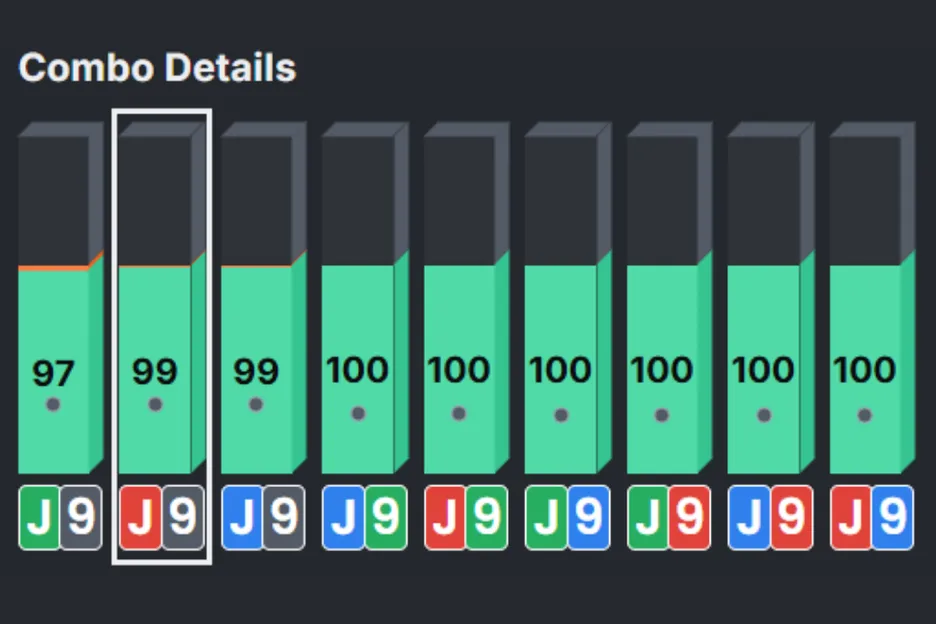
is a pure check in this spot, only betting around 1% of the time.
The turn
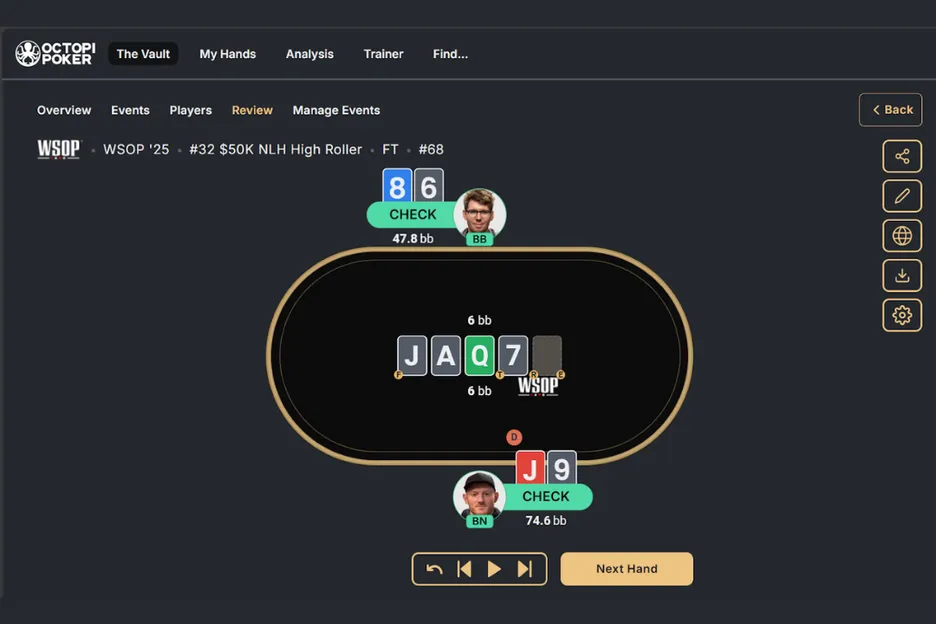
Andrew, BB: check
Jason, BN: check
The  is a fairly wet card, completing the flush but not improving the straight draws. It’s a relatively neutral turn, as both players still have plenty of flushes in their ranges at this point.
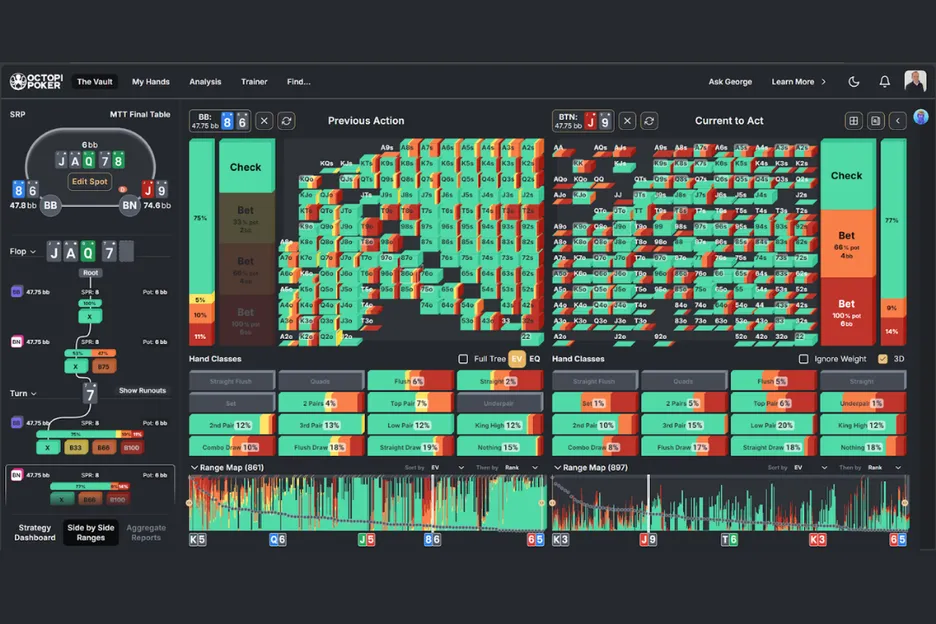
Andrew should check about 75% of the time — not only with 'trash' hands holding little to no equity, but also with the top of his range roughly half the time, including flushes, straights, and two pairs. The middle of his range also checks frequently, aiming to realize equity. This creates a tricky turn strategy, keeping the option open for check-raises with nutted hands while protecting his checking range out of position. As a result, his range remains largely uncapped.
About 25% of his range bets, mixing three sizes — 33%, 66%, and full pot — across various hand classes.
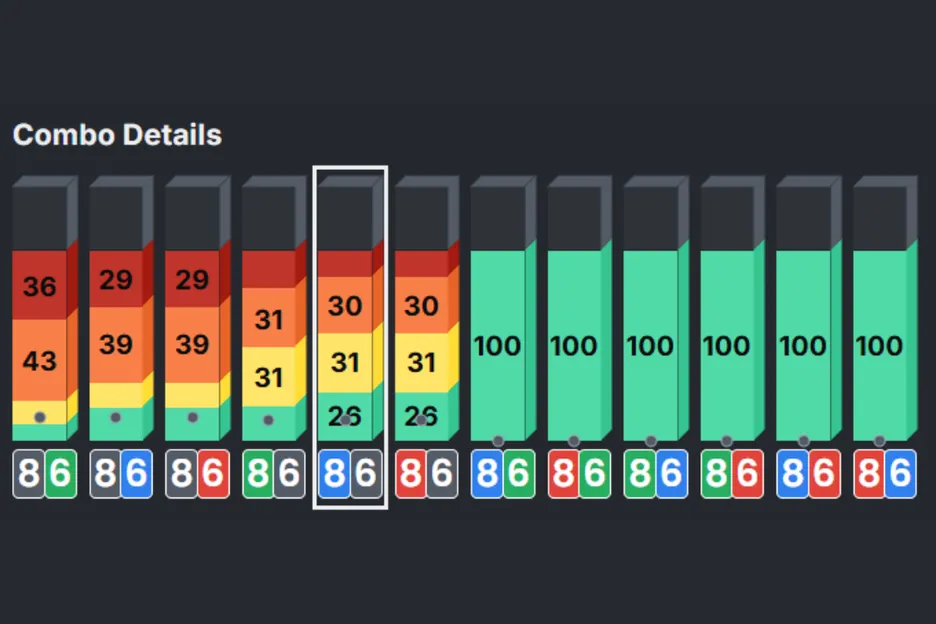
prefers betting the turn but checks about 26% of the time.
Jason should remain fairly passive on this turn, as his flop check already capped his range by removing much of the top end and most straights. The flush-completing card also leaves him vulnerable against Andrew’s potential flushes.
When he does bet, the preferred sizes are 66% or full pot, targeting value with top pair+ hands that checked back the flop, along with some semi-bluffing draws. Notably, 37% of his flushes still check in position on the turn, leaving his strategy unexploitable heading into the river.
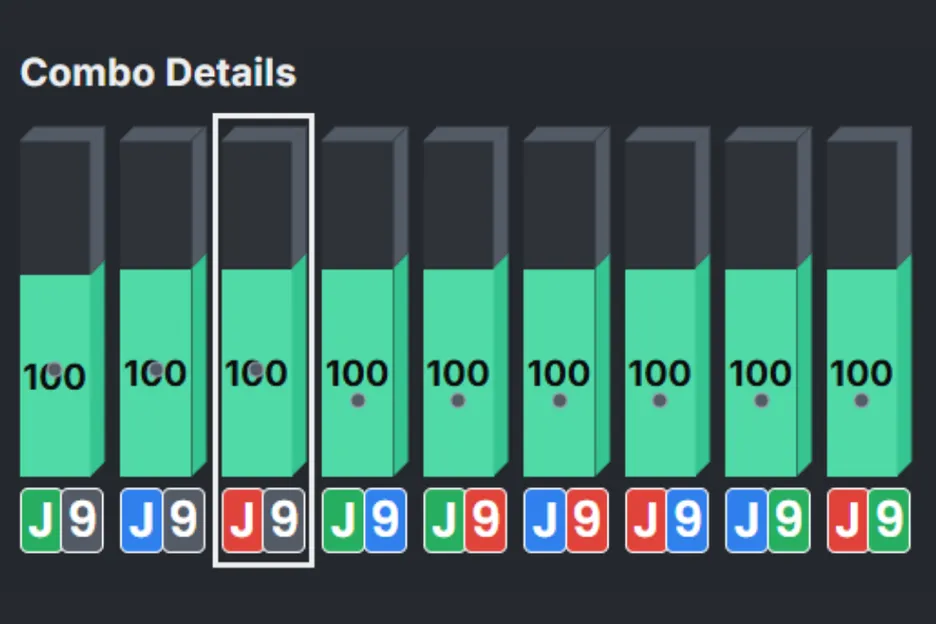
With , betting accomplishes little — the hand isn’t strong enough for value and doesn’t require much protection.
The river
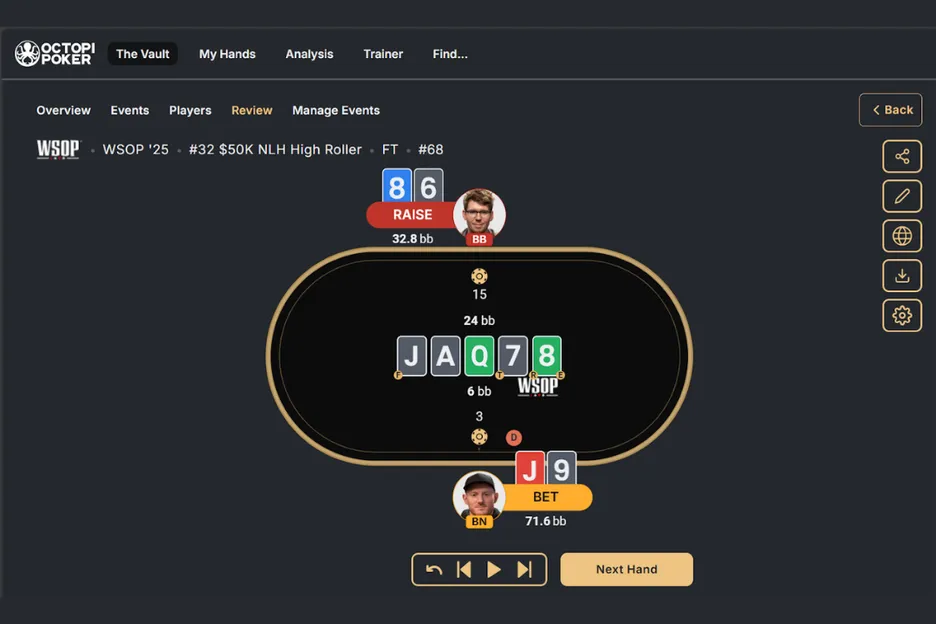
Andrew, BB: check
Jason, BN: bet 3bb, 50% of pot
Andrew: raises 15bb, 100% of pot
Jason: call
The  on the river is essentially a blank, improving neither player’s range except for the occasional T9 straight.
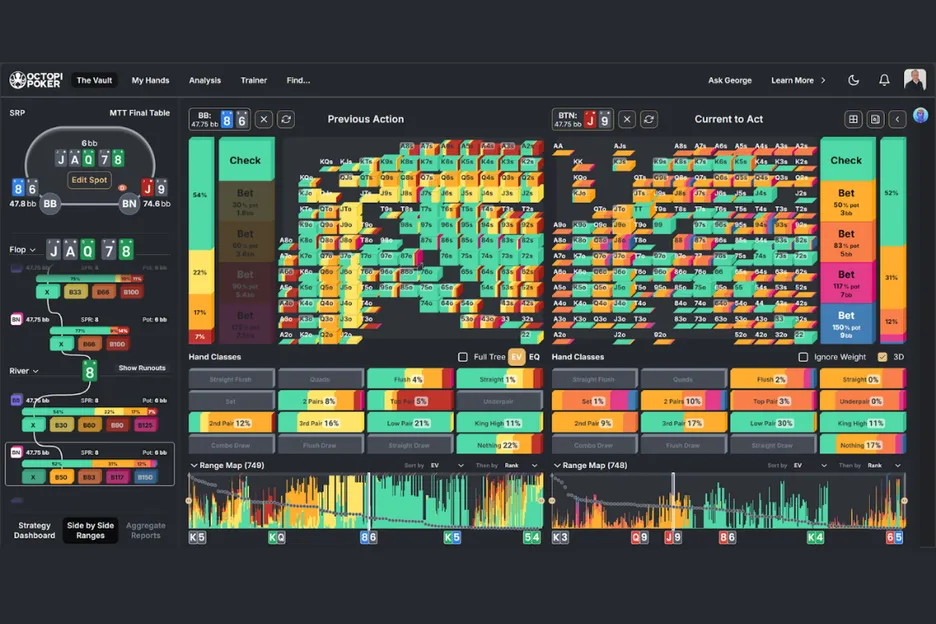
Andrew’s range is fairly polarized, tending to check with the top end — flushes and straights — as well as most low-equity hands. Meanwhile, his two-pair combos, top pairs, and most Qx holdings prefer betting outright, often with larger sizing.
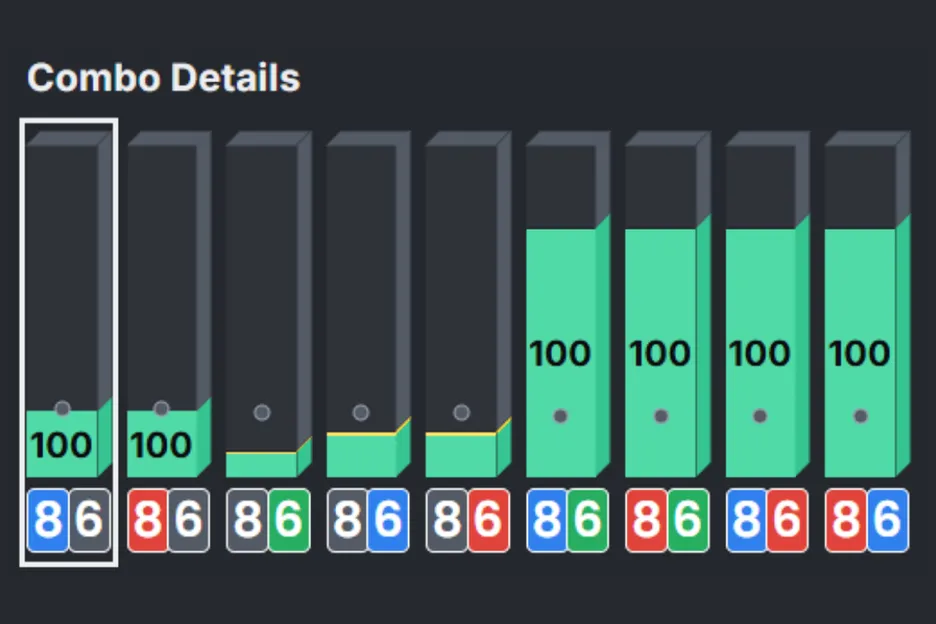
With pairing the 8 on the river, he opts for a pure check.
At this node, Jason can bet with a wide variety of hand classes. His smallest bets are 50% pot, while larger bets up to 150% pot are also part of his strategy, reserved for his double-checked top range and complete trash. He still checks back about 52% of the time with Jx, small pairs, and all his K-high hands.
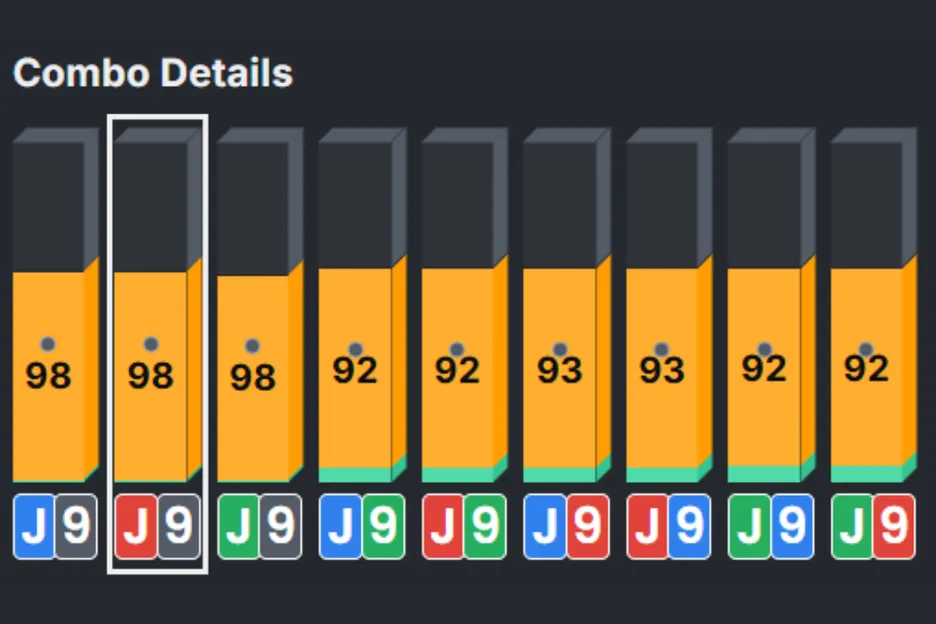
Jason’s hand is a pure value bet, and he chooses the perfect sizing by betting 50% of the pot.
Andrew’s decision to raise
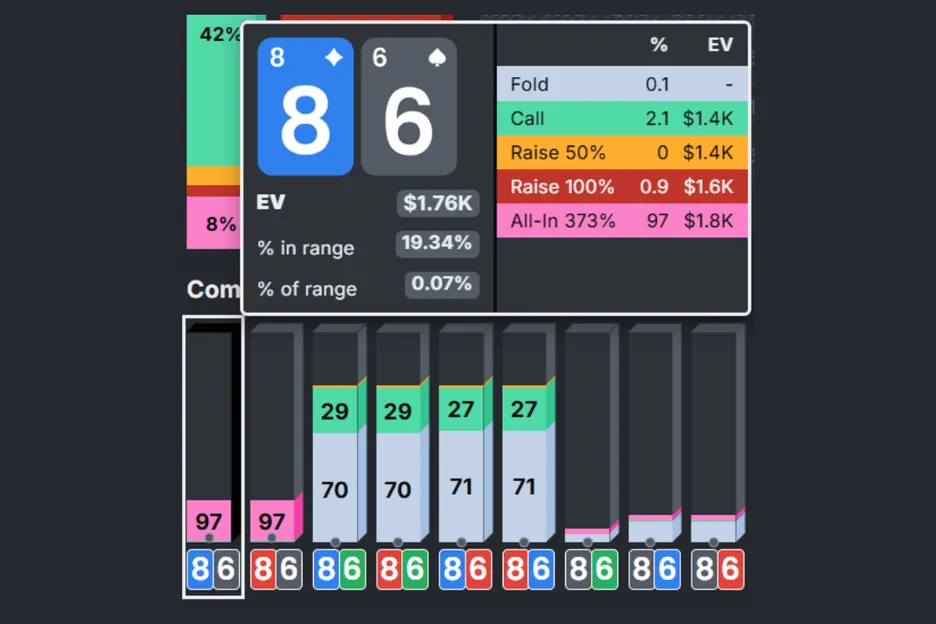
Facing a 50% pot bet on the river, Andrew correctly reads that his pair of 8s is likely behind Jason’s thin value bets. With his blocking some flushes, his hand is a prime candidate for a polarized check-raise bluff. He mirrors how he would play his top range if checked three times to Jason.
He opts for a large raise of 100% pot, while most of his other combos are either barely calling or folding.
However, we can see that this polarized 100% check-raise is actually too small for the spot. The solver prefers a pure jam here, applying maximum pressure on Jason by extracting the most value with strong hands like straights and flushes, while maximizing fold equity with bluffs.
Jason’s decision to call facing a pot raise
We can already see that is almost indifferent between folding, calling, or even re-jamming. As a pure bluff catcher, Jason can’t gain much EV from any of these options unless he deviates from GTO and leans on exploitative reads of Andrew.
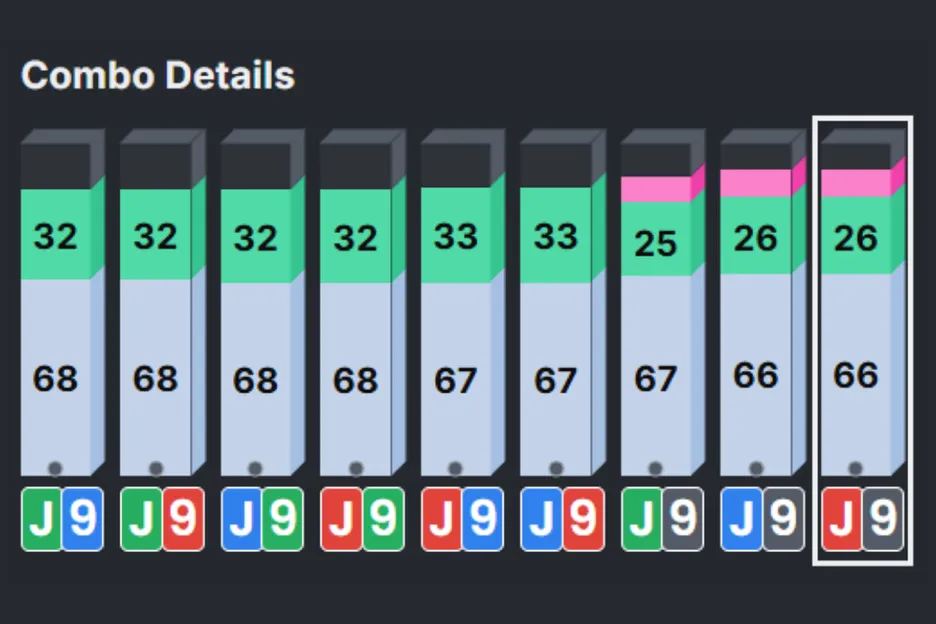
What if Andrew had shoved the river?
Facing a river jam, Jason would mostly fold, calling only about 9% of the time with this specific hand.
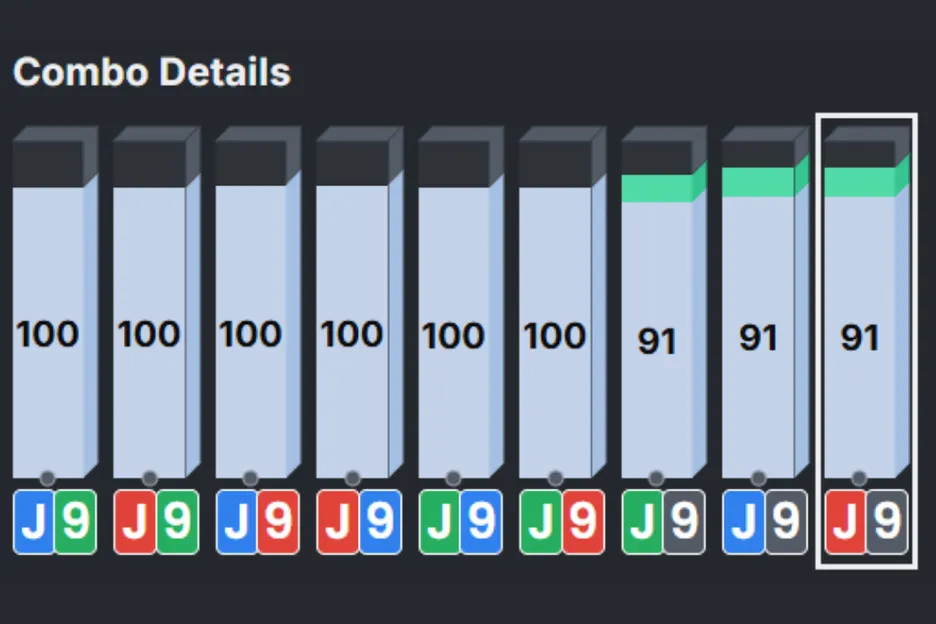
After careful consideration, Jason makes the tough but correct call, increasing his chip lead and his chances of winning another title and bracelet — which he ultimately did.
Conclusion
Today, we took a deep dive into a spot where two outstanding players showcased exceptional range awareness and a profound understanding of the game.
Andrew demonstrated a fierce willingness to fight for every pot, employing creative lines when it mattered most. Can you really fault him for opting for a large raise instead of shoving the river?
Maybe the story would have ended differently, but Jason ultimately sniffed it out and won the match — crediting his opponent for crafting these bluffs and not being afraid to pull the trigger.
Octopi Poker aims to revolutionize poker training making it fun, accessible and affordable, with low subscription tiers for everyone, from beginners to elite pros.
Choose from Community (free forever), Personal ($25 a month) or Professional ($65 a month). Try Octopi Poker Trainer for FREE today!


