

Even when you know the rules of poker and how to play the game, there are still plenty of terms and phrases you’re likely to come across that may leave you scratching your head.
And that’s where Poker Talk Explained comes in. We’ve previously looked at terms relating to poker players, as well as the vocabulary of betting. Now we turn our attention to poker games themselves.
So if you’re not sure what the difference is between the 7-2 game and a game of 2-7 (trust me, they’re very different), this one’s for you.
For a comprehensive guide to all poker terminology, check out our detailed poker terms page.
3-max, 6-max, 8-max: Indicates the maximum number of players at each table.
7-2 game: A ‘carnival game’, putting a twist on a regular game of Texas hold’em via a special rule: anyone who wins a pot holding 7-2 (statistically the worst hand in hold’em) immediately wins a set bounty from every other player at the table. Not to be confused with 2-7 (deuce to seven), a lowball draw variant where players try to make the very worst hand possible (2-3-4-5-7).
Big-bet: If it’s not fixed limit, it’s a ‘big bet’ game — either pot-limit or no-limit poker.
Bomb pot: A type of hand you can play in any flop game, such as Omaha or hold’em. Everyone pays an ante, receives their cards, and then the preflop betting round is skipped entirely. Betting begins on the flop with the player to the left of the dealer. With no preflop betting, anyone really could have anything. Add in the extra cards of PLO, and even double-board versions with two sets of community cards, and you’ve got a fun — if hair-raising — game of poker. Bomb pots might be played occasionally, such as when a new dealer enters the box, or even as an entire cash game or tournament.
Bounty: A tournament format which sees a prize awarded for every player you eliminate, usually in addition to standard tourney payouts. Each buy-in is split between the regular prizepool and the bounty pool.
Cap: A cap game or hand gives each player the same set limit of chips they can put in the pot, which they cannot exceed; when they reach the cap they’re effectively all-in — even if they still have chips behind.
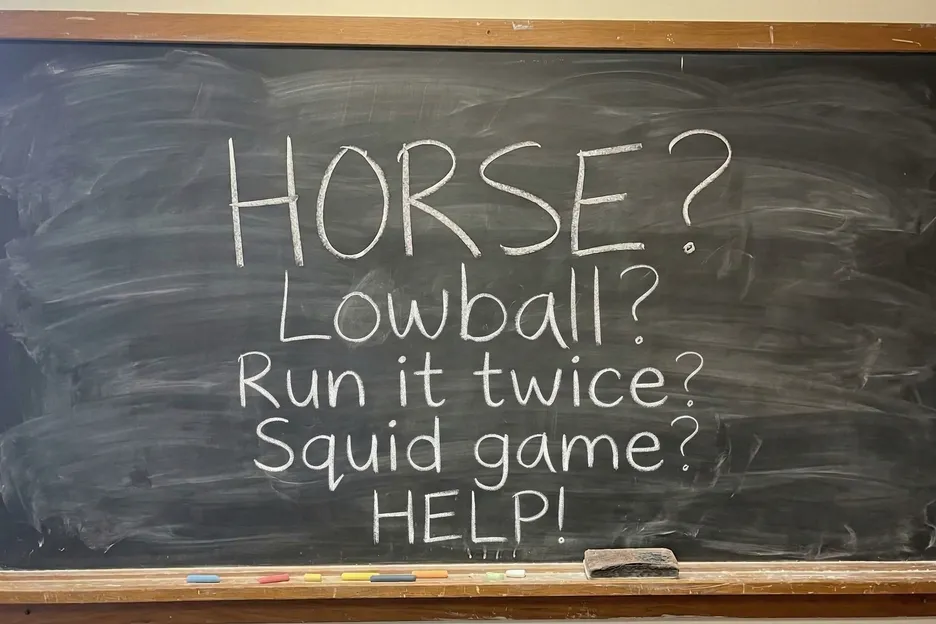
Carnival game: A ‘game within a game’ of poker, adding a twist usually intended to make the game play looser or bigger. Examples include the 7-2 game mentioned above, and the ‘stand-up game’ which sees all players remain standing until they win a pot, at which point they may sit down; the last player standing pays a forfeit to all other players, such as in the 7-2 game. This might also be played with tokens, and called names like the ‘squid game’.
Double-board: The ‘board’ in a flop game like hold’em is the row of community cards which everyone may use. In a double-board game, two boards are spread simultaneously, with the pot split evenly between the winners of each. It’s possible, and obviously desirable, to win both boards.
Fast fold: A format, used for both tournaments and cash games, where all players are grouped into a pool. As soon as you fold, you’re instantly re-seated at a new table with opponents from the pool, making for a much faster experience and the ability to play many more hands in less time.
Heads-up: A poker hand played between just two people. Any hand can reach heads-up when only two remain, but heads-up games or even entire tournaments (played with knockout brackets) are also common.
HORSE: A mixed game that includes five poker variants, played in sequence and usually as fixed limit games. Together, the names of the games spell out ‘HORSE’ (sort of): Hold’em, Omaha, Razz, Seven-card stud and stud Eight-or-better.
Jackpot Sit and Go: A sit and go poker tournament with a randomised prizepool, usually winner-take-all and ranging from just double the buy-in (in a three-handed game, for example) to many multiples, even up to a million dollars. Hitting a larger multiplier is much less common than hitting a low one.
Lowball: A poker game that inverts the traditional poker hands rankings, with the worst hand winning at showdown. Includes draw games like 2-7 triple draw or single draw, and stud games such as razz (which is 7-card stud played low). In some games straights and flushes do not count as high, making A-2-3-4-5 the lowest (and therefore best) hand. In others they do, making 2-3-4-5-7 unsuited the best hand. Make sure you know which version you’re playing.
Meet-up game: A (usually) friendly game organized as a chance to meet up and play with a community or a notable name, such as a vlogger, a well-known pro or a cardroom ambassador.
Milestone satellite: Also known as a ‘target’ or ‘cash-out’ satellite, these tournaments award their prizes whenever your stack hits a certain size. For example, if your starting stack is 3K, you might win a ticket when you reach 50K. If you have chips left over after hitting the target they may be removed from play, or you may be able to remain in the game and use them to try and win another ticket.
Mystery Bounty: A bounty tournament (see above) with a difference. Bounty prizes are only available once the tournament reaches the payout stages, and winning one affords the player the chance to randomly draw from all remaining bounty prizes, which will vary — often dramatically — in size.
Private game: An invitation-only poker game. This might be a friendly home game with friends, or a collection of wealthy high rollers in a roped off corner of a casino.
Progressive bounty: Another type of bounty tournament, this time where the bounty on each player’s head increases every time they bust out another player. Often, when you eliminate a player, you will add half of their bounty to your own, and take the other half as an instant cash prize. Also known as a Progressive KO, or PKO.
Run it twice: When a player is all-in in a flop-based cash game before the river, if everyone involved chooses to run it twice the remaining community cards will be dealt twice, effectively creating two separate boards with the winner of each receiving half the pot. Some games may offer the chance to run it three times, or more.
Satellite: Any tournament where the prize is not cash, but instead grants access to a higher buy-in tournament. For example, a $10 satellite might award one entry to a $100 tournament for every 10 players in the satellite.
Sit and go: A poker tournament that begins as soon as the required number of players have registered. These could be single-table or multi-table tournaments. Furthermore, ‘on demand’ sit and go tourneys begin when a certain number of players have registered, but keep registration open for a set amount of time, or until a maximum number of entrants is reached.
Stand-up game: A carnival game designed to increase action and punish nits — see above.
Time game: A cash game where the house does not take a rake from pots, as is customary in many casinos, but instead charges players a set fee, usually charged every 30 minutes. Time games may be spread for legal reasons, in places where taking a rake is not permitted, or in higher stakes games where the usual rake percentage may be deemed too high by players.
Visit the PokerOrg poker glossary for a detailed explanation of every poker term you'll ever need to know.
Featured image created using AI.


