


We’ve all been there. A player in front of you opens the pot.
You look down at a playable, but non-premium, hand. Folding, calling, and three-betting are your options.
How do you decide?
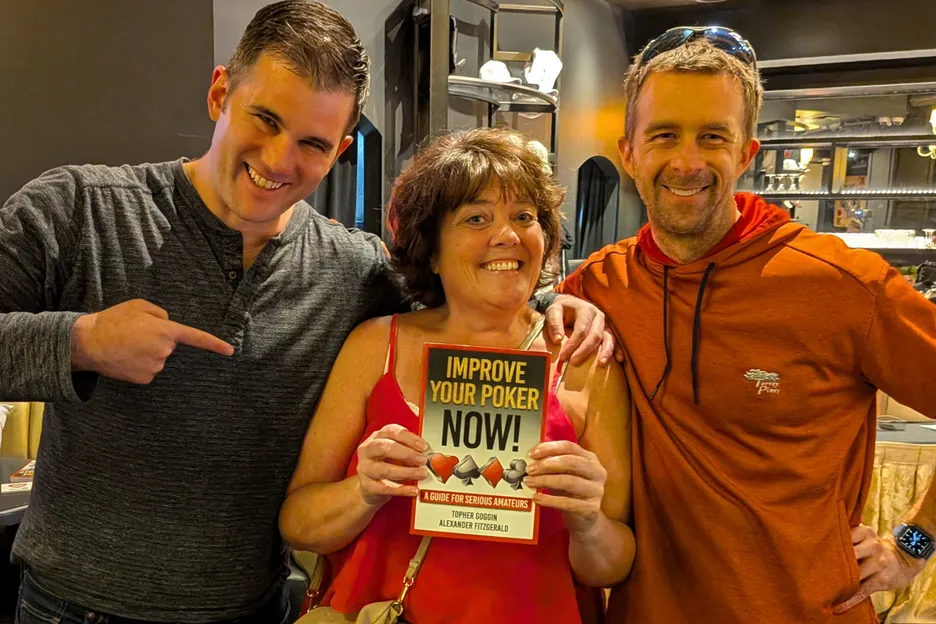
When Alex Fitzgerald and I were writing the 2026 updates for the audio version of our book - Improve Your Poker-Now! A Guide for Serious Amateurs, this was a topic we specifically wanted to address.
Years ago, Alex began recommending that recreational players strongly consider three-betting their playable hands in position. While it was a higher-variance play, it was highly profitable against the weak competitors in lower buy-in fields.
Recently, however, Alex has tweaked this recommendation, now advocating for a more nuanced approach that blends in more calls. What’s changed, and how can we use that info to guide our decisions?
Looser preflop play changes approach
Alex’s three-bet recommendations were motivated by a series of specific trends. Uninvolved players would rarely enter a three-bet pot without a premium hand. The only real concern was the initial raiser.
By attacking loose-openers, a three-bettor would usually get heads-up, in position, against a player with a wide range that would be extremely hard to defend after the flop. The three-bettor could then claim a higher-than-deserved percentage of pots when the original raiser check-folded to the three-bettor’s (perceived) strong range. This was exceptionally advantageous, and an opportunity that couldn’t be wasted.
Today’s game has evolved. First, some openers have gotten better post flop, refusing to roll over and give us the pot when both players miss. That’s not true across the board, but we don’t want to bloat pots against stronger foes that won’t just get out of the way when both players miss.
The real problem, though, isn’t the opener. It’s everyone else.
Players aren’t shy about getting involved after a three-bet anymore. Seeing a cold call or two, or even a cold four-bet from a non-premium hand, has become much more common now. That makes the large investment of a three-bet riskier and forces us to be more selective. In the past, an in-position three-bet might get us heads up (or just win the pot) 90% of the time. Today, it’s more like a 50-50 proposition. If we three-bet a non-premium hand and end up out-of-position in a large multiway pot, a beneficial move instantly morphs into a big blunder.









Three-bet, but selectively
This doesn’t mean that we should stop three-betting unless we have a premium holding. Not even close. But it does give us guidance on when to three-bet and when to lay back.
Say we’re in the cutoff, a few levels into a tournament. Stacks are just starting to shallow out. A looser player UTG opens, and we look down at 
 . Should we flat or three-bet?
Both plays could have merit depending upon the table. We should first assess what is likely to happen if we raise. Is it likely we’ll isolate the raiser heads up, or do we expect action from others?
Focus on the players on the button and in the blinds. How have they played so far, specifically against three-bets? If they’ve generally just gotten out of the way, there’s a good chance they’ll fold here too unless they pick up a monster. That creates a prime opportunity to seize control and get heads-up, which is especially promising if the original raiser isn’t some post-flop wizard.
But if the folks behind us are splashy, chucking chips around because they want to see flops, then the story changes. Queen-jack suited is good, but it doesn’t want to play a giant pot against the world. We also aren’t thrilled about raising light if the original raiser is one of the table’s better players. In either case, calling to see a flop first has much more merit. Admittedly, if we do this, the pot is almost certainly going multiway, since at least the big blind is likely to tag along. But now we’ve made a small investment with a hand that could flop really well, creating a lower-risk, higher-reward situation.

Preparing for multiway action before calling
Hand selection factors into our decision, too. As noted, flatting an open in position might as well guarantee multiway action. We should be much more willing to travel that road with hands that “flop well” like suited connectors, suited aces, and connected broadways. Small pairs can work too. As long as stacks are deep enough for a big payoff when we connect, we are looking for hands capable of making flushes, straights, and sets. (Understand that hands that flop well can be great to three-bet too, but they should be a prerequisite to flatting raises in 2026 at lower stakes.)
Contrast the QJs we analyzed earlier to having A9o in the same spot. Against a wild opener who’s raising every J7s in sight, an offsuit ace could easily be ahead. But A9o is a multiway nightmare, waiting to deliver maximum pain if it gets much action. Calling and inviting more players in is hardly promising.
If we believe three-betting is likely to secure a heads-up pot in position, ace-nine offsuit could be the perfect hand to punish the opener for playing too much. But if a three-bet is just going to cause everyone to jump in the pool, this is a good time to sit one out.
Keep three-betting, but intelligently
If you are regularly battling recreational competition, Alex and I still want you to consider three-betting playable hands whenever you can. It’s too powerful of a play to ignore. The value of getting heads-up, in position, with the betting lead can hardly be overstated. You should constantly be asking if you can reach that outcome. It can still be done.
When you can’t, flatting and taking a flop is a viable alternative. But before you pick that road, ask yourself if your hand can hold up multiway.
Keep these factors in mind preflop and your postflop experiences will be considerably more pleasant.
'Improve Your Poker Now!' by Topher Goggin and Alexander Fitzgerald is available as an ebook or paperback from D&B Poker, and now as an updated 2026 audiobook on Amazon.
Image courtesy of Craig Tapscott.