

As 2025 turns into 2026, we’re talking to some of the biggest names in the poker world and reflecting on the past year’s most interesting stories and events.
Here we present some strategic exploitative concepts shared in our exclusive ‘Pro Tip Series’ earlier this year by Andrew Moreno and James Sweeney.
Exploiting vs. shorter stacks
Andrew Moreno: I've been primarily playing live poker for 20 years. And something I see in live poker that I think people tend to often get wrong is that they look at a particular player and think, 'This guy's aggressive' or 'This guy's passive,' and tailor their strategy around that.
I suggest you take that into consideration but also weigh heavily on the player's stack size and position before making big decisions.
People focus too much on whether someone is recreational or professional, aggressive or passive. They miss that bluffing frequencies are going to be higher when people have bigger stacks, both preflop and post-flop, and they're going to be lower both preflop and post-flop when they are short.
This situation means that when the player in position is short-stacked, they're way less incentivized to make light 3-bets against you.
When you're playing as this player in late position, and you open, and the short stack 3-bets you, make sure to factor in not only if they're a professional player or recreational player, but also their stack size.

If they're investing a significant portion of their stack and get it wrong, it's very costly. So, we're going to weight them towards value hands, and we could potentially do some over-folding, especially against recreational players.
This scenario doesn't mean that you always fold, and good pros find bluffs off of short stacks, but the population tendency is for these players in possession of these shorter stacks to be weighted more heavily towards really strong hands and not have many bluffs.
With a lot of poker study, we tend to look at symmetrical stacks, which simply means a 50 big blind stack against a 50 big blind stack or a 100 big blind stack against a 100 big blind stack.
As you progress through tournaments, you will most likely be playing 30 big blinds against 70, or 100 big blinds against 14. These are the real-world scenarios that you'll often see and are more challenging to study for.
For many situations that you haven't studied, you will want to make sure that you're aware that these short stacks are less incentivized to run bluffs against you during later stages of a tournament specifically, and vice versa.








How do we know when an exploitative play is winning?
James Sweeney: Being able to demonstrate the profitability of an exploit with math is a powerful tool. It gives us the confidence to continue using that exploit, even if it appears to be failing in the short term.
Because let’s be honest, even +EV bluffs will sometimes get snapped off, and +EV value shoves will sometimes get called by the pure nuts.
But by staying long-term focused and always looking for exploitative opportunities, we can develop edges far beyond attempting to perfectly mimic GTO solver output.
Solvers provide us with a theoretical benchmark, but real opponents rarely play at equilibrium. The power of exploitation lies in recognizing why deviations occur; whether from emotional tilt, cognitive bias, incorrect poker ranges, or misunderstanding of strategy — and then crafting our own plays that systematically capitalize on those leaks.
Unlike purely theoretical study, this exploitative process rewards creativity, observation, and adaptability. A sharp player doesn’t just memorize outputs; they recognize recurring human errors and build counter-strategies that thrive in imperfect environments.
When we have a large dataset on our player pool, we can establish which mistakes our opponents are making on average.
This allows us to target average tendencies and exploit unknown opponents by assuming they are exploitable in the same way as the rest of the pool. In some cases, our exploits will not work, but we will be right on average, which is what makes the approach profitable.
Live players can make use of online hand histories to develop exploitative strategies for their live games, since the similarities outweigh the differences.
Developing large pool data requires sufficient play at a specific limit within a reasonable timeframe. While there are other means of gathering such a database, be sure to check with your poker site’s TOS first.
In The Exploitative Edge, we consider many examples of pool exploits. Constructing villain-specific exploits follows the exact same procedure. We simply make use of villain-specific datapoints as opposed to generic pool averages.
Since pool exploits are based on the average tendencies of a certain player pool, and over a certain period of time, this might lead us to the following assumptions:
- Assumption 1: The correct exploitative approach might be drastically different depending on the player pool.
- Assumption 2: An exploit that worked six months ago may no longer be profitable, since the player pool has adjusted.
These assumptions are totally reasonable, but they do not represent reality.
A comparison of population data from separate online pools reveals the following:
- Reality 1: Although pools have differences, the vast majority of tendencies are almost identical.
- Reality 2: Exploits that were valid over 10 years ago are still making money in the modern game.
We find that regardless of the player pool, the average poker player is exploitable in exactly the same ways. This is irrespective of whether they are live or online players.
Furthermore, we see the same average tendencies presenting themselves throughout the entirety of online poker’s relatively short history.
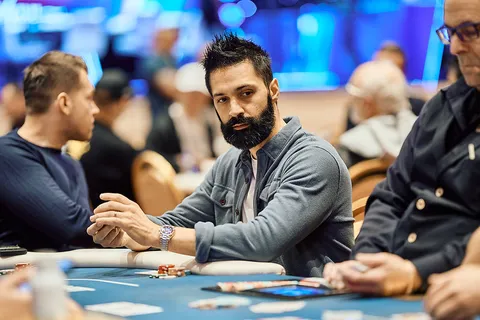

Andrew Moreno is a professional poker player with 20+ years of experience. Andrew is a sought-after poker coach, as well as a member of the PokerOrg Player Advisory Board, and his primary focus is exploiting players in live tournament poker. Contact Andrew on his coaching site, Amo4sho.com, and follow him on IG and X.
James 'SplitSuit' Sweeney is a poker player, coach, and author dedicated to helping players think deeper and win more. He is the co-founder of Red Chip Poker and creator of numerous strategy resources — including The Poker Bank YouTube channel.


