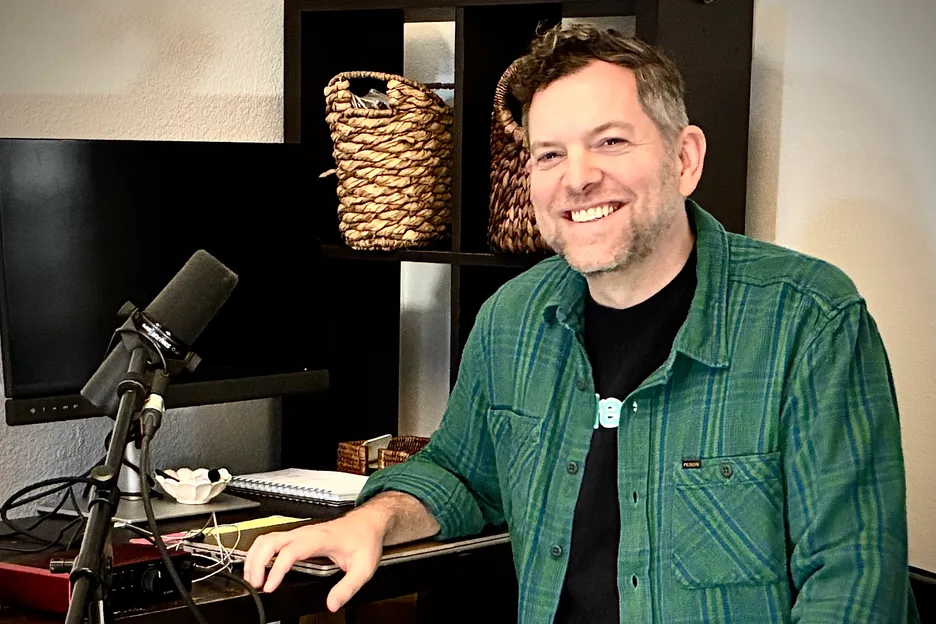


If you're one of the tens of thousands of people who watch Hustler Casino Live, you'll recognize Charlie Wilmoth's voice – he's a regular commentator on the show.
But because he's not on the HCL camera, he could sit down next to you at Hollywood Park, and you wouldn't know you were sitting next to a poker celebrity – and one of the most thoughtful guys in the business.
He also has a podcast called Third Man Walking, which is one of the sharpest, most intelligent podcasts in the space. It's so good that I use it as a way to force myself to go for a run ("I don't get to listen to this episode until my trainers are on and the running app is started").
I asked Charlie to do an interview by email – you’ll see why I’m such a fan.
From Ohio to LA: evolving poker games
How long have you been a Los Angeles poker pro? How is it different now compared to when you started?
I moved here in 2018. I played cash games in Ohio for a few years before that. Since I got to LA, there have been three phases. From 2018 until COVID hit, the games were great action, but they were also tricky, or at least that's how it seemed to me then. I did fine, but I had to adjust to the increased aggression here.
From 2020 through about 2023, the games were much softer due to poker's popularity during the pandemic and to many pros staying home. But since then, things have gone downhill, as some of the good effects of pandemic-era poker have worn off, and private games have removed some fun players from the pool.
On your podcast, you've spoken at length about the shift to private games at the mid-to-high stakes. Do you think this is the 'new normal,' or is this transitional to some more permanent state?
Obviously, there are circumstances where private games make sense. High-stakes games often need to be private, or at least have curated starting lineups. So do streamed games. But it's been sad to see private games take hold to the degree that they have even at the mid-stakes, where public games should be able to run on their own.
The downsides of private games are obvious, from the risk of getting robbed or cheated to absurd rake to the politics of getting people to agree to play with one another. I’m not sure what it will take to bring people back to public games.
The problem seems more pronounced in LA than it is in some other parts of the country, fortunately. I do think no-ante no-limit hold'em with no side games has gotten pretty stale, and one area where private games have outmaneuvered cardrooms in LA is in allowing antes and side games. Several cardrooms have made some strides recently in adding some of these extra wrinkles, which is encouraging.
On your podcast, you've spoken about the (potential) California blackjack ban. How big an impact do you think that will have on the poker ecosystem?
Whatever the cardrooms are going to do in response to the blackjack ban will happen in the next few months, unless they’re able to get the rule changes delayed. A lot of people will probably lose jobs, and some rooms might close. It'll be bad.
As far as the effect of the blackjack ban on poker is concerned, I think there's a chance that it will have a slight positive effect, in that some people who normally play table games will play poker instead. But if cardrooms try to compensate for lost revenue by significantly raising rake, I think it will drive away tons of players and make it nearly impossible to play public games for profit in LA. So the downside greatly outweighs the upside.






What poker looks like in 2030
Taking all of that into account, what does poker look like in 2030?
No-limit hold'em will still be the main televised game. People don’t watch PLO or other games as much, since it’s harder to follow the action. Because of that, no-limit hold-em will still be the popular format for small-stakes games. The games will slowly get tighter, but they won’t be that different.
Other poker variants will, however, continue to grow in popularity at the mid-stakes. Hustler currently has a game that’s only double-board PLO bomb pots, and I could see things like that taking off elsewhere. Stand-up and bounty games will continue to gain in popularity, and we’ll invent and popularize new side games as well.
A lot of people are realizing, in different ways, that if you’re just playing no-limit hold'em with no ante and no side games, preflop is a big problem. Just memorizing charts gets you further than it should, and recreational players are arguably punished too much for not adhering to charts. I think many players are finding they’re more interested in decisions where you can’t just look up the correct answers.
There are other factors that are hard to predict. Big changes in the overall economy, in either direction, will have a significant effect. And it’s hard to say where poker will be legal in 2030 and under what conditions.
I’m concerned for the immediate future of legal live poker in California and Texas at the moment, for example, but there could also be positive developments in the next few years that are hard to foresee. Ten years ago, for example, I wouldn’t have guessed that live poker in Texas would explode the way it has.

You are the invisible voice of Hustler Casino Live. How did you get the gig, and what do you get (aside from money) from doing the commentary?
I split time with David Tuchman and DGAF, with Raver, Kiran Raina, and Adam Johnson in the mix also. Those guys are great.
When I started Third Man Walking, I was playing in a $5/10/20 game a lot with Marc Goone. He heard early episodes of it and invited me to join him in the booth at Live at the Bike, where he was commentating at the time. That led to a regular gig there. A couple years later, I moved down to HCL.
Before I was a poker player, I was a musician and a writer, and I’ve always just liked making things and sharing them. I love poker, but it can be lonely, because even though you’re hanging out with people when you’re playing live, you’re trying to take their money, and they’re trying to take yours. Podcasting and commentating let me make things and participate in poker culture in a way that feels less zero-sum.
I like how frequently I’m surprised by what I see when I’m commentating. Often someone does something different than what I would have done, but I can talk it through and imagine what their reasoning might have been. There can be many ways to think through even a relatively simple hand, and it’s good to try to appreciate other perspectives. Lately, for example, I’ve seen several hands where I thought someone should bet small with value, and they’ve bet much bigger and gotten paid. The games I play are less splashy than HCL games, but that’s still got me thinking about spots where I could maybe bet bigger than I currently do.
Commentating is also good, honest, variance-free work, which I’ve missed a little in periods where I’ve only been playing.
Why Third Man Walking resonates
I consider your podcast one of the sharpest in the space. What do you get out of it?
When I started Third Man Walking, I felt like there was a lot of poker content that was light and fun, and also some that explained how to play, but not a lot that addressed what playing poker really meant or how it felt.
I get a lot of emails about the podcast from poker players, but I sometimes also hear from people who don’t play poker at all. I find those listeners the most interesting, because I think part of why I want to make this podcast is to explain to people like me, and maybe even to myself, why I went into poker and what I’m doing here.
You are a movie buff who has reviewed a lot of poker and poker-adjacent movies on your podcast. If you made a poker movie, what would it be like? How will it avoid all the cliché pitfalls that plague virtually every poker film and still be compelling to people beyond those who play at Hollywood Park?
A lot of poker films have basically used the Rounders template, where a flawed protagonist has this talent that for some reason they’ve never fully tapped, but they manage to harness it as they accomplish something great. I can see why that makes sense as a movie plot, but that was never the way poker worked for most people, and it definitely doesn’t work that way now.
I wouldn’t want the hero’s arc to be so obvious. Poker is funny because we sit at the table imagining ourselves as the center of the universe. (We send each other hand histories calling ourselves 'hero'!) But we’re messy. We’re unreliable narrators, even when we’re trying not to be. We’re overly sensitive to swings of luck that feel to us like injustice.
We go to the casino one day and back the next, and things are sort of different but mostly the same. We sometimes learn something that makes us better at the game, but we’re not sure by how much, and the convoluted feedback loop of variance doesn’t make it obvious right away. Our interest in poker reflects some of our good qualities but maybe also some of our bad ones.
My favorite piece of poker fiction is Jesse May’s book Shut Up and Deal, which has this circular, dreamlike quality. I’d love to see some adventurous director try to turn that into a movie.
I could see poker serving as a backdrop for some sort of mystery that’s never fully resolved or that’s presented non-linearly. Or maybe poker could propel the plot in a movie that’s very formally adventurous, like Memento but with cards.
[I asked Charlie for book, movie, and/or music recommendations. To keep the article length manageable, I'll just list his suggestions. But suffice to say he gave compelling commentary on every item in the list. I have No Roses playing as I write this piece – it's glorious.]
- Books: Agustina Bazterrica – Tender Is the Flesh; Tony Tulathimutte – Rejection
- Music: Mdou Moctar – Funeral for Justice; Shirley Collins – No Roses
- Movies: The Game; Delicatessen
Note: I edited down some of Charlie's responses but put zero words into his mouth. A huge thanks to Charlie Wilmoth for his time and thoughts. And do check out his Third Man Walking podcast.


