

It’s a poker tournament, and you’re fast approaching the bubble with a short stack and questions you need answers to, quickly.
When do the blinds go up? How many players do you need to bust before you make the money? How much time until you need to grit your teeth, cross your fingers and make a move?
For the answers you need a tournament clock, which is why big poker rooms will have TV screens dotted around and available for a quick glance. But that’s not always the case.
What if you’re in a seat where you can’t easily see the clock? What if the nearest TV is showing sports, a different tournament, or being blocked by people standing in the way? What if you’re playing in a bar, pub or any game where there is no such available screen?
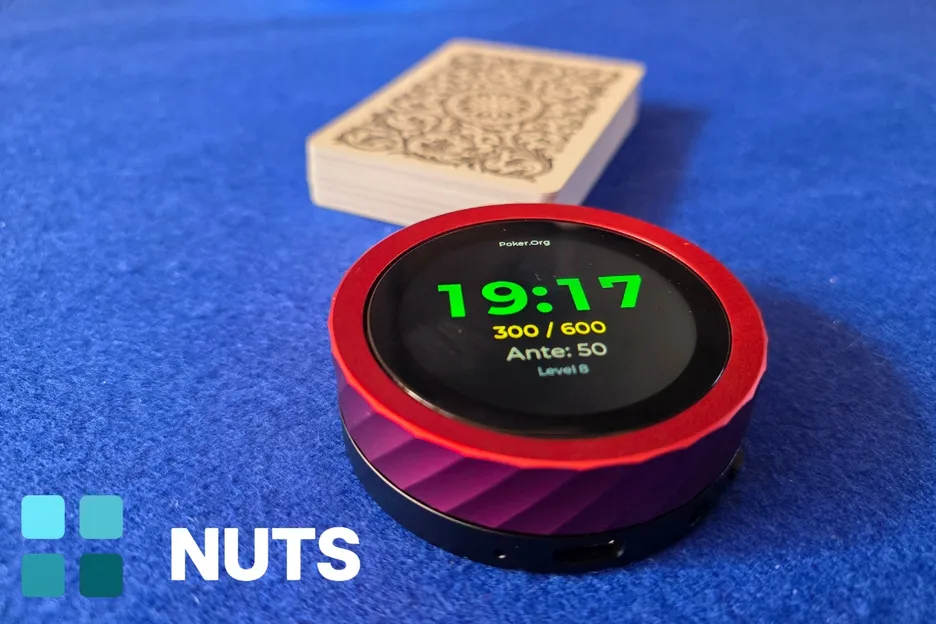
It was this line of thinking that gave Richard Green, a poker enthusiast and inventor based in London, UK, the idea for the Networked Ultimate Timing System (NUTS) — a smart, connected touchscreen dealer button.
“One day during a tournament I was just looking at the dealer button, looking at the wall clock, and I just thought, ‘Why can't we put the data from there onto that?’
“The dealer button is ubiquitous, everybody's familiar with it, everybody knows it has a purpose. I thought, ‘Why not? Let's just see where this goes.’”
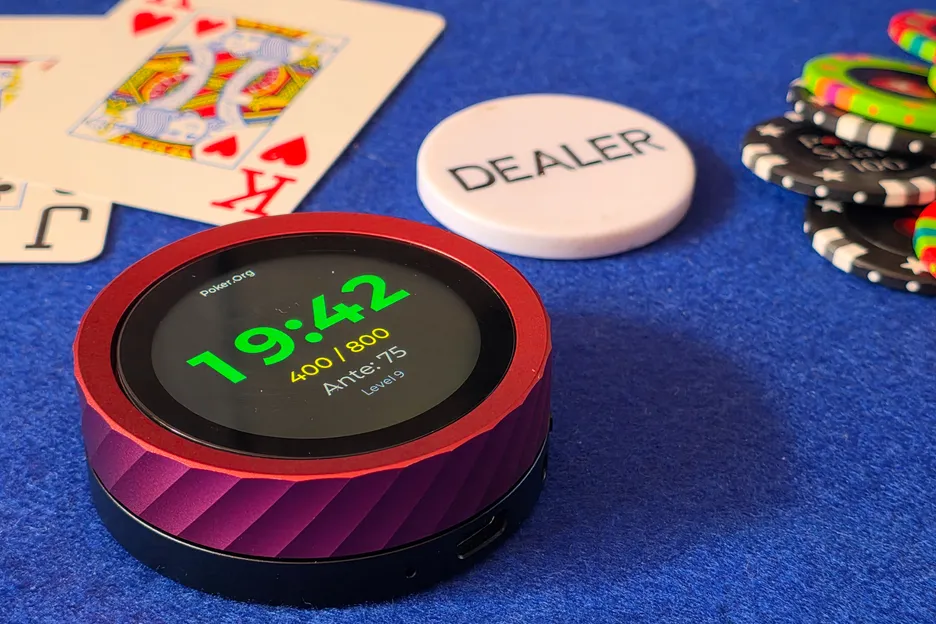
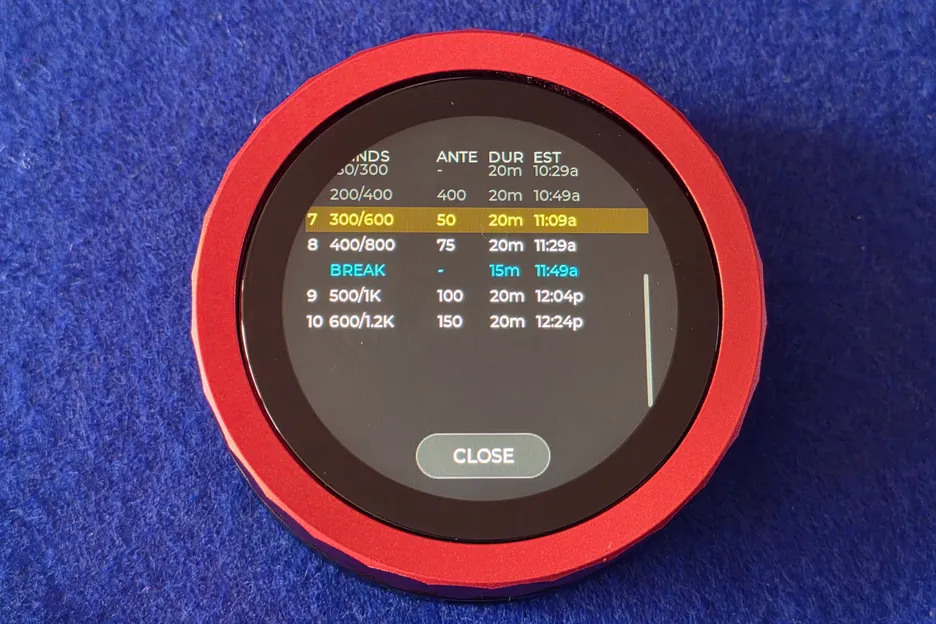
Where it’s gone, so far, is a fully functional prototype that can operate concurrently across multiple tables displaying level time remaining, current/next blinds and the tournament’s level structure. It can also be used as a shot clock, can signal and time tourney breaks, alert players to the final minutes of a level, and slots right into any existing tournament software. Future updates may even see it capable of working as a Triton-style chess clock, and more.
“What I don't want to do is build a tournament management system,” explains Richard, “they are great products and I don't want to compete with that: anyone who is already running one can just plug into that.”
But that doesn’t mean they can’t operate as standalone devices. “There is a basic tournament management system built in, so that if you are just running your home game or a couple of tables, you can use that. There will be a companion app for iOS and Android where you can set your structure and send it to the unit, or units.”
Richard walks through the functionality of the device in the short video below.
Solving the phone problem
Initial testing has been taking place in the pub and club games where Richard plays most of his poker: 3-5 table tournaments in venues which are not set up with traditional tournament clock displays.
In games like these, phones are often used for level timers, but that comes with significant downsides. Only one table can see it, the owner has to leave it out and unlocked — even on breaks — and if they need to use their phone, or head home after busting out, that leaves it out of use.

"Especially for hosts of friendly home games, it can be a challenge to smoothly coordinate and communicate structures and blind levels to players in real time. An integrated clock like this that everybody can read would save me having to step back from the table to update all the other players every 20 minutes instead of spending that time enjoying the game with my friends."
NUTS solves those problems while adding more functionality. Multiple dealer buttons can be synced, and present on every table, so everyone knows exactly how long is left and when levels change. Tournament directors can also pause all clocks simultaneously or make adjustments on the fly.
“They’re networked and running an internal clock,” says Richard, “so they’d work for literally hundreds of tables at the same time as there is no internet traffic, no delay whatsoever. There’s theoretically no limit on how many could be running for the same tournament at the same time.”
And, as he explains, the functionality can be restricted to ensure not just anyone can mess with the tournament structure on a whim, or by accident.
“You need logins, credentials or specific keys that are pre-generated in order to make any updates or changes to the tournament. There's a layering of permissions as well, so you might have a tournament director who can do everything, or you might have floor staff who might just be able to pause and resume the clock, and different levels in between.”
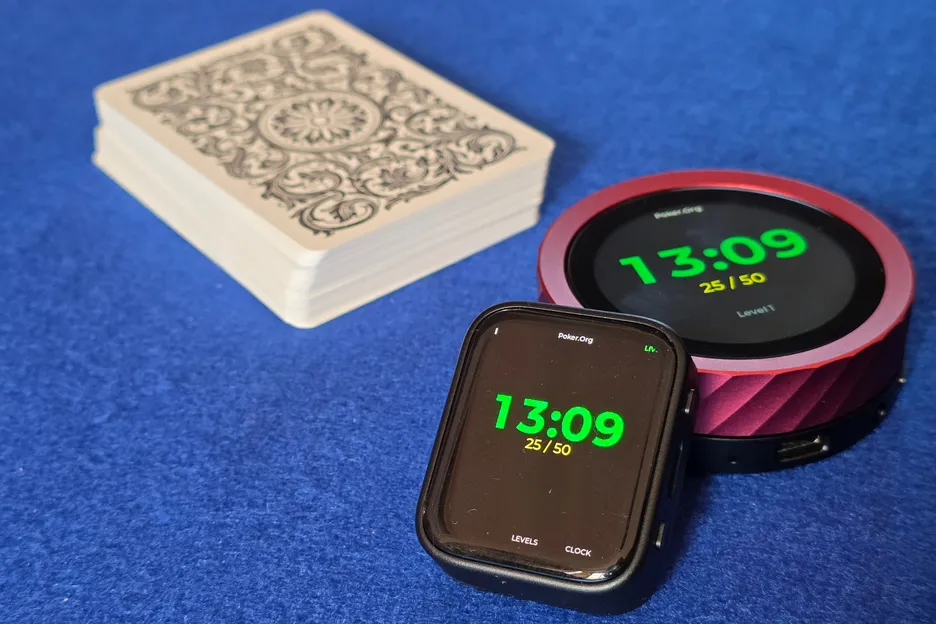
In addition to the smart buttons, which are charged via USB-C and crafted from aluminum with a rotating outer ring, various control switches and a touchscreen, the system also supports smaller, wrist-based versions which can be worn by staff to control the tournament at any point. Further iterations of the main unit will be aimed at getting it thinner, white, and styled more closely to traditional dealer buttons.









Testers wanted
NUTS is not Richard’s first invention — he’s previously explored various ideas around mobile gaming technology and even a floating spanner for use on boats. Although that was an idea which, ironically, sank without trace (“I realized that if everyone in the world who needed a floating spanner bought one, I would still not have made money”).
As a solo developer with working prototypes, Richard is now looking for poker players around the world to get involved and test his new product in the field. He sees three potential audiences for NUTS, and he’s keen to hear from all three of them.
“The first are the people who have their own poker room, a nice chipset, some nice chairs and a nice poker table. They like having some friends round to play, and this product fits straight into that setup. It means you can use the TV to watch sports, and you don't have to have your phones out.
“Then there are the small to medium poker rooms with 2-8 tables, which would benefit from a connected way of running their tournaments, having them networked and synced over wi-fi for a cohesive experience for all the players.
“And then there are casinos or poker tour operators that have all their information and control in-house. The design of the platform is such that it can run within their own data center, within their own infrastructure, so they would have complete and total control over everything. No data would ever leave their network, and they could run it by themselves.”
"It’s cool. I would buy one for a home game for sure. I like that it would make a noise when the levels go up, that helps solve a problem better than what exists today."
Anyone interested in trying it out or learning more can sign up for the beta test, and Richard suggests that the first backers may even receive some bespoke, special models, although details are still being ironed out.
“It will be released more widely when it's good enough, but please sign up even if you just want the solo, single unit. It's the same unit and the same software that will also enable the networked multi-table experience. From influencers to enthusiasts to poker tour operators, there is no tournament too small, and there is certainly no tournament too big. I want to get the device in your hands, I want to get your feedback, and I want you to tell me how to improve it.
“I've always just liked putting things together and seeing if it works, you know? I think the best feeling I had was when someone naturally just moved it around the table without me having to point out it was the dealer button. And at that point I thought, ‘This could be something.’”
Do you think it’s something? Would you use one of these in your home game tourneys, or like to see them in your local card room? Let us know in the comments.
Register for the beta test now at the NUTS website.