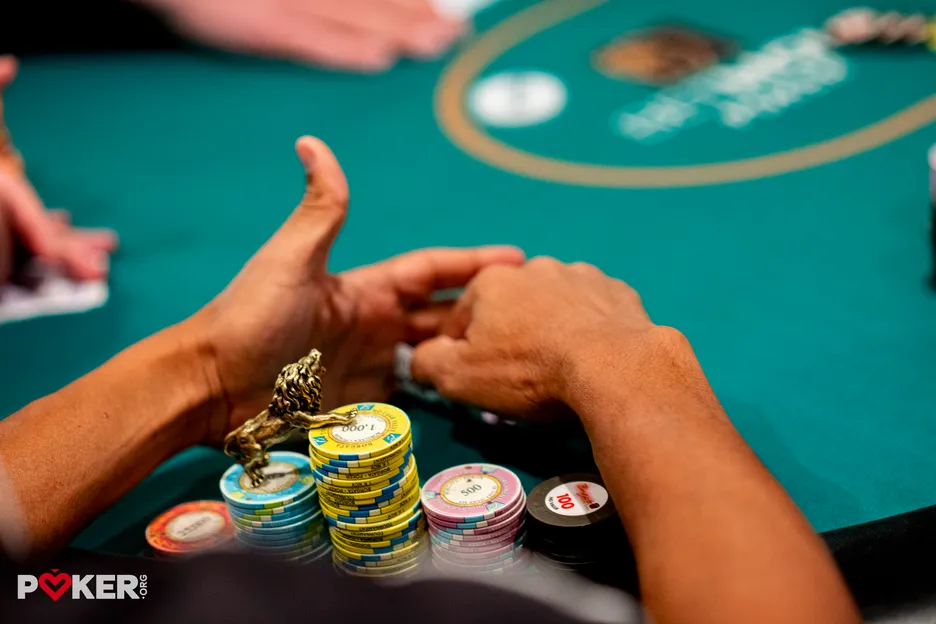


It's been an exciting week at my local cardroom. Last Friday, for the first time ever, they spread a legit $5/$10 no-limit hold'em game.
I say 'legit' because for the last couple of years, we've been playing with a $10 straddle in the $5 game, 99.9% of the time. That 0.1% will figure prominently in what happens next.
There has been a $2/$3/$5 no-limit game at this club as long as I've been playing there – since the Covid pandemic subsided.
I don't remember when the $10 'winner straddle' became a thing, but it's been around for years.
A winner straddle (also known as a 'rock') simply means that whoever wins the pot puts out the $10 straddle, and action starts to the left of the straddle. We can debate whether this is a good structure, but let's stipulate it as settled practice in this room.
The problem with the 0.1%
The hitch comes when the winner of the pot doesn't want to straddle.
You see, the straddle isn't mandatory – the plaque next to the dealer says there are blinds of $2 (on the button), $3, and $5. It says nothing about a $10 straddle. There's a straddle button that the straddler places in front of them with the $10 straddle.

If the winner of the pot throws the straddle button back to the dealer, things get a little awkward. Some dealers drop the button in their rack. Other dealers offer the button to see if anybody else wants to take it – often one of the 'action' players will grab the straddle button, and order is temporarily restored.
Unfortunately, this practice has a loophole. A player who always rejects the straddle button will never pay the effective 'big blind.'
Such a player pays $10 ($2 + $3 + $5) in blinds each orbit. But if they raise and steal the blinds and the straddle, they profit $20 (less the $1 preflop drop). If you play tight, and don't make big post-flop mistakes, you can turn a tidy little profit from this angle.
And let's be clear – it is an angle. Poker is unique in that we have a term for something that is marginally within the rules but violates the spirit of the game. This straddle rejection is a textbook angle.





Bob and the new big game
When the new $5/10 game kicked off last week, there was a jubilant vibe in the room. Our little cardroom was moving into the big leagues.
The game organizer brought in a box of baked goods. Dealers pushed along their string and spread stories of the new game.
You see, when the club spread the new, larger game, they made a couple of changes.
First, the button blind, a quirk of a handful of clubs in the area, was gone. Two blinds, $5 and $10, exactly where they should be. The missionary position of no-limit hold'em.
Also, the straddle button was gone. If you want to straddle, it's $20, directly to the left of the $10 blind. Again, as vanilla as the game can get. And man, that $20 straddle went on while the echoes of the starting gun were still in the room.
And it stayed on – we had us a $5/$10/$20 unlimited Texas hold-them game. Which made perfect sense because there was a $2/$3/$5/($10) game just two tables over.
The game went swimmingly for most of a week, with the $20 straddle permanently on. But yesterday, 'Bob' sat in the game.
Bob is the prime practitioner of the 'straddle rejection' angle. I suppose he felt that it was silly to grab the occasional free $10 when he could grab the occasional $20. I was playing in the $3/$5/($10) game nearby when it happened.
Bob walked up to the table with his chips and started to sit down. Immediately, half the table stood up and went to get chip racks. The game stopped. Serendipitously, the club's owner, 'Brian,' was nearby. He is a hands-on guy and knows the backstory, the dynamics, all of it.
Brian's also a poker player himself – he knows what Bob is up to.
Brian gathered up the players and had a talk with them. I don't know what he said, but it worked. Pretty soon, cards were back in the air, and yes, Bob was still sitting there. I don't know what equilibrium was reached, but fortunately the new $5/$10/$20 game didn't break.
The aftermath
I chatted briefly with Brian later. He clearly saw both sides of the issue. "They enabled Bob all that time by somebody else putting out the straddle when he wouldn't take it. The right solution was to say, 'If you're not taking the $10 winner straddle, then it's off, and we're playing a $5 game.'"
"Sure, but the rest of them wanted to play a $10 game," I said, "and a few of them were willing to toss in the extra straddle to continue that."
"I get that. But they'll have to stop enabling Bob, or he'll keep it up."
I also (separately) spoke to the fellow who organized the game and generously brought cookies to the first day. He was on his way out the door, though not proximate to Bob's arrival, as far as I could tell. His face was pinched with frustration.
"Lee, I was excited for this game. Sure, it was going to be great to play bigger. But you know what I was really looking forward to? A nice easy, consistent game. The $20 straddle was on, no messing with a straddle button. Nobody having to pick up the straddle when somebody threw the button back to the dealer. We weren't going to have to deal with Bob and people like him."
The social contract
My wife and I were sitting with our coffee this morning while California spring sunlight streamed through the sliding glass door. She doesn't play poker, but as you might imagine, she understands the ins and outs of the game better than most poker players.
I told her about yesterday's drama. She didn't blink before responding.
"Bob needs to go."
"Say more?"
"Life has rules. It also has social contracts. Without social contracts, community fails. Bob might be following the rules, but he isn't following the social contract. Poker, more than most games, is one of community and social contracts. If people don't adhere to the social contract, then community and game fail."
Did I mention that my wife is a mental health professional? She continued...
"If you walked into that club wearing a shirt that said, 'F*CK EVERYBODY IN THIS ROOM,' what would happen?"
"They'd send me home, obviously."
"Same thing. It's a social contract that you don't do something that insults everybody you encounter. Bob isn't following the social contract that says everybody will put on the straddle. He needs to either adhere to the social contract and put on the straddle or not play the game."
My wife, she cuts to the chase.
Private games enforce social contracts
There has been much discussion about how private home/underground games are poaching players from public cardrooms.
This came up in my interview with Charlie Wilmoth, and is a source of concern for players and managers of public poker rooms everywhere.
There are a lot of reasons for this emigration to private games, but 'social contract' figures prominently in many of them.
When you go to Debbie's basement for a Thursday night game, there is an understanding of how the game will play. Maybe it's officially a $1/$2 game, but everybody agrees they will put on the $5 straddle. Maybe the seven-deuce game is always on.
If Bob goes to the game but doesn't put on the straddle and won't participate in the seven-deuce game, guess what happens? Bob doesn't get invited back if not told to hit the door immediately. Home games live and die by their social contracts, not rule books.
Here I address myself to the poker club owner, Brian: You do a hell of a job. You run a great poker room, and I deeply respect you as a fellow poker player and lover of the game. But my wife has this one right.
The great majority of your players, particularly the higher stakes ones, have implicitly established a social contract that the $20 straddle will be on in the $5/$10 game.
This is how communities work; having one or even a small handful of players who violate that contract threatens the whole community and game. If it continues, players will go somewhere where the social contract is enforced and the game thrives.
Please, Brian, recognize and enforce the social contract, even though it's not in the rule book. The health of your higher-stakes games depends on it.


