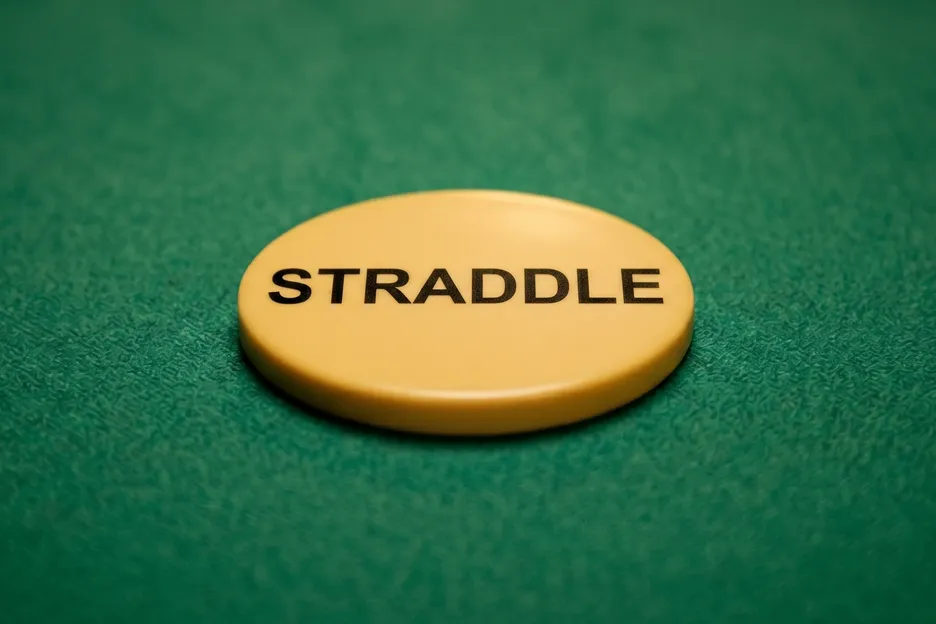


A month ago, I published an article describing the importance of social contracts in poker games.
I described how a single person who refuses to take a straddle – in my case, we'll call him 'Bob' – can cause friction for an entire table, and potentially disrupt the smooth flow of a fine poker game.
I got some interesting feedback about that article, and want to clarify some things I said. I also want to expand the discussion a bit.
A quick fix to the straddle problem
Full marks to the management at my local watering hole. Within a month of opening the new $5/$10 NLH game, they had gotten clearance from their municipality to spread an official $5/$10/$20 NLH game.
This instantly solves the problem of the 'Bobs' of the world, who don't want to straddle. If the plaque says '$5/$10/$20,' then Bob can post the straddle (third blind, whatever you call it) or stand up and leave – there is no in-between choice.
Further, it solves the issue of how much Bob (or anybody) owes when they come back from missing the blinds. Is it $15 ($5+10) or $35 ($5+$10+$20)? If the plaque says $5/$10/$20, then the answer is $35 – shall I deal you in?
Look, I hate straddles for a number of reasons. But all those reasons revolve around the fluidity and social contract negotiation inherent in optional straddles.

A newbie sitting down at a $5 BB game suddenly discovers that they're playing an (effective) $10 BB game. Or maybe they're being pressured into making the game a $2/$5/$10 game. Or maybe a 'Bob' is making things awkward in a perfectly fine $2/$5/$10 game by rejecting the straddle.
What my club (and the Wynn in Las Vegas and others) did eliminates the need for this particular social contract.
That's good because social contracts are unenforceable in public places. Gladys can un-invite you to (or boot you from) the Thursday night game in her basement, but a public poker room doesn't have that option.









The other side of the social contract
My previous article focused on the unfortunate effect of 'Bob' refusing to honor the straddling social contract. There's another side of this coin:
If Bob (or anybody) doesn't honor this, or any other, social contract, the rest of us have to accept that. As I noted above, social contracts are unenforceable. Attempting to 'enforce' them just leads to friction – friction that no rule book can solve.
Here's an example:
In our $3/$5/($10) game, we usually play a $20 bomb pot on the dealer change. We don't have a bomb pot button – the bomb pot is just played as part of the regular button orbit. Furthermore, anybody can choose to play or not play the bomb pot. If more than a 1-2 people pass, then the bomb pot gets skipped.
We have a guy in the pool, Murray, who sometimes plays the bomb pot, sometimes doesn't. If you watch, you'll figure out that Murray plays the bomb pot when he has good position, and passes when he doesn't.
Yes, it's an angle. Yes, it's violating the social contract. No, there's not a damn thing we can do about it.
This behavior has been tilting me, but I need to get over myself. The rule book says nothing about bomb pots. There has been an implicit understanding that you can have a bomb pot. But the house does not and will not participate in the management thereof.
So if Murray wants to angle the bomb pots, nothing can stop him. Furthermore, by allowing his angling to get to me, I'm costing myself unnecessary pain. Just like getting upset at Bob, who won't straddle.
Support the rules, ignore social contract violations
If somebody is breaking the rules, if they're cheating, then every clear-headed poker player should scream bloody murder. A good live poker game depends on wide respect for the rules. If you see somebody shorting a pot or otherwise cheating, call them out.
But the Bobs and Murrays of the world are operating in a shadowy space that exists, whether we like it or not.
To the degree that we can eliminate their angle of choice (e.g. a '$5/$10/$20' plaque or a bomb pot button) great. I love rules that defeat angles. But if they're violating only the social contract, we need to accept that and move on. It's better for the game (less friction) and better for our souls (no tilt around the angling behavior).
If you want social contracts to be implicitly enforced, go check out Gladys's game on Thursday night. Just hope that Gladys runs it on the square, doesn't take too much rake, and pays the winners quickly.
Poker is never simple, is it?
Featured image generated using AI.