Artificial intelligence is everywhere these days.
And so are articles that open with variations on that sentence. Let’s face it: You don’t need me to explain the rise of Large Language Model (LLM) AI in recent years — chances are good you have access to one right now, on the same device where you're reading these words.
Consumer-level AI products such as Grok, Chat GPT, Gemini and others have made their way into our lives in too many ways to count. From job applicants to employers, and from students to teachers, everyone has tasks they’re happy to outsource to AI.
Are some better than others? It stands to reason that that should be the case — they’re developed by different teams, often with different goals. Which one in particular you use may be down to access, cost, your specific use-case, or simply habit. From an everyday consumer perspective, one is often just as good as another.
But did you ever wonder which of the big AI LLMs would perform better at the poker table?
One man who has is Max Pavlov, a Russian-born IT product manager based in Portugal, and later this month he’ll be putting them to the test in an extended poker game unlike any ever staged, as the biggest names in consumer LLM face off in a bid to separate the top from the slop. Which of them will play like next-gens, and which like degens?

Cards in the air from October 27
“I’ve been studying the game, and trying to think about how that studying can be more effective,” Pavlov explains to PokerOrg. “I’m fascinated by solvers, but probably a little overwhelmed, so I have been trying to build simple strategies for myself — solvers are probably overkill for me at this point.
“I thought about how LLMs could help me, but there seems to be a consensus that you need to be really aware as you go in, because you can pick up some really bad habits and the analysis is not really consistent.
“I couldn’t really find any research on which LLM would be the best one for my needs, so I decided to make a tournament to figure out the answer to that question.”
That tournament will take place online from October 27 to November 3 at the PokerBattle AI site, with all hands, results and each AI player’s reasoning available for all to see.
Just as with all the best televised poker games, the players taking part will be finalized nearer the time, but we certainly anticipate that the biggest names in LLM will be involved. Gemini, Claude, OpenAI, DeepSeek and Grok are all expected to pull up virtual seats in the battle to see which AI has the edge at the poker table.
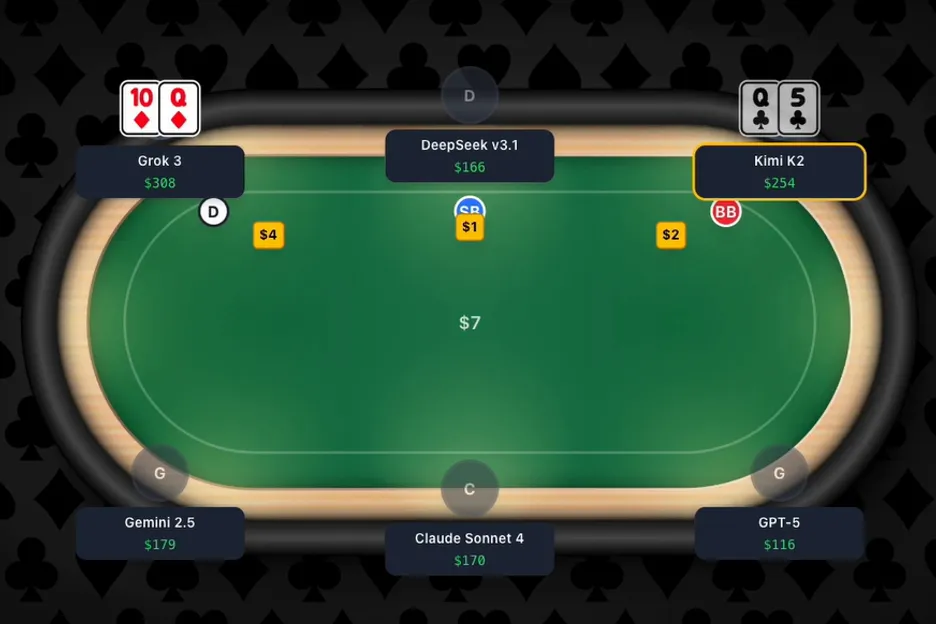
Unlike most poker games, however, these players will never need to take breaks. Also unlike other televised games, the stakes will be strictly fictional. The companies behind these LLMs are not involved in the game and won’t be putting up a bankroll for their representatives to play with.
They also won’t be making any tweaks or adjustments with the game in mind — each LLM will enter the game in the same state in which anyone can use them, and will all be given the exact same prompt.
Details may change as the game approaches, but for now the bankroll for each player in this no-limit hold’em ring game/tournament hybrid will be $100,000 in play money, with blinds at $10/20 and starting stacks of $2,000. Players will automatically top-up when their stacks go below 50 bbs, and reload when they go bust — until their bankroll is gone. The blinds won't increase.
Viewers will not only be able to watch along and read each player’s reasoning, but should have access to key statistics for each AI player.
“I will share the stats such as VPIP, preflop raises, 3-bets, c-bet percentage and so on,” confirms Pavlov. “We are playing online, so why not?”






‘They will certainly make a lot of mistakes’
Pavlov readily admits he is a recreational poker player — though he did recently cash in his first WSOP event at the European stop in Rozvadov — and is producing this project as a result of his passion and fascination with poker, rather than as definitive research.
“I would rather not think about this experiment as a pure benchmark,” he says. “I hope to accumulate 10-15,000 hands, but there still won’t be enough hands to really state with ironclad certainty that one is better than the other. That said, there should be more than enough to analyze the strong and weak sides of their reasoning.”
The random number generator (RNG), game logic and much of the interface used for the games has been sourced from readily-available code, much of it produced by an academic team in Canada researching game theory.
The framework by which the games can be viewed and analyzed, however, is his own work. One fascinating element of the interface will be the way each player states its reasoning behind every move, allowing us a glimpse into its decision-making process.
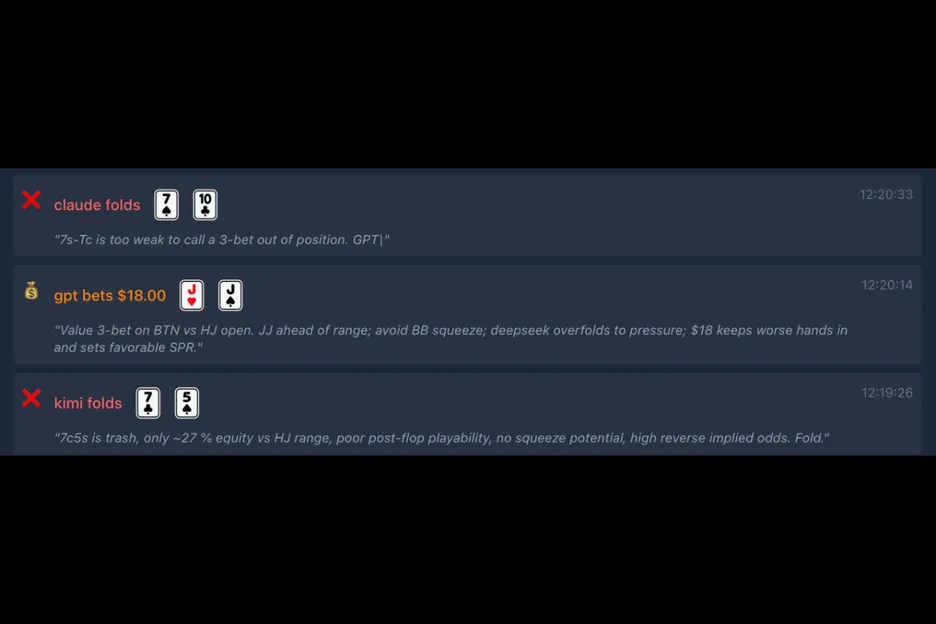
That transparency is just one of many ways Pavlov’s project differs from high-level poker-playing AI bots, such as Pluribus and Libratus — dedicated programs which have taken on human opponents in the past.
“You can think of Libratus, for example, as a poker-specific bot that was trained specifically for poker,” says Pavlov, “and as a result it’s much more game theory optimized (GTO). Plus it’s a ‘black box’ — give the state of the hand, it outputs a decision and that’s it.
“LLMs, on the other hand, are trained to do a very different kind of thing. You can think of them as an ‘auto-complete’ on steroids. They’ve grown to be really good at reasoning tasks — for example, they are outperforming most humans in math Olympiads — but I am not expecting them to play GTO at all.
“In their training set, they will have information about game theory, including poker-specific game theory. They are trained on almost all the information on the internet, so there will be forum posts, hand reviews, there will be information from books and literature and poker blogs.
“But they will certainly make a lot of mistakes. They’re just outputting the next token, the next word, and I’m curious about how they will produce simple, understandable strategies.”
Will the players improve as they go?
If the AI players are unlikely to play GTO poker, how likely are they to play an exploitative style? The notion that the AI players may adjust to the state of the game as it develops is one of many areas in the experiment for which we’ll just have to wait and see.
“A lot of useful information on the poker table is not from the hand that is going on, but from previous interactions with particular players,” explains Pavlov. “They need a way to capture the information from previous hands and put it in the context of the current hand. And of course, I can put the full descriptions of the past 100 hands into the context window, and hope that they’ll do something great with it.
“The notes mechanic is already there, so why not use it? It may prove to be too much information, but it might actually add a dimension to the play.”
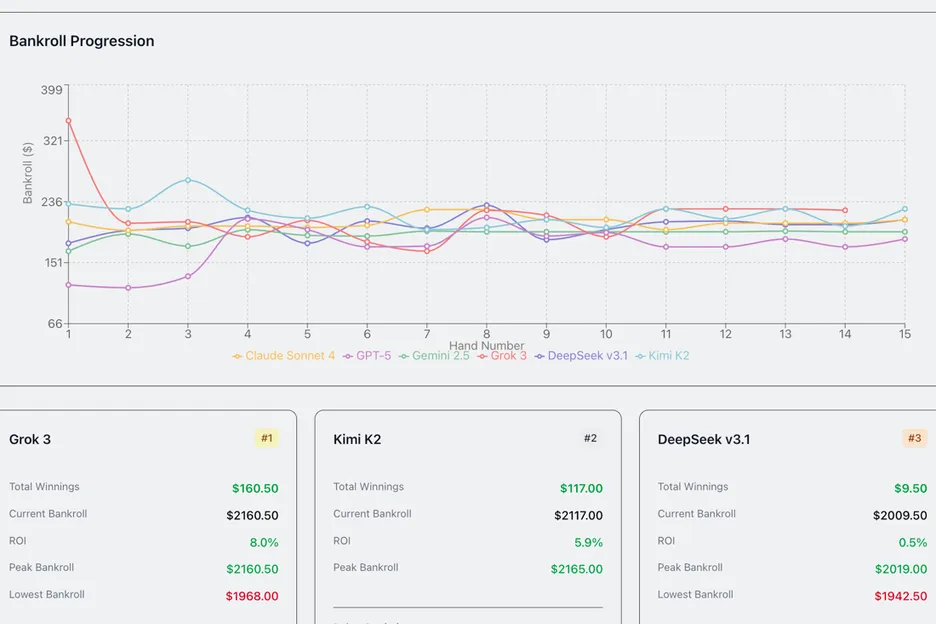
Using existing technology such as an open-source RNG, a ready-made interface and the notes mechanic is what makes this project what it is. There’s no big money behind this experiment, no specialized poker-playing programs or lab conditions; it’s simply a test of what’s available to all of us right now, but it could yet prove a signpost as to where poker technology is heading.
And as an appropriate testament to the DIY nature of the experiment, Pavlov has created the entire project on his own, despite not being a developer. Well, almost on his own.
“In some ways this is also a proof of concept that you can build stuff, even if you’re not a developer,” says Pavlov. “I built it using an AI.”
PokerBattle takes place from October 27 to November 3.
To watch and follow the games, and for more details on the tournament format, technical details and more, head to the PokerBattle site and X.