


At PokerOrg we’re used to covering big live events, where people from all over the world gather to play cards in the hopes that their talents, skills and a little luck will help them claim the lion’s share of prizepools worth millions of dollars.
But we’re more used to seeing black aces played than a Black Lotus, we’ve lost more times to a counterfeit than a Counterspell, and are more likely to suffer the wrath of an opponent than the Wrath of God.
But things are different in the world of another card game that has entranced players for decades. Magic: The Gathering (MTG) is now over 30 years old and has only risen in popularity since it was created, with an estimated current global player population of around 50 million.
And the best in the world will be getting together in Washington state from December 5, for the annual Magic: The Gathering World Championship.
Why should poker players be interested? The game’s relationship with poker is almost as old as MTG itself, with numerous successful poker players getting their start in competitive card games thanks to Magic.
With MTG’s showpiece event just around the corner, we spoke to various players with experience in both games, including Bryn Kenney — poker’s #1 ranked tournament player of all time with over $78 million in recorded tournament earnings — about the allure of MTG and its complicated relationship to poker.
Watch our exclusive interview with Kenney above.

What is MTG?
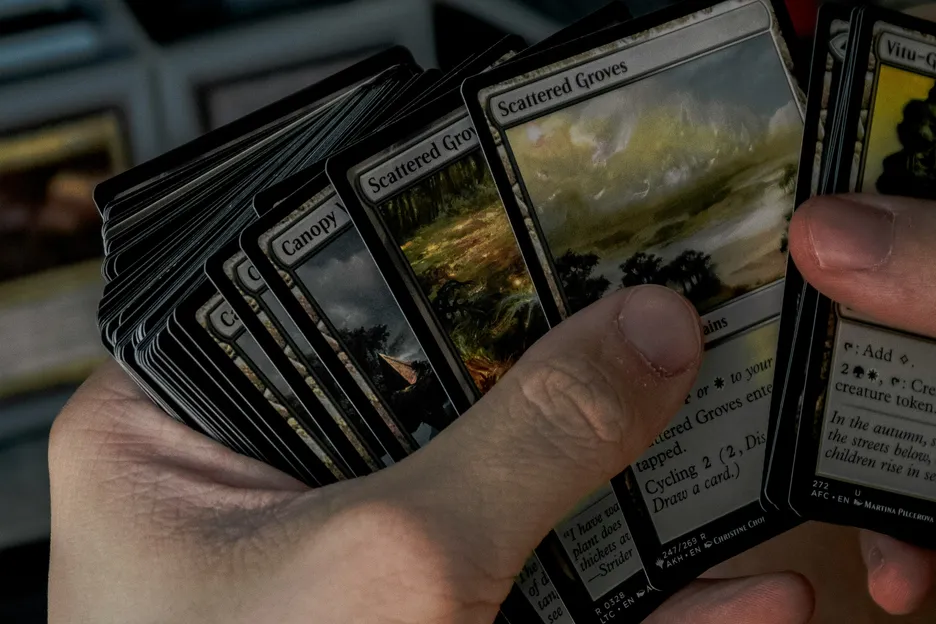
MTG’s colorful cards (with equally colorful names, such as Necropotence, Ancestral Recall and Demonic Tutor) differ from a standard poker deck in a multitude of ways, given the very different game they’re used to play.
First off, it’s a game of heads-up combat, with no wagering. Players use the cards in their deck to summon creatures, cast spells, build resources and inflict damage on their opponent, using synergies between different cards to craft complex strategies and counter-strategies.
Secondly, there are more than 52 cards to play. A lot more. While each player uses a deck of 60, they can personalise that deck with their own selection from over 27,000 unique cards that have been released for the game to date.
The result is a game with a vast array of different specific strategies to employ, though a number of different styles, or archetypes, continue to evolve and emerge as new cards are released and the meta-game develops.
As a consequence, crafting the perfect deck is a pastime that never ends.
For more on MTG formats, deck types and strategies, here’s a useful guide.








Bryn Kenney: ‘Far Fortune, End Boss’
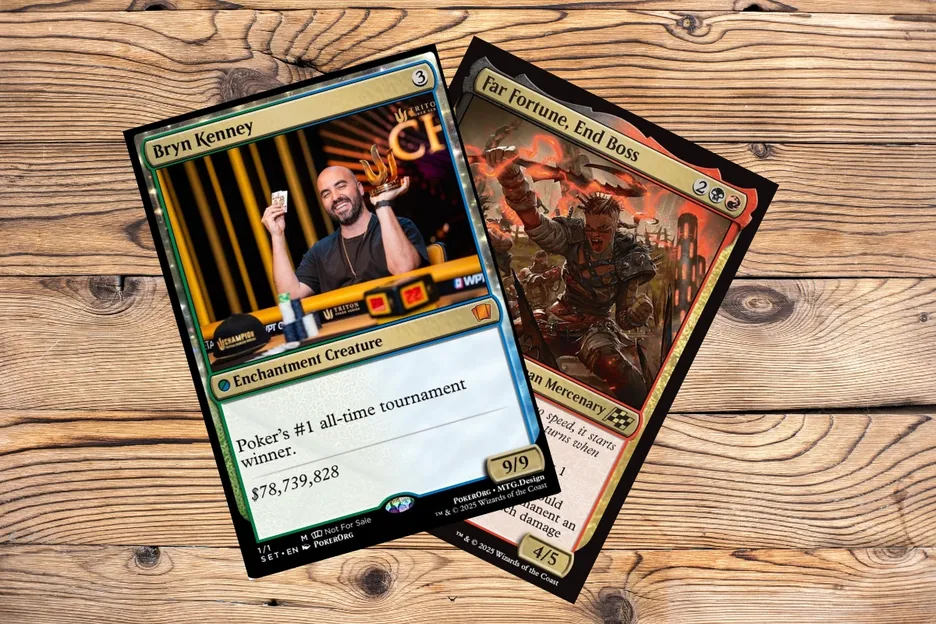
“I was creating decks in school and wasn't listening to what the teacher was saying,” says Bryn Kenney, a MTG player from childhood. “One of my uncles owned a card shop, and he had these preconstructed MTG decks. I asked my mom to buy one for me, and the next thing you know, I'm in the game. I just loved it, and I put all my attention into it.”
The game would provide a spark that drove Kenney’s young mind in pursuit of perfection — a quality that’s endured into his peerless poker career.
“When I get into something, I really put everything into it,” says Kenney, “so that's really all I would think about. I had on my mind that I wanted to be number one in the world in 15-and-under events.”
It was a goal Kenney would attain, reaching the top of the MTG ranks as a junior, before the game of poker came along to soak up his time and attention. It didn’t hurt that success in poker paid a little better, too.
“These Magic competitions at the highest level were very tough competitions, and the winners of these pro tours — and maybe there were 5 of them a year — would get $30,000 to $50,000, and of course it's hard to win tough competitions.

“Then, you've got poker emerging, and you see these guys like Chris Moneymaker, winning this huge tournament [$2.5 million in the 2003 World Series of Poker]. Just a normal guy. So a lot of people that played Magic were like, ‘Okay, well, I'm gonna get into poker.’”
In terms of taking his MTG skills into the poker arena, Kenney sees similarities in his approach to both games.
“I liked playing blue/white, blue/red and blue/green decks — versions with a bit of tempo and creatures — so preparing for more of a long mechanic game. It’s kind of how I think about poker.”
Jonathan Little: ‘Think Tank’
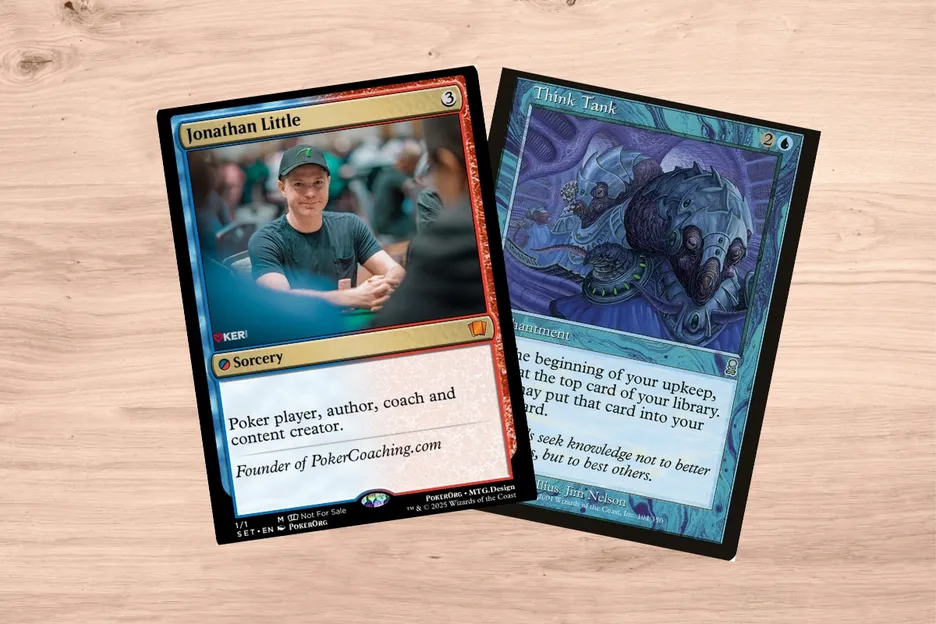
“Magic and poker are both games that include known and unknown information. They are quite different from many games where all or almost all variables are known to both players.”
Jonathan Little knows his way around a card table, whether it’s poker — the player, coach and author picked up his first WSOP bracelet earlier this year — or MTG.
“I started playing when I was 12-years-old,” says Little. “I was introduced to it by a friend in school who I regularly played chess with. I never played the World Championships, but I qualified for a Pro Tour once when I was a kid, but I couldn’t go because it was in China.”
Little, a member of the PokerOrg Player Advisory Board, is also an avid art collector and found himself drawn to the visual appeal of MTG’s vast range of cards.
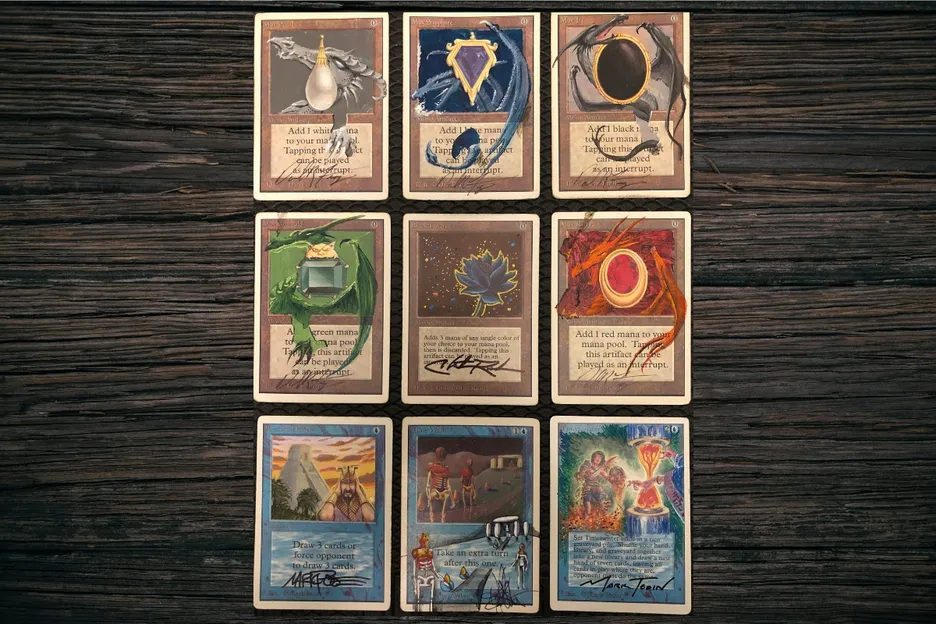
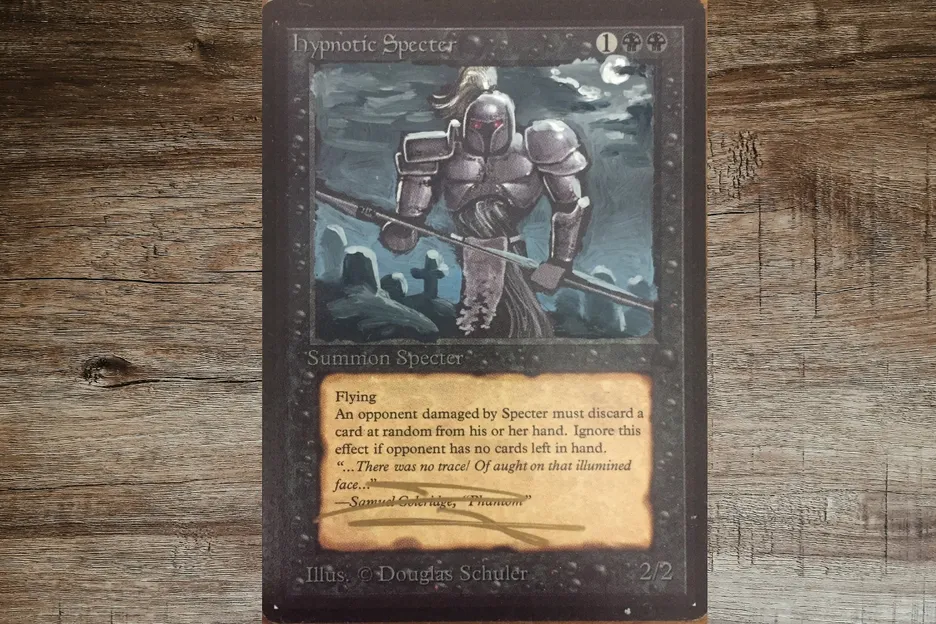
“I own basically every card needed to play Vintage (which is a format that allows you to play almost any card ever printed), with most of them being altered by the original artists. I have a set of altered Power 9, which are essentially the most powerful cards ever printed."
“My favorite card as a kid was Hypnotic Specter, but it is no longer an especially powerful card today. At one point, I had over 1,000 copies of it.”
When it comes to his personal style of play in MTG, Little favors aggression — a key attribute in successful poker play.
“I typically play some version of Control, which allows me to react to whatever my opponent does. I usually favor the more aggressive styles of Control though, where I get a little bit ahead at the start of the game and ride my small advantage to victory.”
Little is a strategic thinker — as you would expect from the man who founded PokerCoaching.com — and believes MTG can be a useful step on the route to successful poker play.
“I think Magic is an excellent training ground for teaching people how to piece together known and unknown information. It also helps you understand statistics and variance.”
Justin Bonomo: ‘Big Winner’
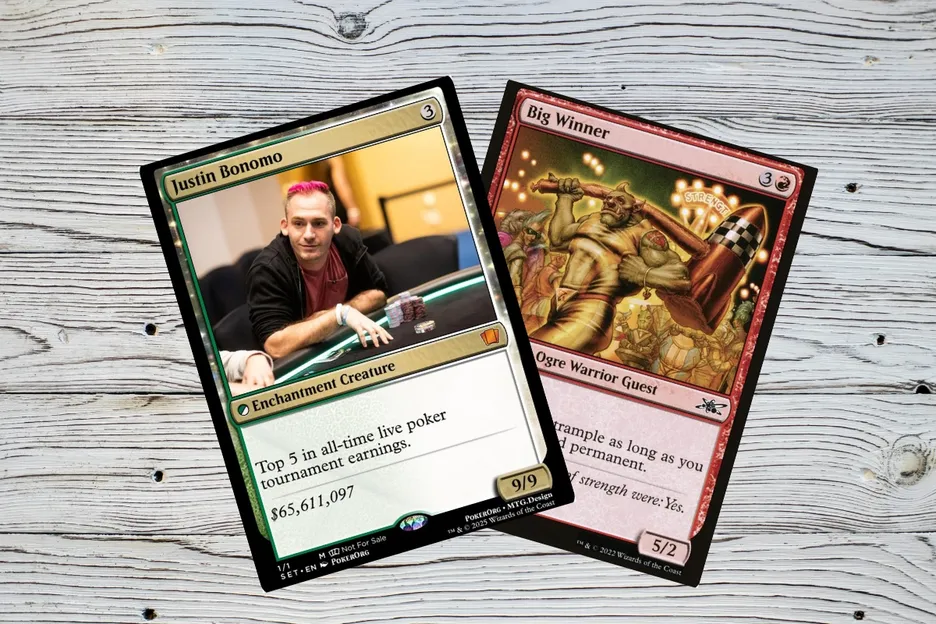
Another MTG player turned top poker pro — currently in the top 5 tournament winners of all time with over $65 million in career earnings — is Justin Bonomo.
Originally from Virginia, Bonomo took up MTG at the tender age of 8, playing with kids in his neighborhood, before discovering the existence of tournaments.
“I played in the Junior Super Series when I was 13-15,” he tells us. “I won four separate $1,000 scholarships from those tournaments, including from a heartbreaking 9th place finish at the Junior World Championships in 2000, just narrowly missing the top 8 playoffs on unlucky tiebreakers.”
Graduating from the junior tour, Bonomo went on to try his luck in MTG’s major league.
“I qualified for three Pro Tour events and the US Nationals the year I turned 16, but never had any strong finishes in those. When I was 17 I started making money playing poker and decided to quit playing Magic. Of course it's such an amazing game that I've gone back to it many times over the years.”
Unlike Little, Bonomo did not hang on to his card collection, selling them all ($1,600 worth) once he decided to go all-in on his poker career. Since then he’s enjoyed playing MTG in his spare time — especially the Cube Draft format in MTG Arena, a digital version of the game — but hasn’t played competitively since.
Nevertheless, Bonomo too sees some parallels in his approaches to the two games.
“Similar to how I approached poker, I always played the deck that I thought was best, not really paying much heed to my personal playstyle. I wanted to win. If you look at the decks I won tournaments with, it would be a hodgepodge of all the different strategies — 5 Color Blue, Stompy, Rebels, Bargain, Psychatog, UG Madness and Tinker come to mind.”
Having achieved success in both disciplines, Bonomo is quick to point out that, while skills in each can inform those in the other, the relationship between them isn’t as simple as some like to think.
“A lot of Magic players will tell you that it really helps train you for poker, but I don't think that's really accurate,” Bonomo explains. “I think it's far more accurate to say that Magic is a ‘litmus test’ for poker.
“If you have the skills and mindset to succeed in Magic, then you'll likely succeed at poker too. But for every kid who did well at both Magic and poker, there are 20 more who played both and never really had much success in either.
“That said, Magic is definitely the best table-top game I've ever played in my life.”
Javier Dominguez: ‘Fervent Champion’
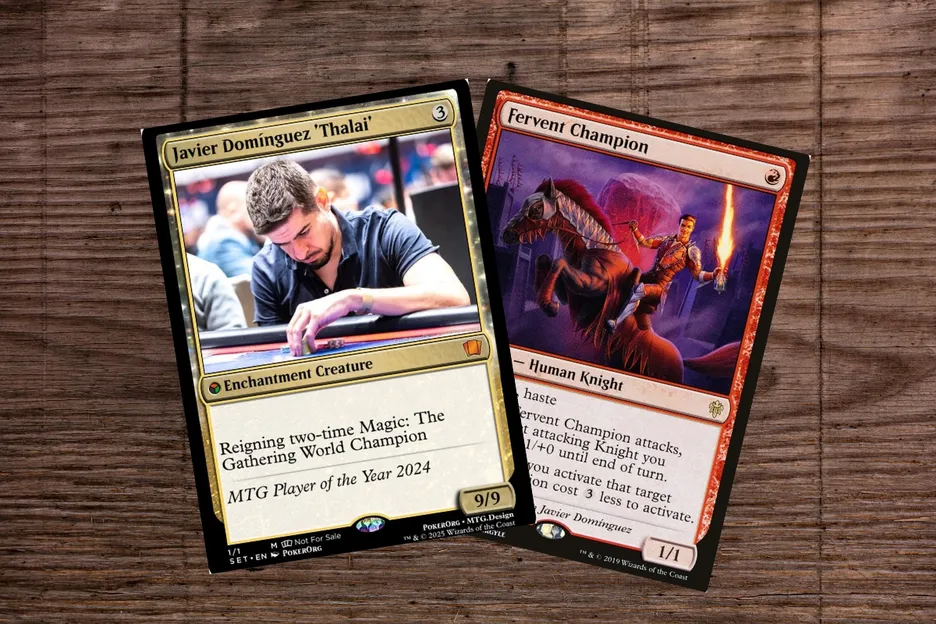
Not every successful MTG player who learns poker ends up leaving the game behind. Javier Dominguez, for example, spends the majority of his time focused on MTG, only playing poker every few months.
But then, Dominguez is not your average MTG player. A two-time winner of the World Championships — first in 2018 and again last year — the man from Spain is not only the reigning MTG World Champion but also the 2024 Player of the Year.
“My best MTG memory is obviously winning the World Championship, and I’ll be back this year,” says the champ, “ but my favorite poker memory is playing the World Series of Poker Main Event for the first time. It’s truly a special experience, even after all these years.”
When it comes to MTG strategy, Dominguez again sees a connection with his approach to poker.“
I tend to like decks that are flexible across archetypes,” he explains. “For that reason, Midrange and Combo decks together tend to be my prefered strategies. I think it has some relation with poker in terms of flexibility, as playing poker you have to learn to be offensive and defensive simultaneously.”
When it comes to a favorite card, Dominguez is quick to reply. After all, not many people actually have a real MTG card made for them.
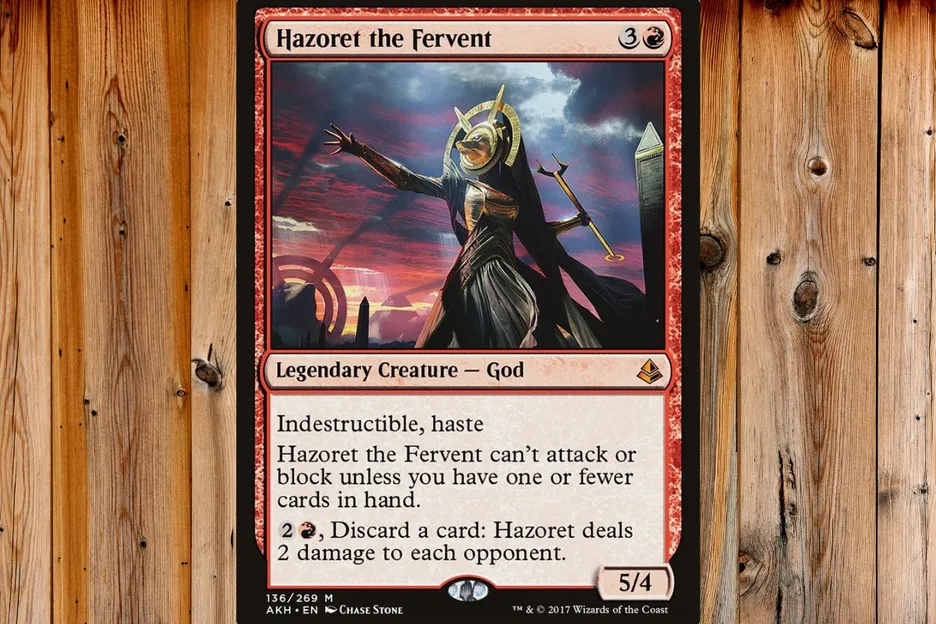
“My favorite card is Fervent Champion,” he says, referring to the card which bears his name and face, and was created following his 2018 World Championship victory, “but it is named after my other favorite card: Hazoret the Fervent.”
On the subject of transferable skills, Dominguez points to one specific poker concept for which MTG can help provide a deeper understanding: ICM, or the Independent Chip Model — a mathematical method of determining value in crucial tournament situations.
“I think both games use skills that translate fairly well between them. However, some of the games naturally will train you better in some aspects. For example, poker will make you way better than any other game at reading hands, but a concept like ICM will already be fairly intuitive for any MTG player.”
When we ask if that makes it easier to transition between the games, Dominguez agrees.“I think it's very easy to make a transition between games you love.”
Key similarities and differences
There’s one quality that few would deny runs through both games: the capacity to express yourself through your gameplay.
It’s why so many of the players we spoke to drew comparisons between their strategies for each game, whether it’s a focus on aggression, flexibility, grinding out the long game or carefully balancing risk and reward. But the comparisons clearly don’t end there.
“Similarities between poker and MTG are really everywhere,” explains Dominguez. ”Both are games of small margins, where information matters, and where having a sound strategy goes a long way."
“To succeed at these games you need to be able to interpret abstract information in a way that gives you actionable data for your decisions,” says Bonomo. “It's a very logical and linear way of thinking that requires a strong attention to detail. That's why intelligent people with autism are likely to succeed in both games. Having an obsession with the game as a special interest, of course, helps enormously as well.”
But along with the similarities, there are some key differences between the games that anyone considering making the transition — in either direction — should be aware of.
As Little sees it, the biggest strategic difference lies in the overall approach to winning.
“In Magic, when you are decently ahead in the game and unlikely to lose if nothing goes wrong, you are usually more concerned with not losing the game than you are about winning the game quickly. In poker, however, you simply must take any decent edge that presents itself.”
“With Magic there’s a limit to how much preparation can help you,” says Dominguez. “Boards can become quite large and complex. Think of it as a chess board where you usually play with a few pieces, but then sometimes there will be a bunch of additional pieces that make the evaluation of the gamestate way harder.”
The other difference Dominguez points to is the length of the decision tree, with poker hands often over much faster and with fewer decisions to make — and potentially get wrong.
“Poker is an incredibly complex game that can get really deep once you study it,” Dominguez says, “but it is still a betting game with, mostly, four betting streets. Competitive Magic games often have a length that's not that far from that.
“However, some MTG games have 15 turns, which means you have to keep making decisions and reassuring your position in a game where even a small mistake in the early stages can decide the game 10 turns later.”
Both games are relatively simple to learn, but with a complexity that runs deep. Both allow a wide range of different strategies and playstyles, and can reward those who reach the top with significant cash prizes. But at the end of the day, people play games because they’re fun. And that’s one thing both MTG and poker have in abundance.
“I think the beauty of MTG is its ever-changing nature,” says Dominguez. “It makes it so every tournament I play feels like discovering a new adventure. That’s something I still love every time I prepare for a Magic tournament.”
The 31st Magic: The Gathering World Championship takes place at the Meydenbauer Center in Bellevue, WA from December 5-7. Note that the World Championship is an invitational competition, and the event will not be open to the public.
Learn more about Magic: The Gathering at its official website.
Additional images courtesy of Jonathan Little/Kayl Photo/Usplash/MTG.Design/Wizards of the Coast.


