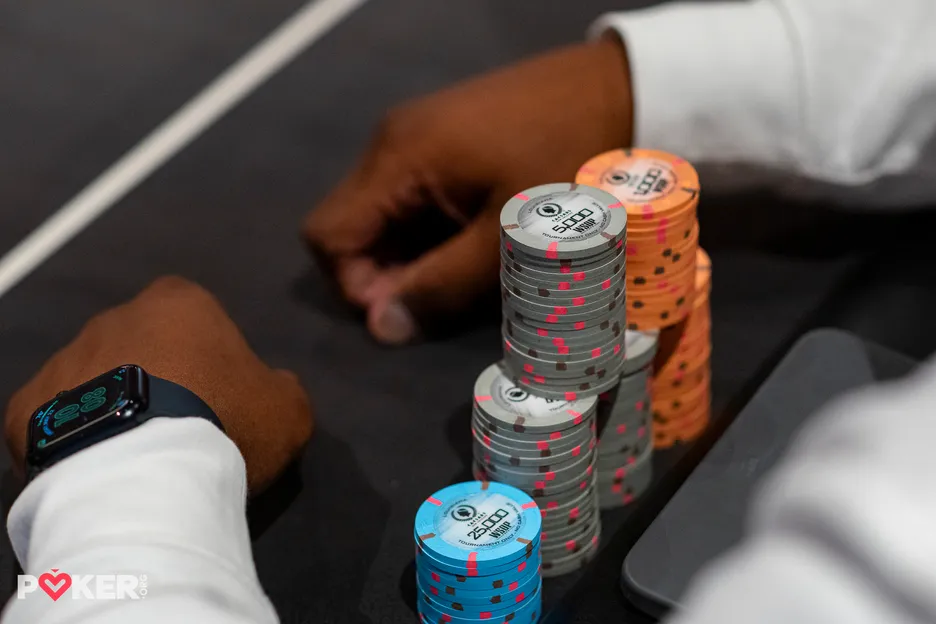


Today, let’s discuss why you are not getting big chip stacks together at the WSOP.
We’re going to look at 5 of the biggest mistakes people make when they’re trying to build a stack, and we’ll see if you’re making any of them.
1. You are not playing enough hands
This happens with a lot of disciplined amateurs.
They read all the poker books, study all the charts, and come away thinking they need to play a very solid range at all times.
What they do not realize is that during the re-entry period, when stacks are extremely deep and people are willing to put chips in with weak hands, you can get away with calling more liberally.
Remember, a pocket pair is going to flop a set or better around 12% of the time. A suited connector is going to flop two pair or better around 5.6% of the time. A suited gapper is going to flop two pair or better around 5.2% of the time.
If you are getting a very good implied odds price, you can consider playing those hands more speculatively during the re-entry period. See if you can flop something solid, and then bet it for all it is worth against the weekend warriors who are in town from Illinois.
That said, you need to give yourself a buffer.
The way poker works is not that you simply hit your hand and immediately get paid off. Sometimes you hit your hand and someone else hits a superior hand. Sometimes you hit your hand and nobody else has anything, so you do not get paid.
That is why you need to look at all the chips you will potentially have access to postflop and divide that by the amount you are calling to determine your implied odds.
For example, let’s say somebody raises to three big blinds from a 300-big-blind stack, and two other 300-big-blind stacks call.
You would be calling three big blinds to potentially win 900 big blinds. That means you are potentially getting 300-to-1 on your money when you hit.
Obviously, you are not going to win all 900 big blinds very often, but it is a useful number to start with.
A pocket pair that flops a set or better 12% of the time is really going to hit about once every 8.3 times. If you are getting 15-to-1 implied odds, that is enough of a cushion to go ahead and work with that hand.
You can also consider playing suited connectors when you are getting 25-to-1 on your money, and suited gappers when you are getting 35-to-1 on your money.












2. You are playing too many hands
Of course, the opposite mistake is also very common.
There are a lot of people who get so excited to play poker that they forget to pay attention during the smaller decisions. That leads to big decisions where they have no idea where they are.
Before you call a 3-bet, remember that the average person still does not 3-bet enough. You need to have a full plan for postflop.
You do not want to call preflop, call the flop, and then have no idea what to do on the turn.
That is when people start justifying bad decisions to themselves. They say they need to defend against a bluffing range that does not actually exist.
Believe it or not, most people are just like you. They have looked at a solver once or twice, but they have not actually done the work.
They are not bluffing enough versus you.
When you call out of the big blind, you need to have a plan to defend yourself on the flop. You need to be willing to check-raise more often, or you need to check-call with a plan for the turn and river if the person is actually capable of barreling against you.
Do not just put money in because the hand looks playable.
Have a plan.
3. You never overbet bluff
I used to tell people there were only three bets that ever got the average poker player thinking.
Overbets, all-ins, and triple barrels.
That was because the average poker player goes to the card room to gamble the same way they would play keno, roulette, or pai gow. Most of the time, they are not trying to think too deeply. They are there to play hands and see cards.
The only way you could get the average gambler to really stop and think was by using a bet that looked threatening.
As time has gone on and people have become more prone to sloppy play, this has become even more true.
That means you should focus many of your bluffs around overbets.
The best situations to overbet are when your opponent just calls you on boards with flush draws or straight draws, especially when they likely would have 3-bet preflop with their overpairs and check-raised the flop with their sets and two pairs.
On those turns, they have a lot of mediocre pairs.
If the turn card is better for your range, you can blast them out.
4. You are not willing to go all-in frequently on the bubble
The bubble is where your fold equity increases the most.
After people have invested multiple hours and multiple re-entries, they typically want to get something back. They want that cash.
That means you can shove a lot of hands you normally would not.
If someone is opening from the hijack with six-four suited or better, but then they do not even want to call your 26-big-blind shove from the big blind with ace-jack offsuit, that means they are doing a lot of folding.
And if they are doing a lot of folding, you can shove a lot of suited aces, suited kings, suited queens, suited gappers, suited connectors, and similar hands.
But you will see many people pump the brakes on the bubble because they are afraid of going out in a blaze of glory.
Listen, you are not playing well on the bubble until you have busted yourself while all the people who suck at poker chortle at you because they have no idea what they are actually doing.

5. You are not value betting large enough
A lot of players fail to build big stacks because they do not value bet large enough.
Let’s say you have ace-jack offsuit, and the board comes jack of spades, eight of spades, four of clubs.
You are continuation-betting into multiple players who are just Bob from the carpet store and Joe Blow the cell phone repair guy from Indiana.
It is not likely they are in the business of folding any pair or any draw to a flop bet.
So bet bigger.
If the draw misses on the turn, they really do not want to fold, because now they want to put you on the missed draw. That gives them permission to keep gambling.
Almost everyone who fails to build a big stack is making these tiny little bets they think are theoretically correct, even though they cannot explain exactly how the theory works.
Just go big for value until your opponents start folding.
Try these tips the next time you play a poker tournament. I bet you put together a bigger stack quickly.
Wishing you the best of luck on the felt.
Alex Fitzgerald is a best-selling author published by D&B Poker. Check out Alex’s most recent book, ‘How to Beat Players Who Never Fold.’
Visit pokerheadrush.com and subscribe to Alex's FREE strategy newsletter to receive three FREE training video packs. Follow Alex on X and Instagram.