

Paul Gibbons is a former Wall Street trader, organizational psychologist, and author of nine books.
A summer-only poker player with career cashes nearing $1 million, he writes on risk, psychology, and decision-making under pressure.
Ask a poker player who the best coaches are and they'll likely start talking solvers, GTO, and population exploits.
But performance coaches are another matter. There they'll point you to a Jared Tendler or an Elliot Roe — guys with client lists to die for who charge many hundreds of dollars an hour.
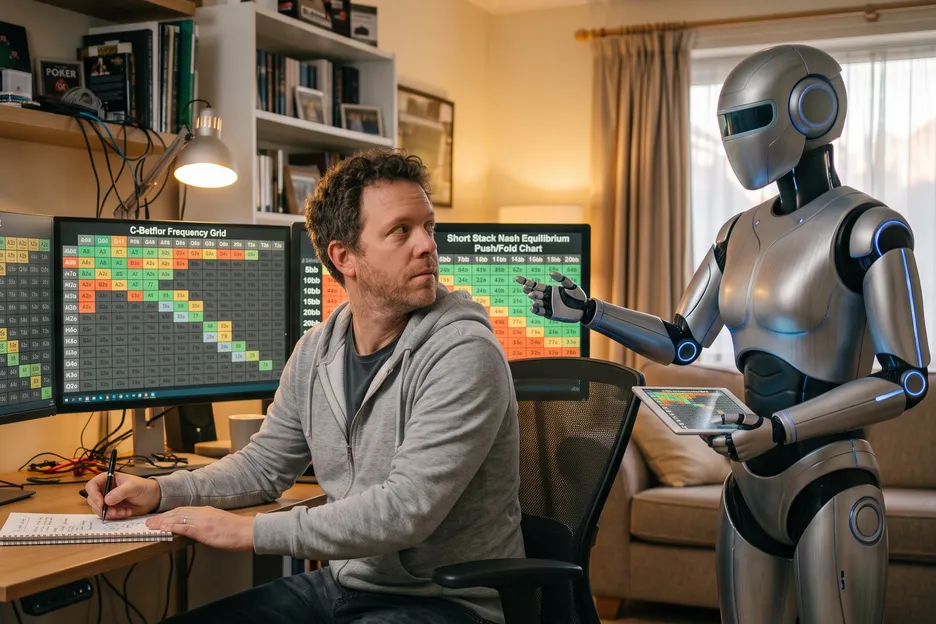
What's undiscovered country is whether AI can do the job for twenty bucks a month. Can it replace the mindset coach charging $500 an hour to keep your ego off the table?
I've been living inside a version of this question for my recent book, Brains, Bodies, & Minds, which covers the AI-and-medicine landscape — whether AI is a better doctor than your doctor, peptides and self-doctoring, whether Huberman is a guru or a snake-oil salesman or both.
But for poker players, the chapter that matters is the first one: Empathy as a Service — is AI any good as a therapist?

The ick factor
For a lot of people there's an 'ick' factor here. The research says there shouldn't be.
The steelman is stronger than skeptics expect. In 2025 a Dartmouth team ran the first proper randomized controlled trial of a generative-AI therapy chatbot — a purpose-built tool called Therabot — and published it in a New England Journal of Medicine title.
Across 210 adults with clinically significant depression, anxiety, or eating-disorder risk, the people using the bot saw symptoms fall by roughly half for depression and a third for anxiety against a control group. More striking still, they rated their working 'alliance' with the bot on par with what people report for a human therapist.

So the lazy dismissal — a chatbot can't do therapy — is simply wrong. Under the right conditions, it can.
Now, therapy ain't coaching; I ran a coaching firm with 50 coaches back 25 years ago — and have a bucket of the coaching certifications — but the bar for therapy is far higher.
You can get a coaching qualification in six weeks; a therapy licence takes years, up to a decade. So if AI is at least competent at the hard thing, it's a fair bet it can handle the easier one.





An always-open door
A good coach is a professional disagreer.
Their entire value is telling you the thing your nervous system is built to reject: that the river bluff that got there was still a bad bluff. That the beat wasn't variance, it was you, for being in the pot at all. That your 'run-bad' is a spreadsheet of your own leaks wearing a costume.
Poker punishes self-serving stories more brutally than almost any arena on Earth, and the coach's job is to strip the costume off — to make you sit in the discomfort long enough to actually change.
Then there's tuning — the practices. Diet, meditation, exercise. AI is a great accountability partner for all of it.
And then there's the 'player-types as emotional triggers' leak.
For me, this might be my most profound psychological leak. The try-hard in sunglasses who looks like a 'd***', talks loud, raises 100% first in. My mind goes: 'I'm going to crush this mother****er's soul'.
Which means I over-deviate — poker turns into a measuring contest instead of a game of patient exploitation and rational decision-making.
My other trap is 'this guy is a complete moron-maniac' — and again, making sure I'm in every pot with him, over-calling, over-bluffing myself. Oddly, that can turn me into the table's whale.
This may sound New Age, but the redirect is almost spiritual: this is a fellow human being, who plays poker terribly, whose plays are guided by ego and emotion. The goal is peace, not contempt. (And paradoxically, that makes me better at soul-crushing.)
AI was genuinely useful in all of those departments this summer.
But what separates AI from a human performance coach may not be quality — it's access. Even if you don't buy the 'as good or better' research, you may buy it is directionally correct.
Say it's 75% as good for twenty bucks a month. That's access. I have friends who pay coaches $1,200 an hour — for most people, that's a closed door.
And here's the killer: whether it's 2am after an exhausting Day 1, or on a break right after you butchered a decision, it's right there. So access isn't just commercial availability — it's time. On call, 24/7.
Push it to push back
As a sparring partner, AI is genuinely useful — but only if you weaponize it against yourself.
Prompt it to argue the other side, to hunt for the flaw, to play the coach who's convinced you punted, and it'll surface lines you'd never reach alone when no human coach is awake.
As a record-keeper and pattern-spotter — logging your tilt triggers, your leak-heavy spots, your recurring excuses — it's tireless and cheap. As a Socratic questioner it's decent, provided you build the adversarial prompt that forces it to push.
I learned this early, as a trader: I don't need people telling me I'm a genius, I need people to take the ego down a notch. In Polymath Poker, out Summer 2026, I flip it around — not how being a trader helped my poker, but the converse.
What can poker heuristics, decision-making under uncertainty, and the decision hothouse we players live in teach VCs, private equity, and traders — the folks making nine-figure calls?
For anyone trying to reach the top of the game — or at least the top of their game — a coach is essential. But thousands a month is a heavy tax.
So, the headline answer: probably about as good, but with 24/7 access at 5% of the cost.
For most players, that's more than good enough.
Read more from Paul at Polymath Poker.
Featured image generated using AI.


