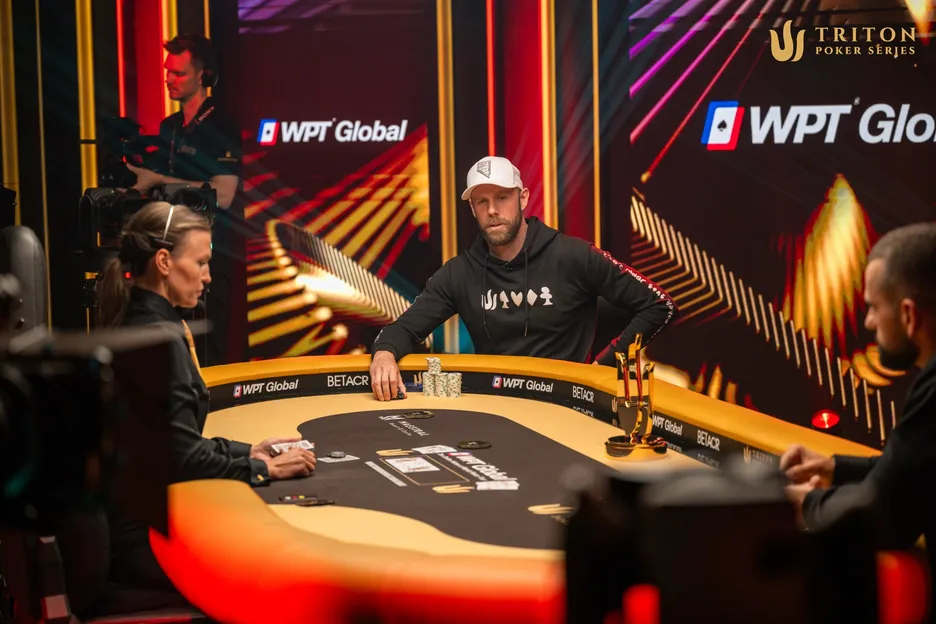


Welcome to another edition of our series exploring key hands from major tournaments with Octopi Poker, where we celebrate great players and their remarkable decisions. In this installment, we break down a fascinating, winner-defining heads-up hand from the $200,000 buy-in 2025 Invitational NLH at the Triton SHRS Montenegro (Event#8).
Seth Davies couldn’t have scripted a more dramatic chapter in his high-stakes poker journey — earning a breathtaking $4.19 million as the runner-up in the record-breaking $200,000 Invitational NLH (Event #8) at the 2025 Triton SHRS Montenegro.
With 133 entries generating a staggering $26.6 million prize pool, this became the largest high-roller field in Triton history, drawing elite professionals alongside VIPs and celebrities alike.
Just days earlier, Davies had secured his first Triton title by conquering the $50K NLH event — a moment that marked a turning point in what had been a relentless grind across this series.
Today, we’ll break down a hand from the final heads-up match against eventual champion Aleksa Pavicevic — where GTO discipline shone, even when short-term variance didn’t reward it.
You can revisit this hand, complete with in-depth pre-flop and post-flop GTO simulations, in the Octopi Vault (professional subscription required).
The spot
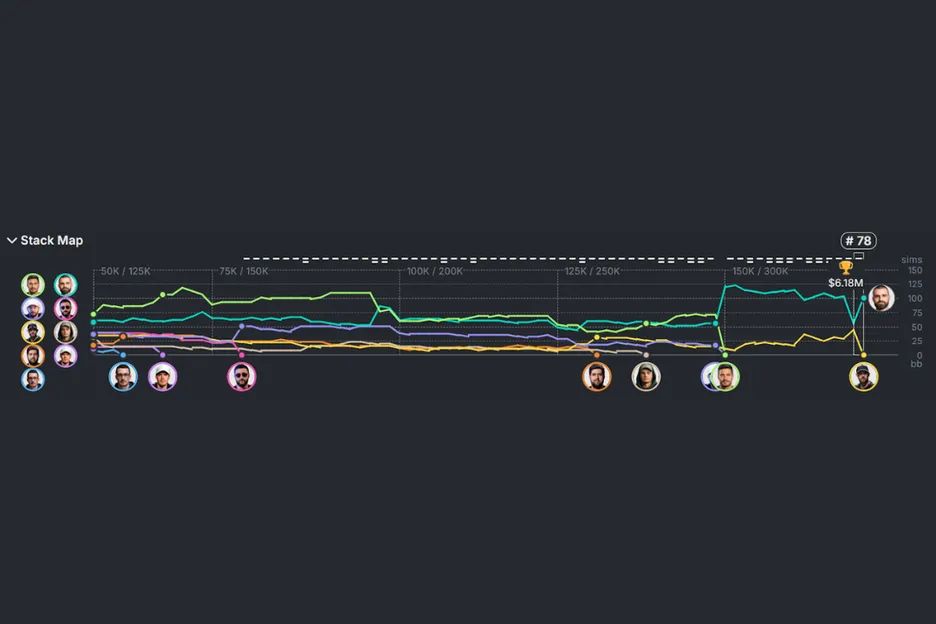
Aleksa, the chip leader, starts on the button with 55bb, first to act. Seth sits in the big blind with 44.8bb. The payouts at stake: $6,180,000 for first and $4,190,000 for second.
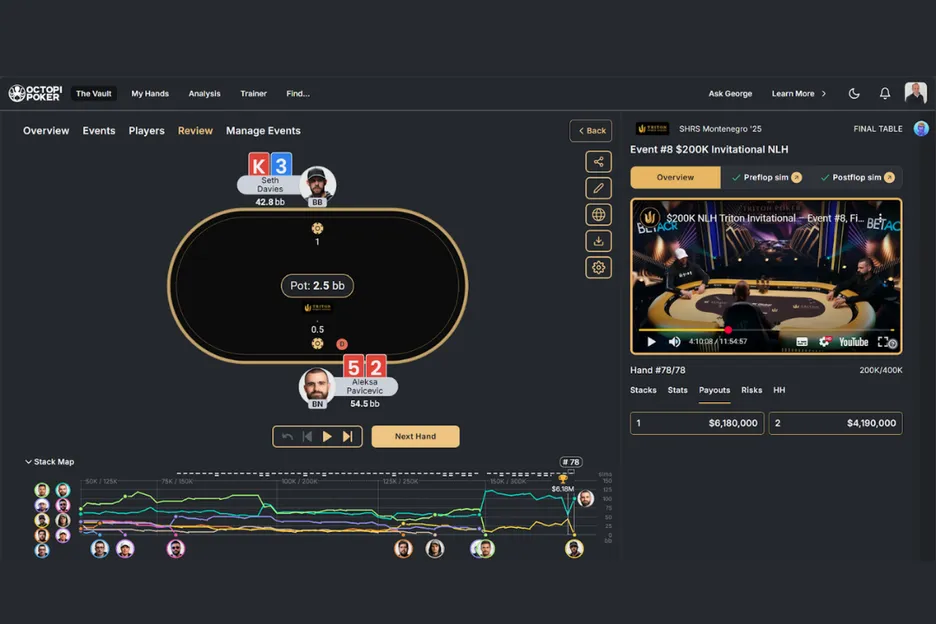
With near-even stacks and enormous pay jumps, especially the steep gap between first and second, every pot is of the utmost importance.





Preflop action
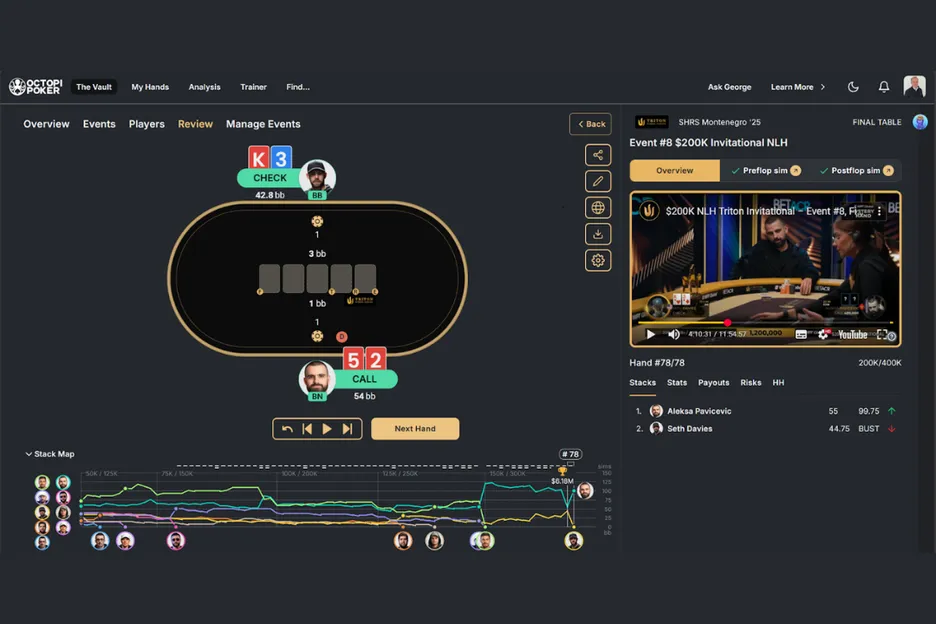
Blinds are 200K/400K with a 400K ante. On the button, Aleksa limps holding 
 , and Seth checks in the big blind with
 .
.
We can analyze their strategies using the custom sim from Octopi Vault to determine if they played correctly and to glean insights into their ranges for post-flop analysis.
Preflop range analysis
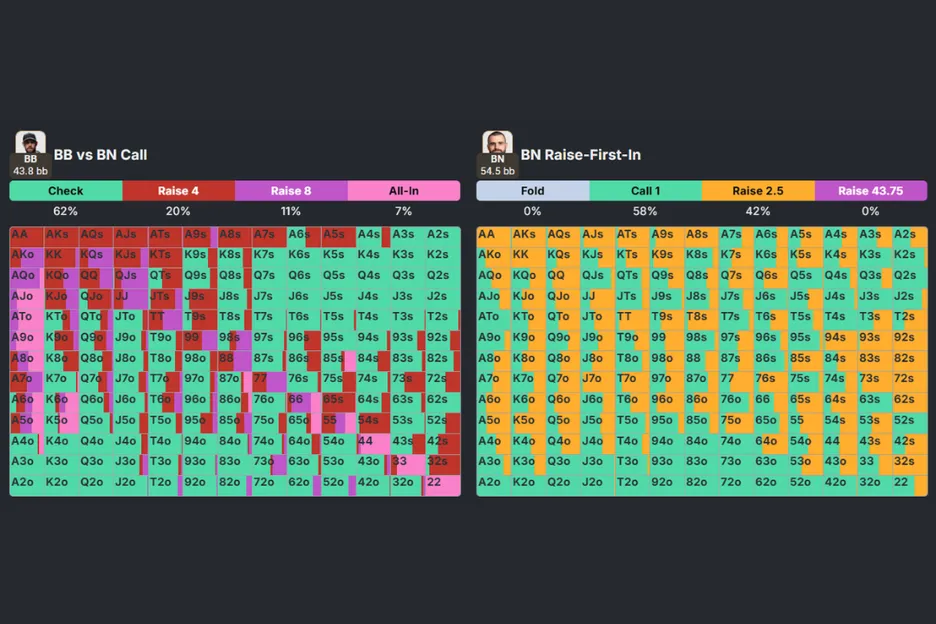
Aleksa's button strategy
- On the button, Aleksa has no folds with a big blind ante.
- About 58% of his range enters as a limp. The limping range includes the worst hands that will easily fold to BB aggression; medium strength hands that can comfortably call a raise and plays well post-flop, and a portion of premiere holdings that can re-raise.
- The remaining 42% of his range is raised to 2.5bb. The raising range is pretty polar, containing premium holdings that want to build the pot right away and ready to call a 3-bet or stack off right away, as well as a healthy doze of raise/folds, that include trashy suited hands, and high/low combos like K5o. By mixing in a wide variety of combinations, Aleksa applies pressure and maximizes both his positional edge and chip-lead advantage.
- As usual, to achieve balance between seeing a lot of flops and play in position, attack the blinds and build a pot when it suits us, most good, playable hands mix limps and raises. Both limping and raising ranges have strong board coverage and contain both strong and weak holdings.
Seth's big blind strategy facing a limp
- When limped to, BB always has an option to see 100% of the flops without putting any more money in, but also will be playing out of position. It’s a pretty good trade-off, and 62% of the time check is the default. The worst hands want to mostly check, and a lot of medium strength hands with good board coverage want to check pure or close to it..
- Yet nearly 40% of the time, the out-of-position player wants to attack the limps, which after all represent the entire range, full of complete garbage. To accomplish that, BB can choose between 3 raise sizes: 4x, 8x and a 40x all-in! While nailing all the polar raises perfectly balanced by the solver is a challenge for humans, there are clear common patterns to the aggression.
- All-in: No hand wants to shove 40+bb pure, but the combos that benefit from it the most are small pairs (22-44) middle pairs occasionally (55-66), middling off-suit Aces (A4o - AQo) and K5o/K6o.
- Smaller, 4x raise (20%): this is a clear choice for the premium hands, along with the worst offsuit hands, with a sliver of off-suit Kx/Qx/Jx/Tx for board coverage and having some flushes on 4-flush boards.
- Bigger 8x raise (11%): used by good high card hands like AQo/KQ/QJs/middle pairs and a mix of the worst of trash.
Preflop range analysis takeaways
At 44bb effective stacks, the limp/check line leaves both ranges somewhat capped, as the best hands raised, but plenty wide for both with good board coverage and some strong holdings.
The flop
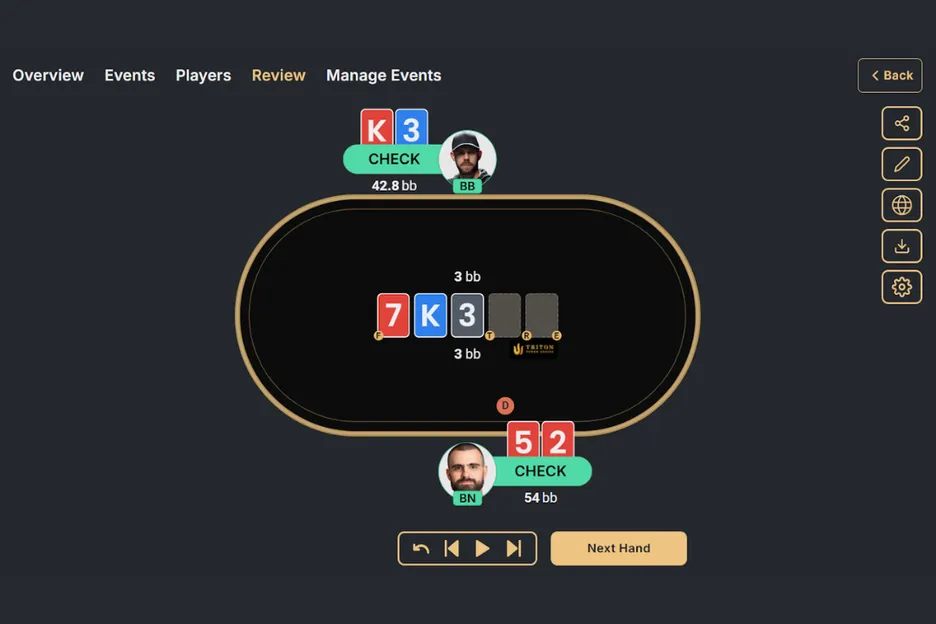
- Seth, BB: check
- Aleksa, BN: check
The 

 flop is dry and disconnected. The button holds a slight range advantage thanks to occasional traps that include more sets and underpairs, though the edge is marginal on this texture.
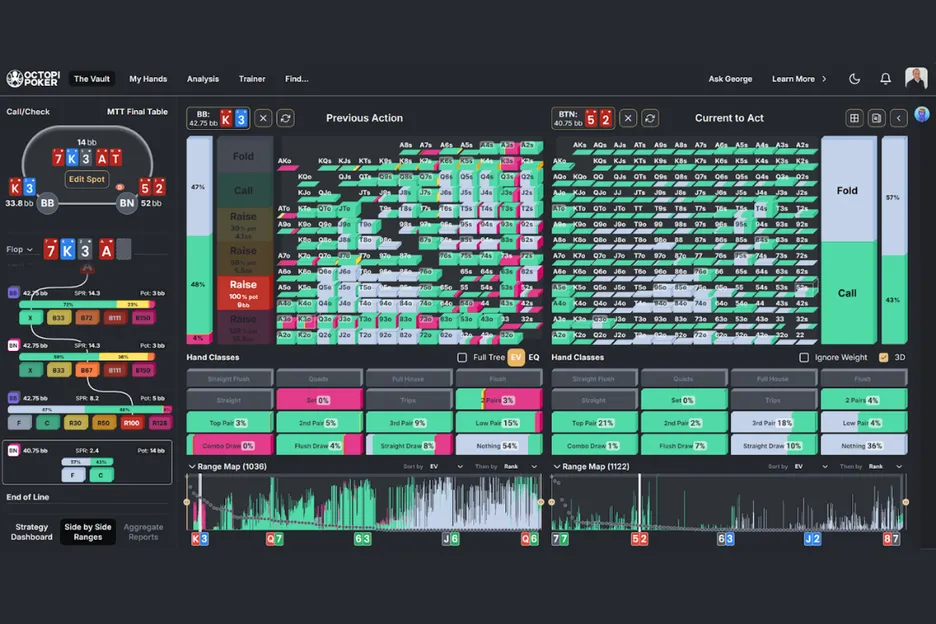
Using Octopi’s Side-by-Side Range Explorer, we can see the flop equities and related strategies for both players:
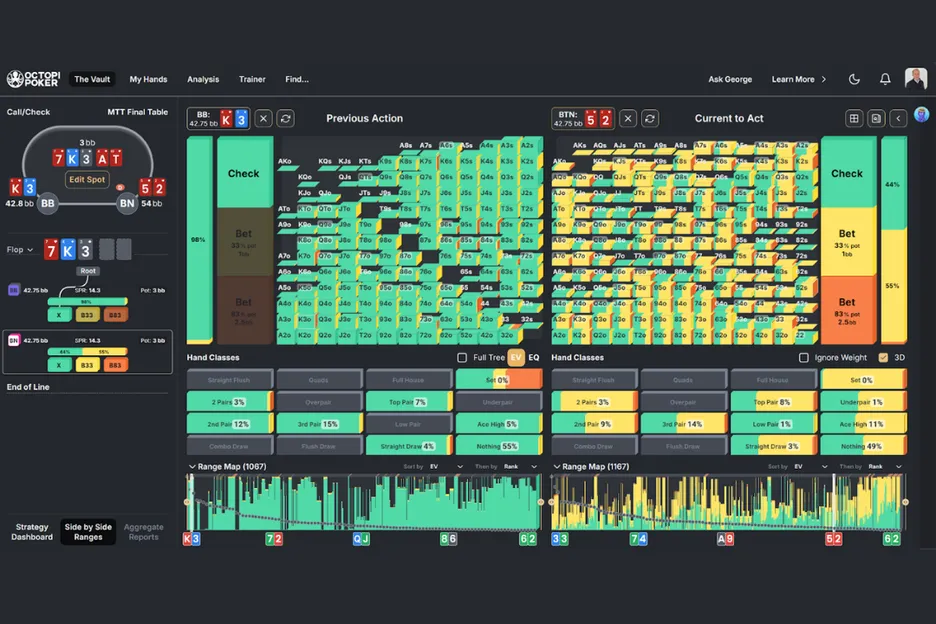
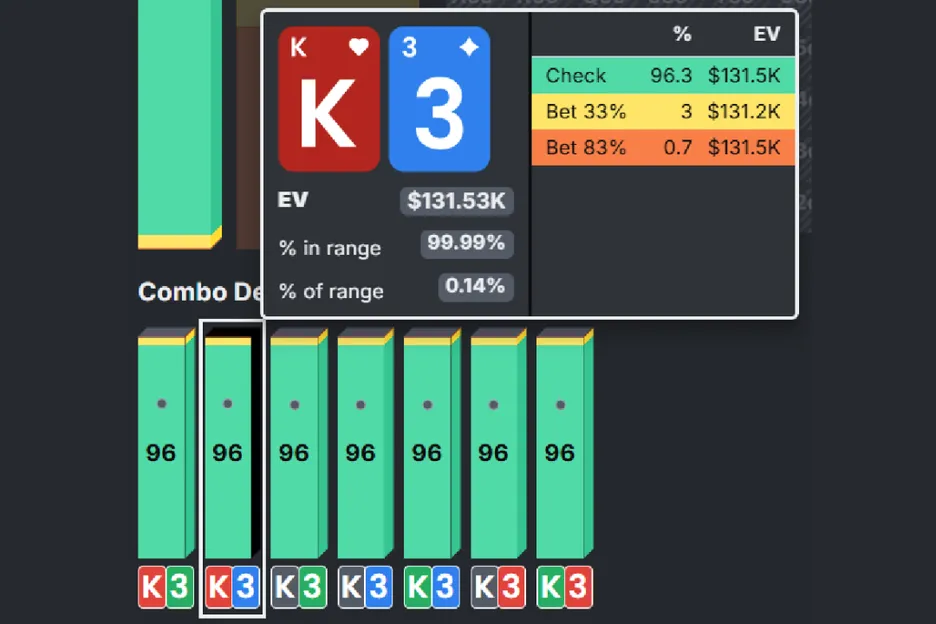
Seth checks nearly his entire range, with only about 2% leading. His specific hand, leads for one-third pot roughly 3% of the time — a tough play to find and execute in real time, as well as unnecessary. Still, some leading occurs in these wide, relatively neutral spots where neither player holds a clear range advantage.
Aleksa uses a mixed strategy here — checking 44% of the time to control the pot and see a turn, while betting 55% for a small 33% pot size with both strong hands and select mixed holdings. A very small portion (1%) opts for a larger 83% pot bet. With specifically, he prefers the small bet 67% of the time but also checks about 31%.
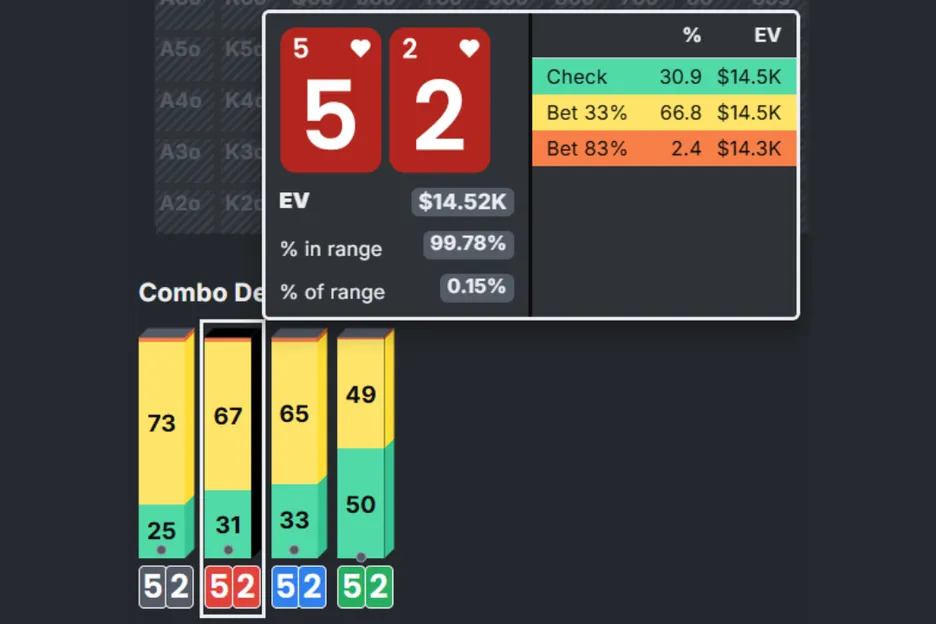
In this spot, both players take the passive line, and the hand proceeds to the turn.
The turn
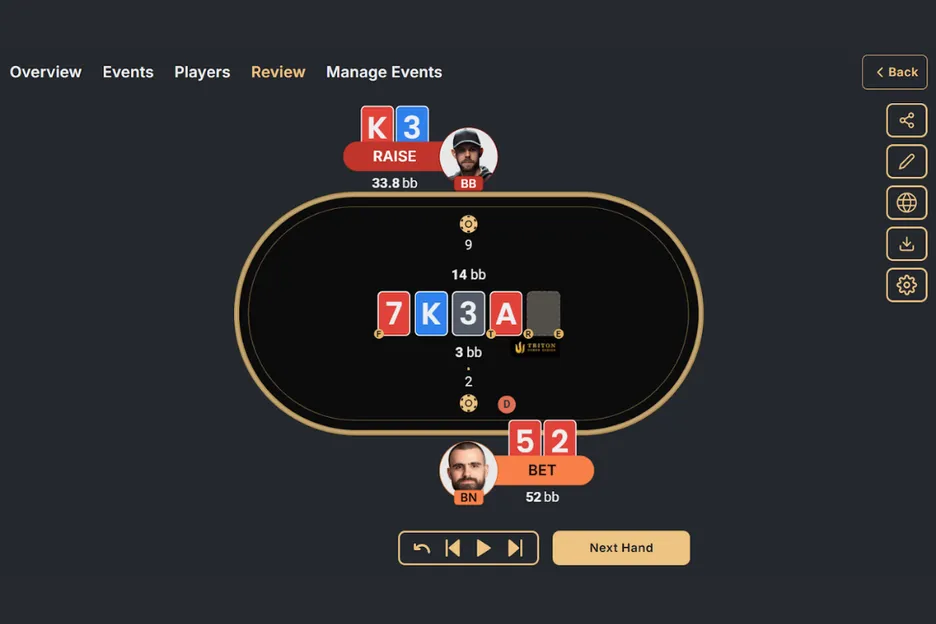
- Seth, BB: check
- Aleksa, BN: bet 2bb, 67% of pot
- Seth: raises 9bb, 100% of pot
- Aleksa: call
The  introduces both flush and straight draws, shifts equity by creating a new top pair, and significantly diminishes the relative strength of Kx holdings.
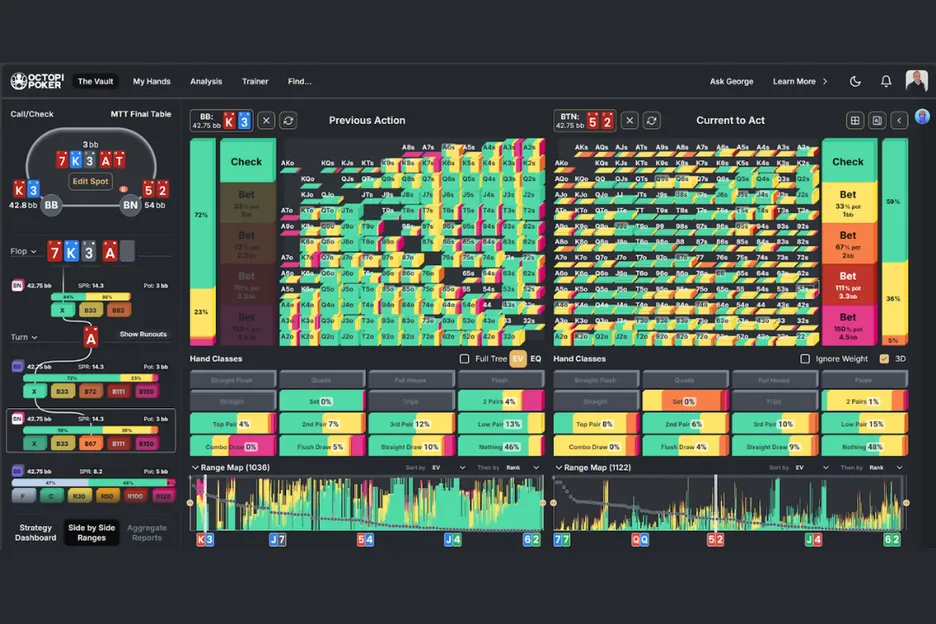
Seth checks around 72% of the time, while mixing in a 33% pot bet about 23% of the time, along with occasional larger leads of 72%, 111%, and 150% pot. The smaller bets serve as merged plays with weaker made hands and strong draws that retain equity on the turn. Larger sizings are reserved for stronger made hands and combo draws.
To protect his checking range, Seth pure-checks sets and a significant portion of his top pairs and two pairs as traps. This makes sense, as Aleksa can credibly represent an ace when checked to, whether betting with value or bluffs. From there, Seth retains the option to check-raise or continue trapping.
is a fine candidate for a check, which Seth takes, though betting outright would have been an equally viable option.
Aleksa checks about 59% of the time, largely due to his relative lack of two-pair combos compared to Seth after arriving at the turn via the flop check-check line.
He still retains plenty of top pairs and some sets, allowing him to bet one-third pot around 36% of the time, with 5% using a larger 67% sizing and occasional 150% overbets. His strongest hands — sets, two pairs, top pair, and select combo draws — favor betting to grow the pot.
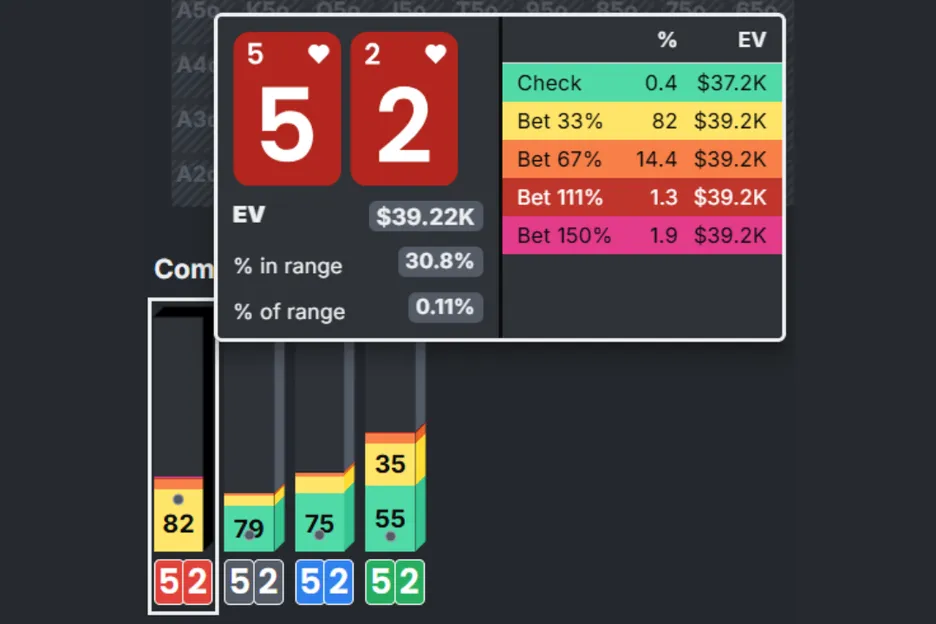
His is a classic combo draw, with both a flush draw and a gutshot but only five-high and no showdown value — making it a pure betting candidate. The solver favors a one-third pot bet, though a larger 67% sizing appears about 14% of the time. In-game, Aleksa chooses the bigger option.
Facing a 2bb bet, Seth’s range remains fairly sticky, continuing with a call about 48% of the time and folding only complete trash with little to no showdown equity. His raising range is highly polar, consisting of two pairs, sets, and strong combo draws.
The solver favors a larger raise — around 128% of pot — to maximize pressure and generate fold equity when semi-bluffing, and to maximize value with his strongest hands against the button’s continuing range.
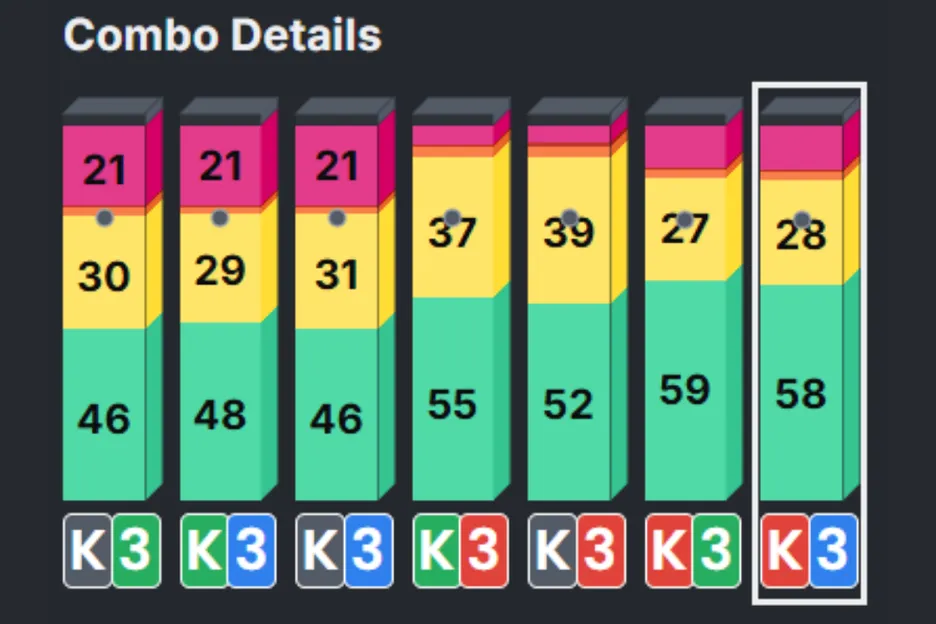
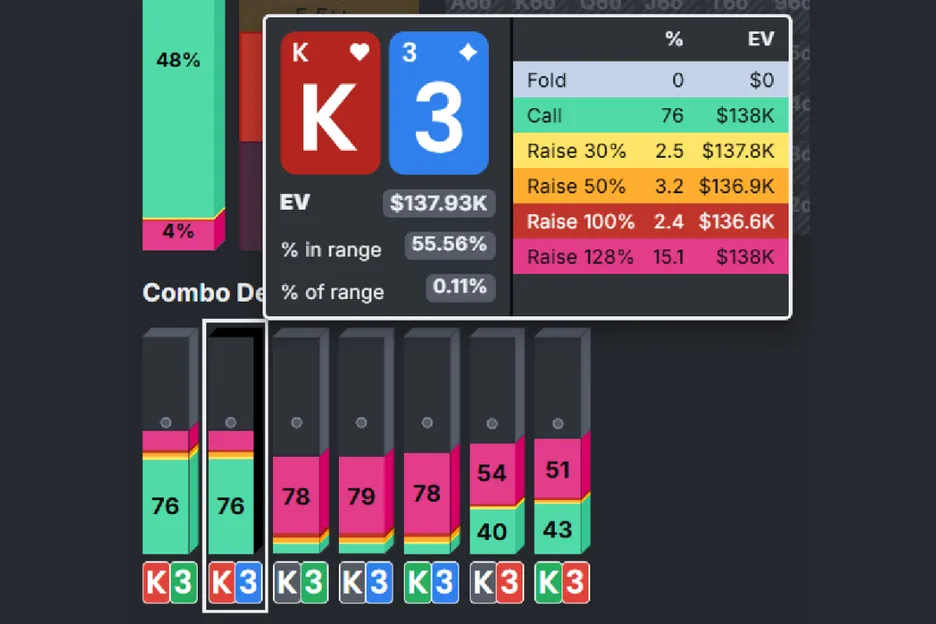
With this specific hand, Seth opts for a pot-sized raise — slightly smaller than the solver’s preferred sizing but still consistent with the overall strategy. Solver output suggests calling about 76% of the time with , as the king of hearts favors trapping more often than non-heart combos. Holding the heart reduces the need to push equity against the button’s potential flush draws by blocking key outs.
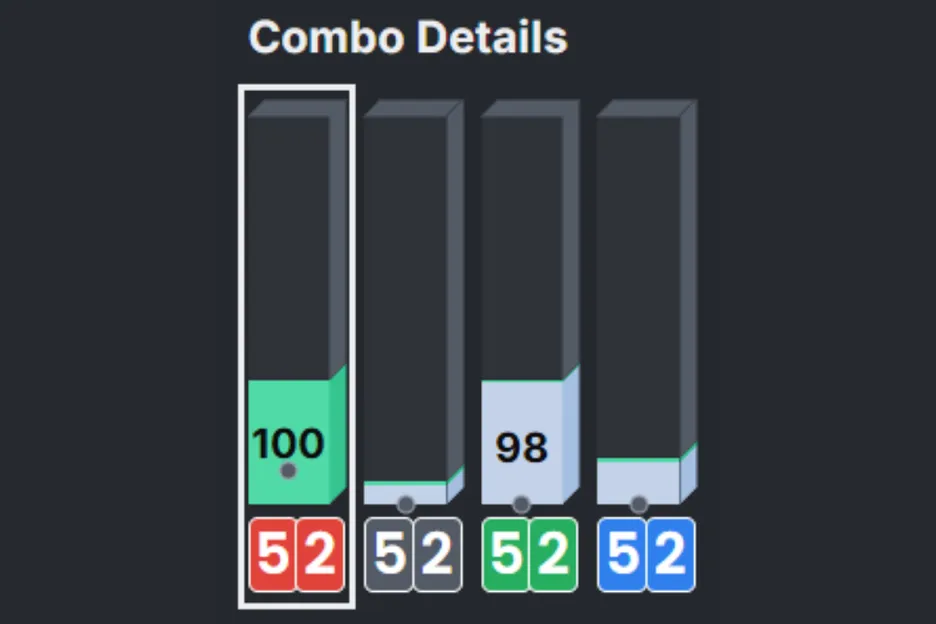
Facing a large raise on the turn, Aleksa’s strategy is limited to calling (43%) or folding (57%). He folds out all bluffs and most third or lower pairs, while continuing with draws and second pair or better. Raising isn’t viable here, as the in-position player faces both a range and nut disadvantage.
Against such a polar raise, there’s no merit in doing anything beyond calling or folding, since no additional equity can be pushed.
With , the call is clear — and Aleksa makes it in game.
Both players navigated this complicated, high consequence turn correctly.
The river
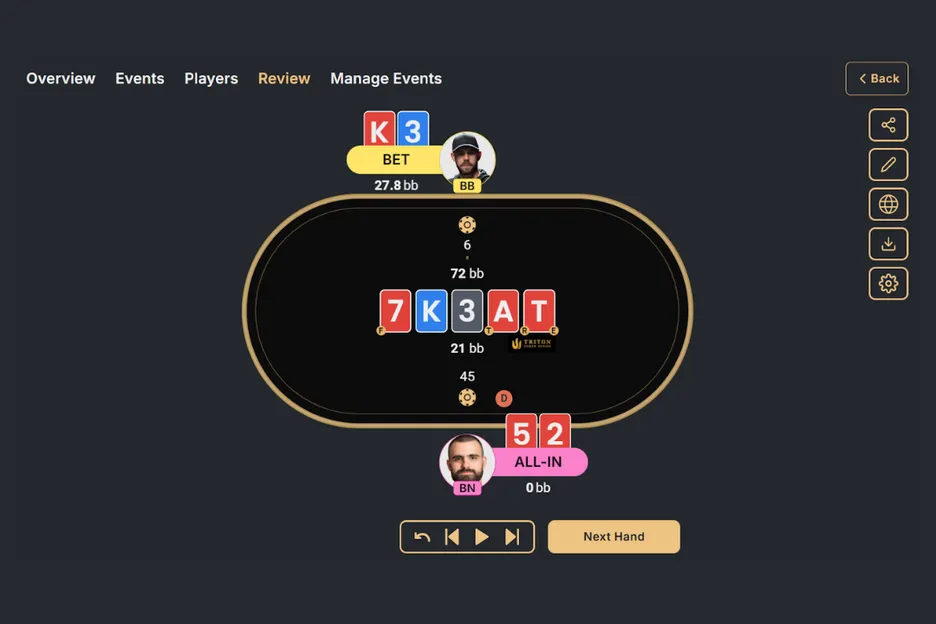
- Seth, BB: bet 6bb, 29% of pot
- Aleksa, BN: all-in
- Seth: call
The  on the river is a spicy card, completing a lot of flushes and straights.
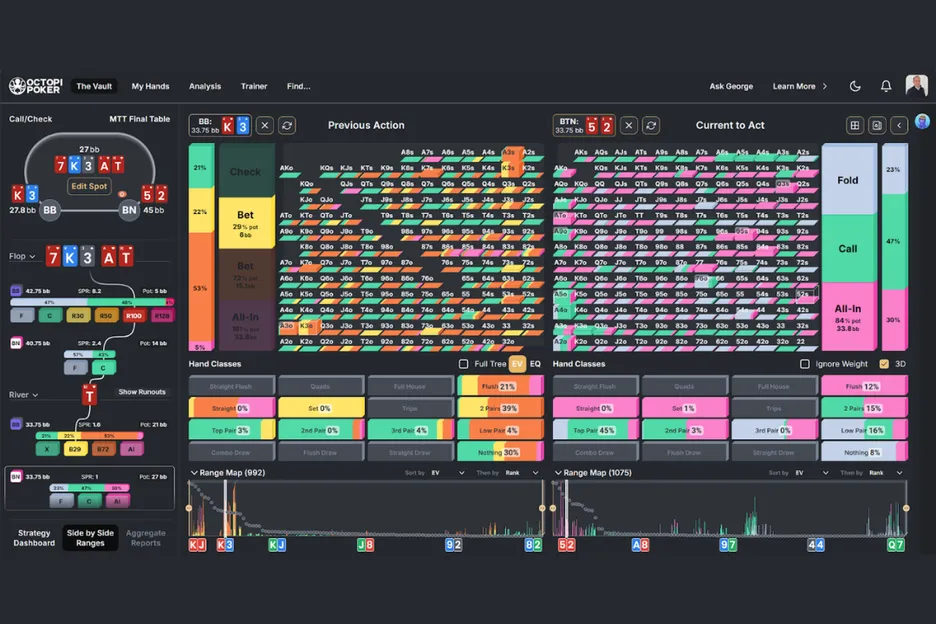
After turn check-raise, Seth rarely has a hand that doesn’t want to bet, 21% of checks come from one-pair hands that want to get a showdown, and some rare give-ups with nothing. With an SPR of 1.6, the solver leans toward a larger 72% pot bet (53%), while incorporating smaller block bets of 29% pot (22%) and occasional all-ins (5%) with flushes. .
Two pairs serve as the threshold for value betting. Seth mixes bet sizes across hand classes to avoid giving away information, to prevent Aleksa from exploiting his sizing patterns.
With the solver prefers a larger sizing — blocking some nut flushes while targeting value from weaker two pairs or top pairs in the button’s range. However, a smaller block bet of 29% is also mixed about a third of the time, and in this spot, Seth goes with that choice.
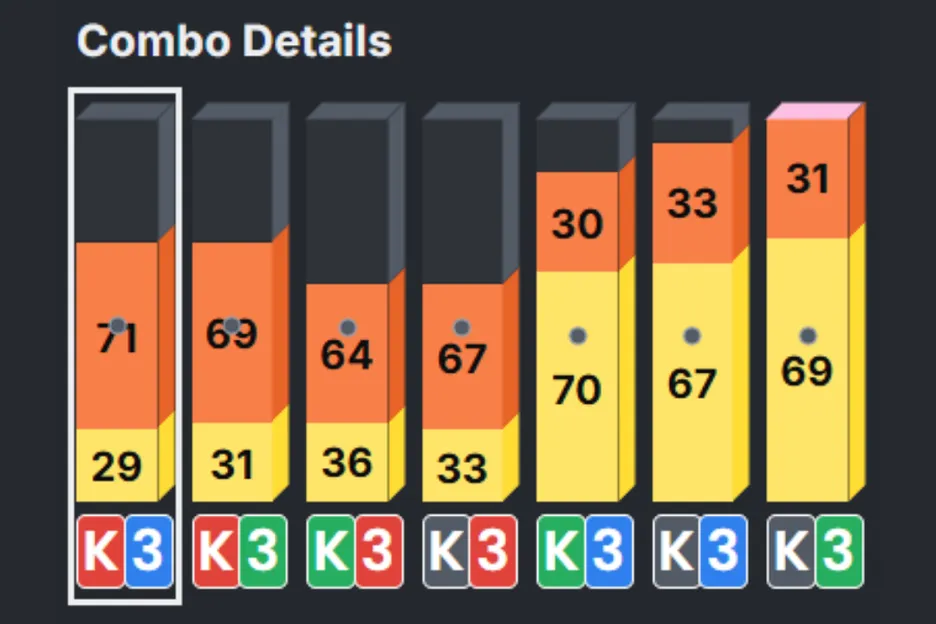
Against the block bet, Aleksa continues with calls about 47% of the time, holding on with his weakest two pairs, top pairs, and some second pairs thanks to favorable pot odds.
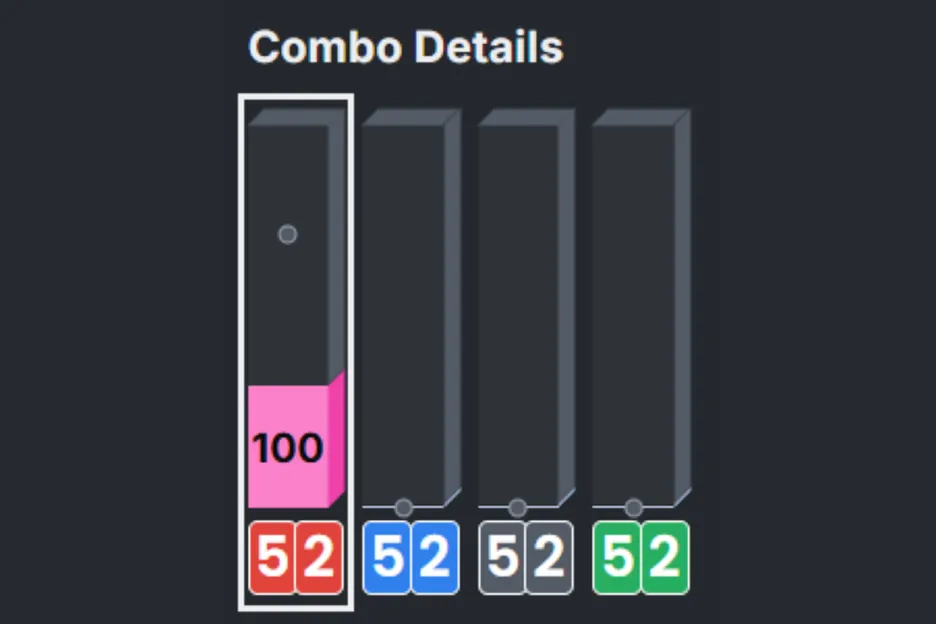
His value-jamming threshold (30%) begins with his best Ax two pair and stronger. Straights, sets, and flushes all jam purely given the shallow stack-to-pot ratio. With , he seizes the spot and moves all-in to maximize value.
Seth’s tournament on the line — call or fold?
Facing the shove, anything short of a flush is an uncomfortable spot for Seth. He can be fairly certain he isn’t ahead of any value.
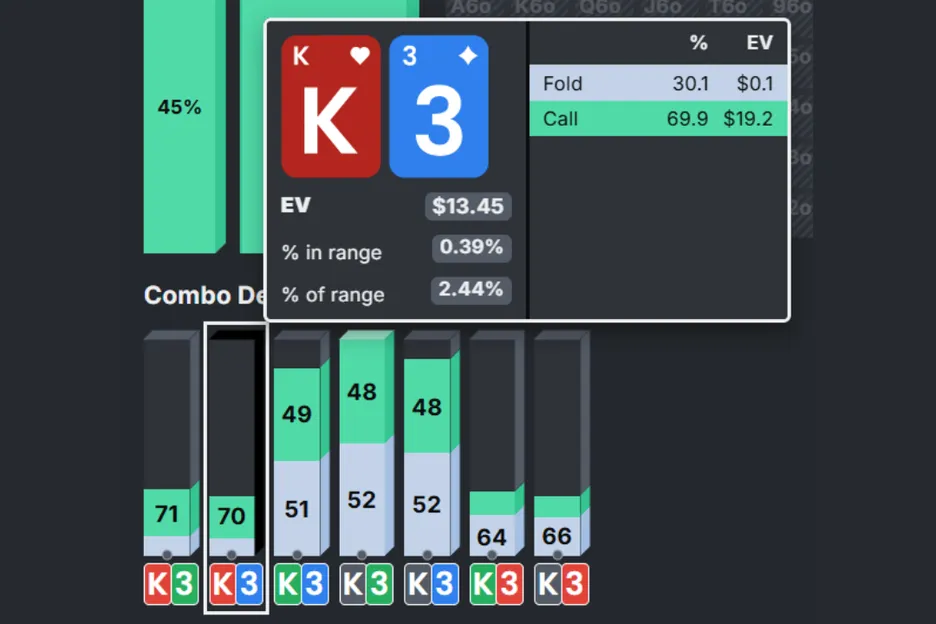
Holding the provides some blocking value against flushes as well as certain A3 two-pair combos. However, he also unblocks possible straights — a drawback — but there remain fewer straight combos than potential bluffs. Some of those bluffs come from hands with blockers and no showdown value, making them strong bluffing candidates.
Solver output shows that this specific combo prefers calling about 70% of the time, with folding still a viable option since the EV difference is negligible relative to the pot size. Seth makes the call and loses.
Given that Aleksa Pavicevic is no stranger to the high-stakes scene, coming from the VIP side of the bracket and having played in numerous multi-million-dollar cash game streams, Seth had likely concluded that he was unlikely to be money-scared, and possibly capable of overbluffing in spots like this to push for the tournament win.
If so, Seth’s specific combo becomes a clear, profitable call, and he makes it in game. Unfortunately for Seth, his opponent completed a runner-runner flush and revealed the winning hand at showdown.
Conclusion
From start to finish, this hand was a showcase of elite decision-making under immense pressure.
Both Seth Davies and Aleksa Pavicevic adhered closely to GTO principles, navigating capped ranges, polarized turn raises, and draw-heavy runouts with precision. Yet, as so often happens in tournament poker, only one player was rewarded in the short term.
For Seth, the immediate outcome meant settling for second place, but in the broader arc of his career, this moment was simply another building block in what became a historic run.
In fact, 2025 proved to be the most successful year of Seth Davies’ career. According to official live results from The Hendon Mob, he amassed more than $12.2 million in tournament cashes, pushing his lifetime earnings beyond $44 million.
His highlights included a breakthrough victory in the WSOP $250,000 Super High Roller for $4,752,551 — his first WSOP bracelet, a $4,190,000 runner-up finish at the Triton $200,000 Invitational in Montenegro, and a $1,490,741 title in the Triton $50,000 NLH event, along with several additional six- and seven-figure scores.
These results elevated him into the global Top 20 on poker’s all-time money list and cemented his status as one of the game’s most consistent and technically refined competitors. In the end, his rise is proof that while variance may shape individual hands, discipline, strategy, and resilience define a career.
Octopi Poker aims to revolutionize poker training making it fun, accessible and affordable, with low subscription tiers for everyone, from beginners to elite pros.
Choose from Community (free forever), Personal ($25 a month) or Professional ($65 a month). Try Octopi Poker Trainer for FREE today!


