

Alan Longo is a high-performance psychologist with five years of experience coaching high-stakes poker players. Passionate about sports, he educates and empowers players with the tools to build their mental foundations, professional routines, and competitive planning for consistent, high-level performance. Find out more at his website.
"You are an idiot. You are completely useless."
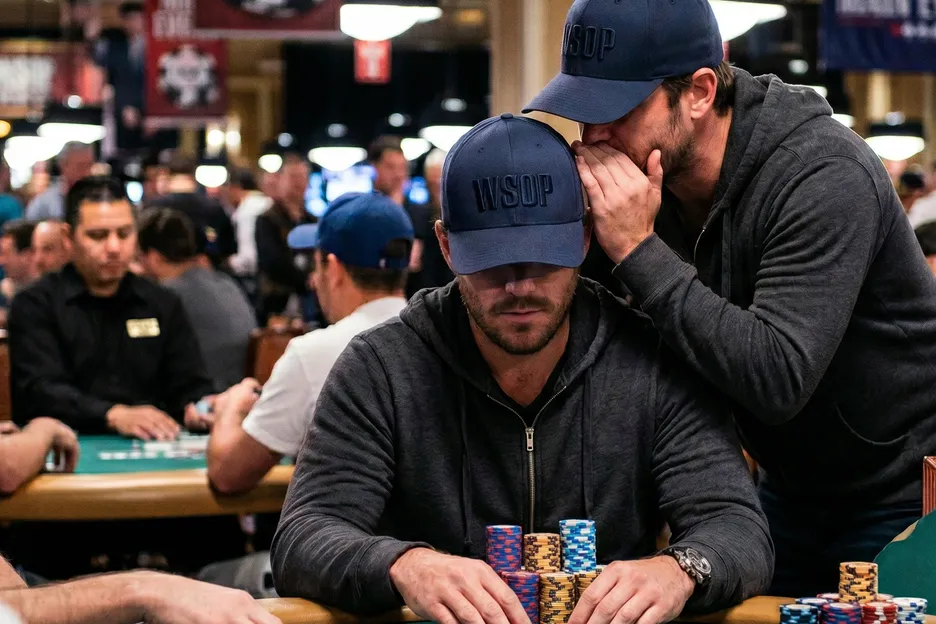
Imagine the coach who prepared you for the WSOP standing right behind your chair, whispering this into your ear after a misplayed hand.
It generates massive friction. Now, every time you make a mistake, this person insults you.
It spikes your anxiety. You can no longer execute correctly. After a few hands of this, you want to stand up and fight them, or just walk away from the table entirely.
But you cannot. Why? Because the person speaking to you is actually inside your own head.
If a real coach spoke to you that way, you would fire them on the spot. But when it is your own voice, you cannot simply walk away. You are trapped with an aggressive, attacking internal dialogue.
For some players, this creates visible frustration. For others, it is a quiet, internal drain. Either way, it heavily impacts your execution. This is the exact example I give the players I work with to illustrate why the way we speak to ourselves physically impacts our performance.
The deeper you go in a WSOP event, the higher the stakes become. As the external pressure rises, your internal emotions amplify. When your emotions amplify, the volume of that internal voice gets louder, and its destructive impact multiplies.
The environment exposes flaws in your mental framework. You cannot control the cards, but you must regulate how you interpret them.



Decoding the internal dialogue
Internal dialogue is the ongoing conversation happening in your mind.
It is not just random chatter — and while it is not a physical mechanism itself, your thoughts can heavily influence your physical responses, just as your physical state can influence your thoughts.
The cognitive mechanism
To understand why your internal voice matters, you have to look at how emotions are generated.
Your brain constantly scans the table and evaluates events as they unfold. The way you talk to yourself shapes how you interpret those events.
Imagine you are running a massive bluff in a crucial hand. Your heart is pounding, and you feel a huge surge of nerves and anxiety.
One player uses their internal dialogue to frame this as a threat: 'I am too nervous, my opponent is going to see my hands shaking and call me.' This triggers a biological threat response.
Another player uses their internal dialogue to frame the exact same anxiety as a challenge: 'My body is just preparing me for action so I can execute this'. This triggers a challenge response.
Your internal dialogue helps you reframe the situation and generate a completely different physical response. And guess what? We perform significantly better under a challenge response than a threat response.
Your internal voice acts as a regulator — it decides if a setback becomes a brief frustration or a full loss of focus.
Impacting 'earned confidence' and pressure
Stress responses generally occur in situations that exceed an individual's ability to cope. At the poker table, your performance degrades when your internal dialogue convinces you that a bad beat is a crisis rather than a statistical probability.
A poorly calibrated internal dialogue destroys your 'earned confidence' — your tactical belief in your ability to execute. If you spend an entire tournament attacking yourself for past mistakes, you create performance blocks.
Learning to manage your internal dialogue aids in managing frustration by keeping your focus strictly on the process. When your self-talk is clinical and objective, you maintain the cognitive bandwidth required to realize your EV.





The tool: The 'reappraisal reset'
You cannot simply turn off negative thoughts, but you can systematically regulate them. You can use a simple four-step process as a tactical 'tool' at the tables.
The next time you take a bad beat in a WSOP event and feel the physical tension rising, execute the 'reappraisal reset':
- Identification: Recognize the physical shift. Notice your heart rate elevating, your posture slumping, or your jaw clenching. Acknowledge that a negative emotional state has been triggered and must be managed.
- Selection: Decide where to intervene. Choose to consciously alter your internal dialogue rather than letting it run wild.
- Implementation: Replace the attacking thought with a functional reality. If you are dealing with a bad beat, say to yourself: 'My execution was mathematically correct. This result is variance, not a failure of skill.'
Alternatively, if you are experiencing a surge of nerves before a massive river call, replace the panic with a tactical anchor. Say to yourself: 'My heart is racing because my body is supplying me with the energy to focus. I can do this; I will trust my math and execute.'
- Monitoring: Track the result. Check your physical tension on the next hand. If the frustration persists, step away from the table for two minutes to physically reset.
By taking control of your internal dialogue, you stop reacting to the game and start managing your response to it.
Combine this 'tool' with active efforts to optimize recovery away from the tables, and your execution will remain sharp deep into the summer.
Featured image generated using AI.


