

Jonathan Jaffe is a poker coach and high-stakes tournament professional with over $20 million in live earnings. He is a co-founder of GTO LAB, where he hosts the GTO LAB Podcast, and is available for coaching both cash game and tournament players. Contact him to find out more.
In this article, first published on his Substack, Jaffe looks back at a fork in the road of his career, and a stark choice he had to face. Stay tuned for more, including exclusive access to new articles.
To understand my demise in 2010, you need to understand the mechanics of the heads-up sit & go ecosystem.
For each stake ($100, $200, $500, $1K, $2K and $5K) there was one lobby1. Once two players sat in that lobby, the match would begin, and a new lobby would spawn immediately. If you wanted to play a match, you had to play the person who was sitting in the lobby, there was no getting around it. If the lobby happened to be empty, you could sit first, but then you would have to play against whomever sat second2.
To sit first in a lobby, you needed to be respected as one of the few players at that level, otherwise the pros who didn’t see it that way would descend upon you.

Everyone had their own approach to the diplomacy and etiquette pertaining to the lobbies, as well as a different appetite for fighting out a turf war.
It was nonstop drama, some of which played out in public chat-boxes during matches, while some of it played out in private capitulations and agreements on AIM or MSN. Someone with a better memory and larger network than myself could probably write a great piece about this topic alone.
In 2007 I’d had my first taste in battling for the high stakes lobbies, but despite an overwhelmingly successful outcome, my downswing towards the end of the year had left me cautious and selective, no longer willing to sit first in the $5Ks.
My score at Foxwoods in November of ‘08 changed that. I now had the ammo to comfortably fight it out with any $5K reg who wanted to battle, and that’s what I did. As it turned out, I didn’t have many challengers and I quickly earned back the right to sit first, largely unbothered by other pros who often battled amongst themselves.
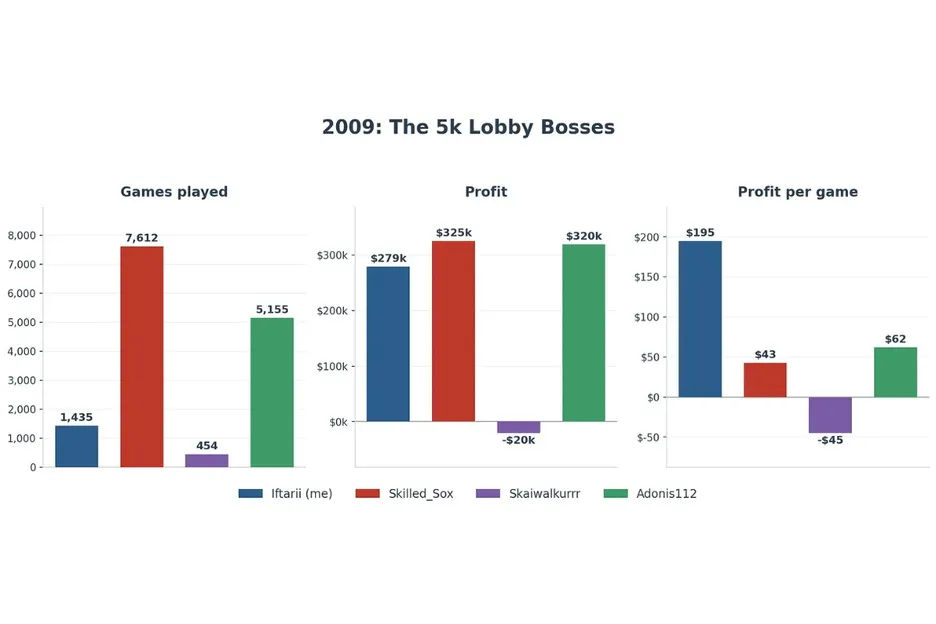
In 2010 that changed. One of the newest top regs, 'Skilled_Sox', was not respecting me when I sat first. And he was correct not to, because by 2010 he was kicking my ass, and it wasn’t just variance.
I didn’t know what was happening at the time, but I couldn’t figure this guy out. I had faced plenty of talented players before 'Skilled_Sox', but with all of them, I felt like I could see what they picked up on, and I would try to counter it, and we would continue this back and forth of trying to anticipate the next move.
Online tells
I think two of my greatest strengths back then were my mental game (not tilting) and my ability to sense how recent events at the table would affect my opponents.
It sounds a bit crazy because in online poker you’re neither seeing nor hearing your opponent, but I often felt very attuned to the emotional state of my opponents.
There were all these little bits of information you could pick up on while playing a match. The speed at which they played was a big one. Some players who manually typed in some of their bet sizes would resort to only the pre-set bet sizes when they were tilted. Sometimes it was less subtle, and they typed their frustration in the chat.
Heads-up is a very swingy form of poker, and no matter how good you are, everyone goes through some disastrous streaks of failed bluffs, incorrect calls, losing flips, coolers, and whatever other forms of bad luck exist. Everyone reacts differently to these various misfortunes, and over time I felt I had a pretty good internal database on how each of my opponents was likely to adjust their play based on recent history.
When I played 'Skilled_Sox', I couldn’t get a sense for how he was reacting to my play.
I would form a narrative that he was likely to stop calling me so much because he’d paid me off a bunch recently, and then that would turn out not to be right.
Then I would guess the opposite might be true, and soon that would prove inaccurate as well.
Over time, I got the sense that his decisions seemed not to be affected at all by momentum, recent results, or any of the tricks I used to try and nudge my opponent into an incorrect exploit. He was committed to his strategies, and largely impervious to my attempts to throw him off. I felt like I was playing against a robot, and I was lost and confused.
Eventually, it was my confidence that dwindled, and I began to bluff less and less often. Once I made that adjustment, I was f*cked. I remember this haunting feeling that came over me in some of my last few matches against Sox. I was just hoping to make hands, as if I had no special sauce left in the tank, my route to victory was less a strategy, and more-so just a hope to get lucky with card distribution.
That thought was as strong a signal as I could receive that I was in over my head, and emotionally, it was a punch in the gut.
'Skilled_Sox' wasn’t the only guy who had my number that year. 'Skaiwalkurrr' (Rachid Ben-Cherif), who would go on to be the most prolific and profitable heads-up sit & go player of all time, was getting his first taste of a full year in the high stakes lobbies in 2010.
While he ended up in the red for 2010, he beat me up pretty badly, and when we squared off in the second round of the 2010 WCOOP HU Championship I knew I was in big trouble. He didn’t just win, he pummeled me. It was one match, and the format was much different than the heads-up sit & go’s we normally played, but I knew after that match that this guy was far ahead of me, and I had no idea how to change that.
One of the ways in which Sox and Skai were beating me was with their commitment to game-plans which were based on math. They weren’t rattled enough by short term results to alter their plans.
Ben Tollerene had also committed himself to a game theory approach around this time. He pointed to his matches against me as evidence that he was following the correct path.

“When we would play, you would take these lines that would push such strong feelings in me, like I should fold, I need to fold. But I would just sit there and be like, ‘calm down, he’s betting 60% pot’, and I’d feel like I wanted to fold so badly. But I’d click call, and you’d have a bluff, and I’d be like ‘YAH!’ You’re tricking me, but I’m not playing that game anymore.”
One of the tools that helped Sox and Skai gather vital data, as well as stay committed to their game-plans, was the HUD (Heads Up Display). If you don’t know what a HUD is, this is a reasonable summary.









Battling Busquet
As they relate to me, the best illustration of the power of HUDs would be in my battles against perhaps the best known HU SNG player of all time: 'Adonis112' (Olivier Busquet).
Adonis and I battled constantly from 2008-2010. Speaking from my end, sometimes it was business (fighting for control of valuable lobbies) and other times it was ego. In any event, we were dead even over that three year span, 147-147, with each year ending up almost exactly even.
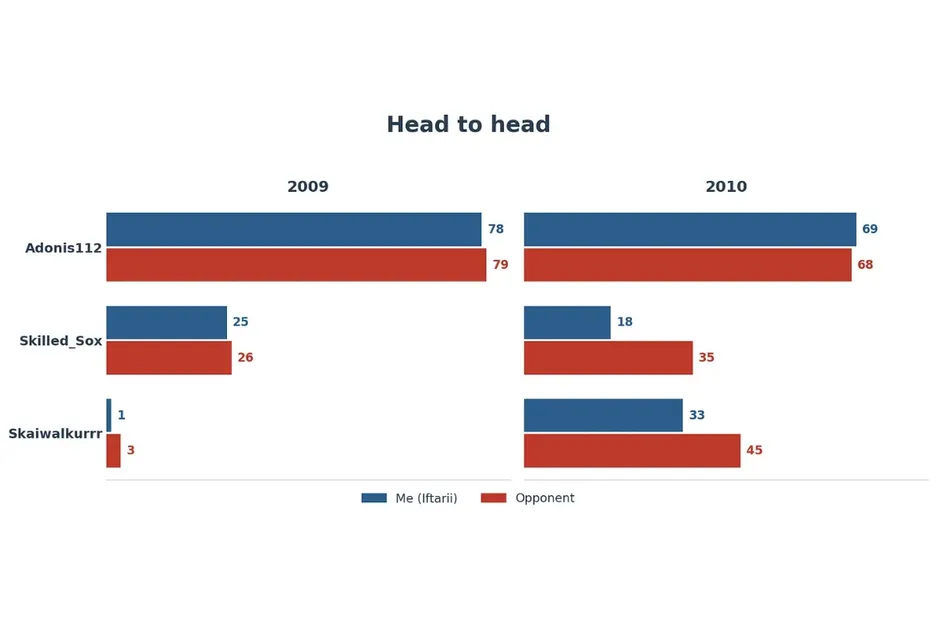
Like me, Adonis was a feel player who relied on his instincts and a natural sense of his opponents. As such, he played without a HUD over that time span, and just like me, 2010 ended up being his worst year to date. Unlike me, he changed up after his disappointing 2010 campaign and adopted a HUD.
From that point forward, he went on to clobber me 147-120. More importantly, his career rebounded, and he continued on his track as one of the biggest winners in HU SNG’s for years to come.
Statistically I broke even (+$2,000), but financially, 2010 was not quite the disaster it might appear to be. The extra volume I’d put in, combined with an extraordinarily high average buy-in, meant that I had achieved ‘Supernova Elite’ status in PokerStars’ generous rake-back program. Reaching Elite meant I’d profit an additional $110,000 that year.
But $110,000 was still a significant step backwards in a career that had only known progress.
More importantly, my identity as 'Iftarii', $5K lobby boss, was dissolving. I took a lot of pride in being able to battle with anyone, and I’d earned a lot of valuable lobbies by doing so. In 2010 the message was clear; if I wanted to sit first in the high stakes lobbies, I would be facing an onslaught of matches against players who were now better than me. I would be the prey.
I had a few options:
I could keep battling, risk my bankroll, and hope this year was bad variance or that I would figure these guys out and reclaim my edge.
I could grind lower games, sit in the $1K and $500 lobbies, accept my new station, and join the dozen or so regs who made their home at these stakes, where a great income could still be earned.
Or I could learn what my deficiencies were, utilize a HUD, and try to learn from others in the community.
Fortunately I was too financially cautious to choose the first. Unfortunately, I was too stubborn, proud, and arrogant to choose the others.
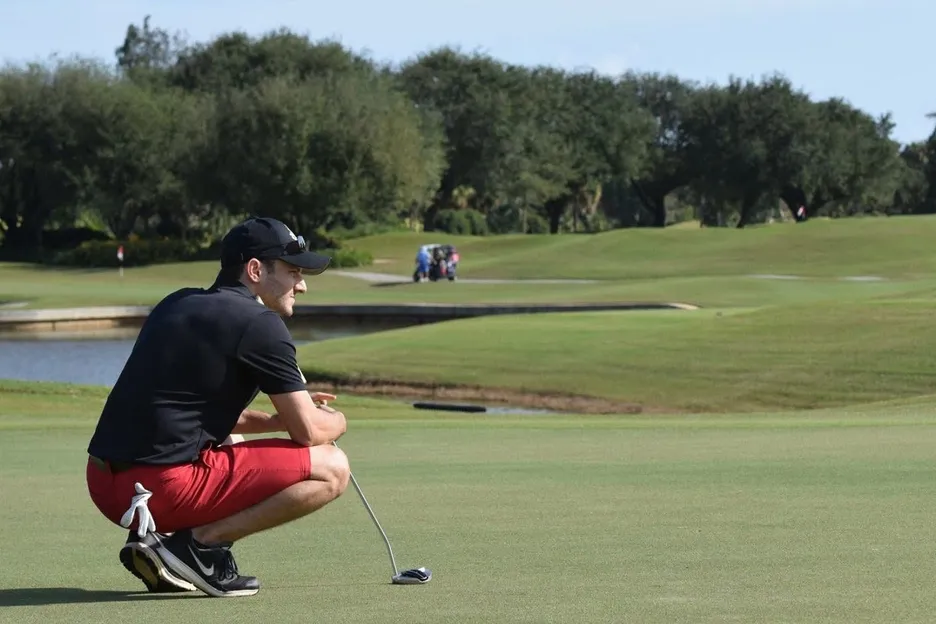
So instead I did what bored rich people have done for a hundred years. I took up golf.
Everything I wasn't
I wasn’t humble. I was unwilling to accept my demotion (even temporarily) with grace, and move down to mid-stakes where a great income was still easily attainable.
I wasn’t curious. My obsession with freedom had its strongest ties to my disdain for authority figures and school. Anything that had a whiff of school was immediately tainted with a stench I intended to avoid. Game theory, learning how to use software, 'studying' hand histories… It all smelled like school to me, and I shunned it all with a closed mind.
I wasn’t willing to work HARD. If it felt like work, that was my signal to check out. I didn’t do what I didn’t want to do, and I thought that was success. My north star to that point in life was freedom. I thought that being able to pick and choose how I spent my time was the ultimate form of success. It took me another decade to decide that hardships will always appear in one form or another, and that a more durable form of success is being able to handle whatever life throws at you.
I wasn’t motivated. I didn’t see how my life would improve that much if I doubled or tripled my net worth. I loved the status gains from being a top dog, but I didn’t like a lot of the emotions that the battles provoked in me. I cherished my freedom, and I was never interested in sitting at the computer for hours on end, multiple days in a row.
I wasn’t a theory player. Or even ‘theory literate’ for that matter. If I had been humble, curious, motivated, and willing to put in the work, it still would have been a very bumpy path forward. There was a whole language and philosophy of poker, and games in general that I would need to comprehend before I could reasonably integrate what I should have been learning at that time. I don’t think I used the word ‘range’ until maybe 2012. I played poker on a computer, but I had no desire to play poker like a computer.
My results in 2010 were the canary in the coal mine. The skills required to succeed in high stakes poker were changing, and the players who weren’t willing to change with it were going to get left behind.
“If you don’t like change, you’re going to like irrelevance even less.” — Gen. Eric Shinseki
1 Technically there were two lobbies at each level, one for the non-turbo format, and one for the quicker blind escalation turbo format. By 2010 I’d guesstimate that 90% of high stakes games were played in the turbo format.
2 This was in sharp contrast to the world of high stakes cash. In a cash game, you could instantly sit out if a player you didn’t want to play against sat at your table.
Check back soon for the next chapter in Jaffe's poker journey. New articles will appear first at PokerOrg.
Visit Jaffe's Substack for more, and follow GTO LAB on X.
Additional images courtesy of Jonathan Jaffe/Rational Intellectual Holdings Ltd..